.svg)

.svg)
%202.svg)
%201.svg)
3 Things to Check in Demand Forecasting Operations
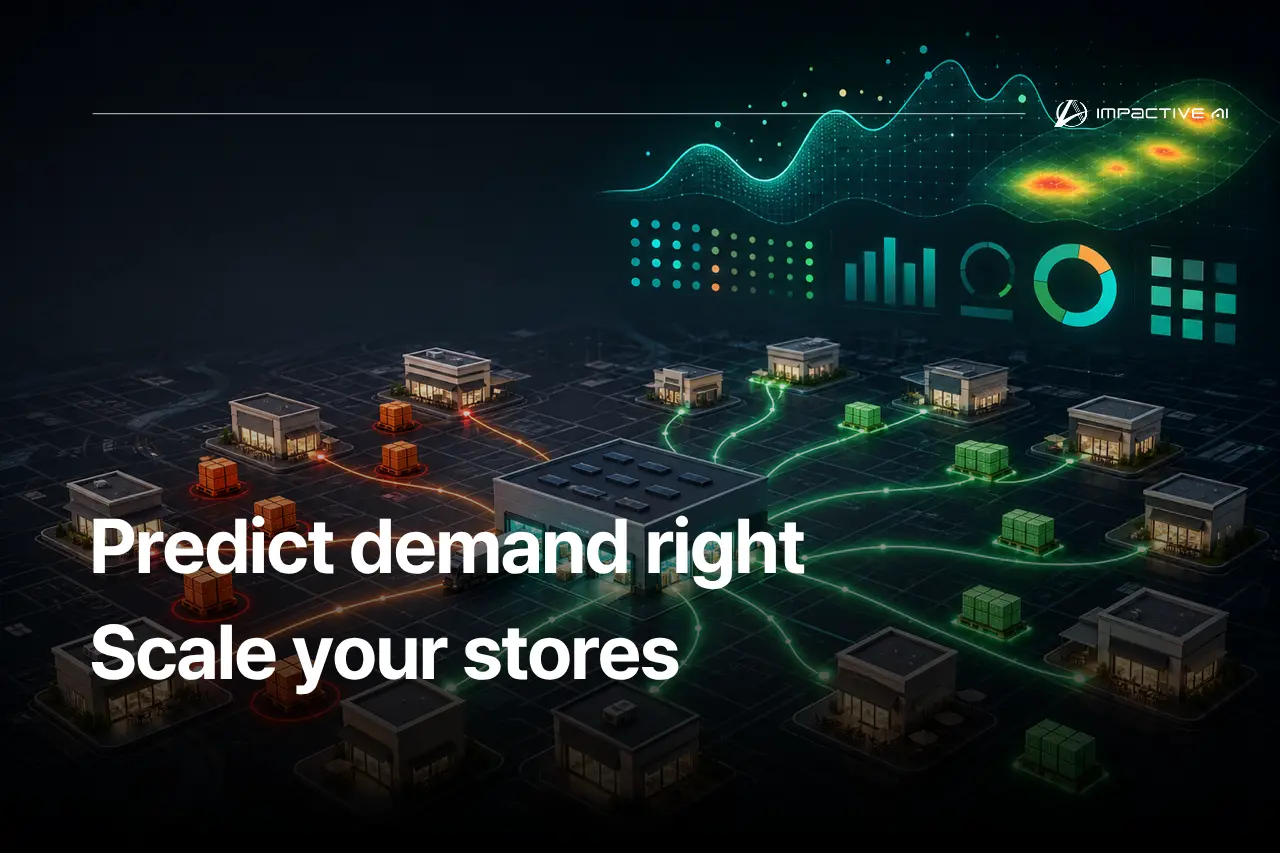
Demand forecasting is no longer optional—it has become a core operational capability for modern businesses. Across retail, manufacturing, e-commerce, and consumer goods industries, demand forecasting directly impacts inventory management, production planning, logistics allocation, promotional strategy, and revenue performance. The more accurate the forecast, the higher the operational efficiency. On the other hand, inaccurate forecasts lead to stockouts, excess inventory, rising operational costs, and missed business opportunities. As a result, many companies are investing heavily in statistical models and machine learning technologies to advance their demand forecasting capabilities.
Yet even after adopting AI-powered demand forecasting models, many organizations experience the same recurring issue in practice. Initial validation results often look impressive, but once predictions are compared against real-world demand, performance gaps begin to appear. Certain products are consistently under-forecasted, and forecast errors spike during seasonal transitions. Despite this, teams are often told that “there’s nothing wrong with the model.” If this situation sounds familiar, the problem may not be the model itself, but rather the way forecasting performance is being evaluated.
Why Validation Scores and Real-World Accuracy Are Different
Most demand forecasting models are evaluated by splitting historical data into training and validation periods. If the model produces low error rates on the validation set, it is considered successful. While this is a necessary step in model development, it also creates a major blind spot.
Validation data still belongs to the past. A model that explains historical patterns well does not necessarily perform well in the future. In real operations, businesses constantly face variables such as:
- Seasonal transitions and changing consumer behavior
- Unexpected promotions or competitor activities
- Demand shifts caused by raw material or logistics cost fluctuations
- New sales channels or customer changes
These factors are often absent—or insufficiently represented—in training data. As a result, the model that performs best on past data is not always the model that performs best in live operations.
The Operational Impact of Forecast Errors
For inventory and supply chain teams, forecast errors are not just statistical issues. They directly affect operational costs and customer trust.
Repeated under-forecasting leads to stockouts beyond safety inventory levels, resulting in emergency procurement and expedited shipping costs. Failure to meet delivery expectations can quickly escalate into customer dissatisfaction.
On the other hand, repeated over-forecasting increases warehouse occupancy and storage costs. At the end of a season, companies may be forced into aggressive discount campaigns to clear excess inventory, while slower inventory turnover negatively impacts cash flow.
The challenge is not only the error itself, but also the difficulty of identifying where and when forecast performance started to deteriorate. Without a proper monitoring framework, organizations often discover accumulating errors too late.
Despite this, many companies still evaluate forecasting models solely based on validation results generated during development. Even after successful deployment, they often lack a structured process to monitor how well models perform in real operational environments, or to identify which product categories and time periods are experiencing deteriorating accuracy.
3 Things to Monitor in Demand Forecasting Operations
To maintain forecast quality after deployment, organizations should focus on the following three operational capabilities.
1. Future Performance Monitoring
Organizations must continuously track the gap between predicted demand and actual demand during live operations. Understanding where forecast errors increase—by product category, time period, or sales channel—allows teams to detect and respond to issues quickly.
Model validation is not a one-time exercise completed during development. Forecasting systems must be continuously monitored and evaluated as markets evolve.
2. Forecast History Management
Many organizations store actual sales data but fail to preserve the forecasts generated at the time. Without forecast history, it becomes impossible to analyze why predictions failed later on.
Historical forecast records enable teams to compare model performance over time and identify which models perform better under specific conditions. Well-managed forecast history is more than just archived data—it becomes an operational asset that continuously improves the forecasting system.
3. Model Selection Based on Demand Scenarios
Real-world demand is never uniform. Some products have stable demand, while others are highly volatile. Some exhibit strong recurring patterns, while others are highly sensitive to promotions or external events.
This is why relying on a single forecasting model for every demand scenario has clear limitations.
The goal is not to deploy the most complex model possible. What matters more is having the operational flexibility to select and manage the most appropriate model based on product characteristics and market conditions.
Time to Reevaluate Your Forecasting Operations
If your organization is already operating a demand forecasting system, consider the following questions:
- Do you know which product categories had the largest forecast errors last month—and why?
- Can you compare forecasts generated three months ago against actual demand today?
- Are different models being used for products with different demand characteristics?
If these questions are difficult to answer, it may be time to reassess your forecasting operations framework.
Demand forecasting competitiveness is entering a new phase. In the past, the key challenge was simply building forecasting models. Going forward, the real differentiator will be whether companies can operate forecasting systems that continuously monitor and manage future performance.
Organizations that can monitor operational forecasting accuracy, preserve forecast history as a strategic asset, and select optimal models for different demand scenarios will be the ones that transform forecasting into a true business advantage.
The real performance of a demand forecasting system is not determined by validation scores in a report. It is revealed in real-world operations—through how quickly organizations can detect forecast failures, adapt to market changes, and continuously improve their models.
What businesses need is not more models, but a living forecasting system where operations, learning, validation, and improvement are continuously connected.
If you are currently operating a demand forecasting model and questioning its real-world accuracy, Impactive AI can help diagnose the problem. From future performance monitoring and forecast history management to optimal model selection by product type, Impactive AI supports the entire operational lifecycle of demand forecasting systems.
.svg)

.svg)






%201.svg)
%202.svg)


.svg)