.svg)

.svg)
%202.svg)
%201.svg)
5 Ways Excess Inventory Drains Your Cash Flow — With Real-World Cases and Solutions

Excess inventory isn't simply a matter of too much product sitting in a warehouse. It's closer to a state where the cash a company could be deploying is locked up under the label of "assets." On a balance sheet, inventory is classified as an asset — but in reality, it represents cash that's already been spent against profits that haven't yet materialized, giving it a distinctly liability-like character.
In today's increasingly complex supply chain environment, excess inventory eats into the buffer resources a company needs to respond to sudden market shifts or unforeseen disruptions. For organizations where cash flow is already tight, overstock can become an existential threat.
So why do companies accumulate more inventory than they need? It typically comes down to two reasons: fear of supply disruptions, and the logic of bulk purchasing to drive down unit costs. But behind these decisions lurks a range of hidden costs — the carrying costs of holding inventory over extended periods.
Inventory carrying costs encompass capital, storage, service, and risk costs, and typically run between 15–30% of total inventory value annually. Efficient operators land closer to 15%, while less disciplined organizations can exceed 30%.
These costs go well beyond warehousing and insurance. They include the opportunity cost of tied-up capital, product obsolescence, and damage risk. Inventory purchased in bulk to capture a volume discount can sit in a warehouse for months, accruing additional costs that eventually wipe out the original savings — and then some. This is what we call the "paradox of economies of scale."
This article examines the five primary pathways through which excess inventory deteriorates a company's cash flow: reduced operating cash flow, impaired working capital liquidity, extended cash conversion cycles, lost investment opportunities, and inventory value write-downs. We'll also look at real-world cases from global enterprises and the strategies that have proven effective in optimizing inventory.
Five Pathways Through Which Excess Inventory Erodes Cash Flow
Excess inventory doesn't damage cash flow through a single mechanism. It operates through multiple, interconnected pathways that compound one another in a cascading chain.
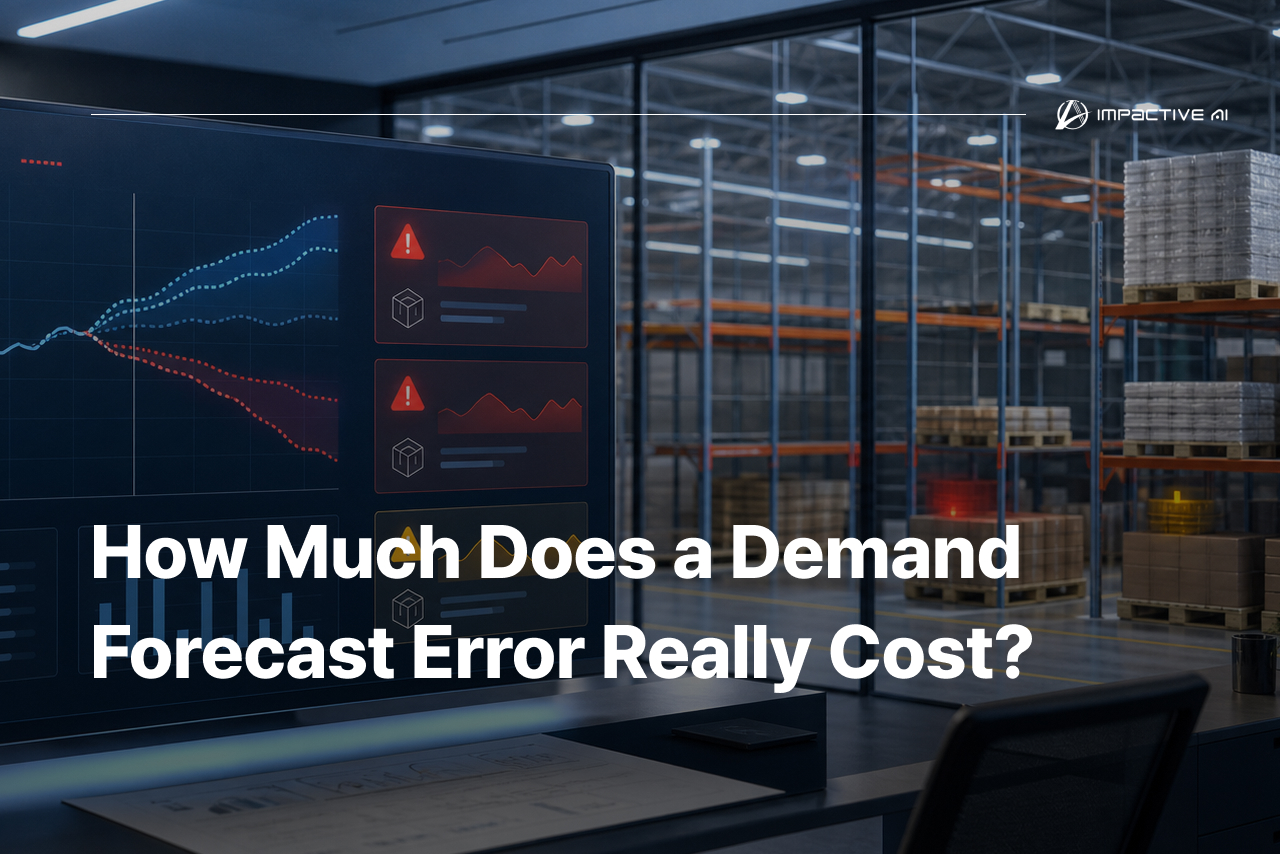
Pathway 1. Reduced Operating Cash Flow from Demand Forecast Errors

As inventory grows, a corresponding amount of cash gets locked up. When purchased inventory doesn't sell through fast enough, cash continuously drains from operations, compressing operating cash flow. Even when revenue is growing, if inventory accumulation outpaces sales, a company can find itself profitable on paper but cash-starved in practice — the classic "profitable bankruptcy" scenario.
The root cause of this operating cash flow deterioration is almost always inaccurate demand forecasting. When demand is estimated based on past experience or partial data alone, shifts in market trends go undetected in real time. When sales data and inventory data are managed in separate systems, decision-making errors accumulate in the gap between them. In industries like food and consumer goods — where demand is seasonal and shelf-life management is critical — the consequences of a missed forecast surface immediately.
Pathway 2. Working Capital Liquidity Impairment Driven by Cross-Functional Misalignment
When inventory claims a disproportionate share of current assets, the total asset base may look intact, but the cash available for essentials like payroll, taxes, and debt service naturally shrinks. This liquidity squeeze isn't caused by the inventory problem alone — it's often exacerbated by poor information sharing across departments.
For example, if the sales team plans a promotion but the procurement team isn't informed in time, inventory piles up with no corresponding demand. Evaluation structures that reward the sales team for revenue and the procurement team for unit cost reductions only deepen this disconnect. In industries with long lead times like pharmaceuticals and biotech, a single over-order can choke cash flow for months.
A company may appear financially healthy on the surface, but when cash is actually scarce, leadership's ability to make agile decisions is severely compromised.
Pathway 3. Extended Cash Conversion Cycles from Industry-Blind Inventory Management
The cash conversion cycle measures the time from purchasing raw materials to selling the finished product and collecting payment. When inventory levels rise, the "days inventory outstanding" portion stretches, and cash stays locked up longer. If inventory turns extend from 90 days to 120 days, for instance, the company must fund an additional month of working capital.
This cycle extension is closely linked to one-size-fits-all inventory management that ignores industry-specific realities. The food industry requires shelf-life and cold-chain management. Pharma and biotech demand regulatory and quality control rigor. Chemical industries need to manage raw material price volatility and production scheduling. When these differences aren't reflected in the system, the tools fail to keep pace with the shop floor, and teams revert to manual management. Segmenting safety stock standards by SKU importance and management complexity is essential to shortening the cash conversion cycle.
Pathway 4. Lost Investment Opportunities from Capital Trapped in Inventory

When capital is tied up in inventory, the funds available for R&D, marketing, new business development, and other growth investments naturally diminish. This impact doesn't show up directly on the cash flow statement, which makes it easy for leadership to overlook — but the downstream effects on the broader enterprise can be profound.
While competitors invest in new product development and market expansion, your company's capital sits idle in inventory, generating zero value-add. In fast-moving technology sectors, missing a single investment window can mean permanently losing market position. The moment bulk purchasing to lower unit costs starts crowding out growth investment is the moment "economies of scale" turns from advantage to poison — a paradox in the truest sense.
Pathway 5. Direct Inventory Value Losses from Neglected Dead Stock
Inventory that sits too long loses value through obsolescence, damage, and shifting consumer preferences — eventually requiring deep markdowns or outright disposal. The resulting write-downs hit the bottom line directly.
The root cause of inventory value erosion is the sunk cost fallacy — failing to manage product lifecycles proactively and carrying unnecessary costs forward indefinitely. In fashion and consumer goods, value plummets once the season passes. In pharma and food, expired products must be destroyed entirely. Dead stock doesn't just sit there uselessly — it occupies space that could house fast-moving products. In chemicals and agricultural commodities, raw material quality degrades rapidly, making swift identification and disposition essential.
In many cases, taking the loss early and disposing of inventory before it depreciates further is the smarter financial decision.
Taken together, these five pathways interlock to form a vicious cycle: demand forecast errors → working capital erosion → extended cash conversion cycles → lost investment opportunities → inventory value losses. This is why inventory optimization should be viewed not as a warehousing task, but as a core financial strategy centered on capital efficiency and risk management.
Global Case Studies: When Excess Inventory Became a Crisis
Cash flow deterioration from excess inventory is a management risk that can strike any company regardless of size. Real-world cases illustrate just how directly overstock impacts financial performance.
Inventory Surge and Margin Compression | Nike
Global sportswear giant Nike faced a severe inventory crisis as post-pandemic demand shifts collided with supply chain disruptions. Multiple seasons of product converged in warehouses simultaneously, while inflation dampened consumer spending. The result: North American inventory surged roughly 65% year over year. Slower turns on footwear and apparel locked up a significant share of working capital, pressuring both cash flow and profitability.
Nike launched aggressive markdowns and discount campaigns to normalize inventory. While this maintained top-line revenue to a degree, the added cost burden weighed on overall margins. The inventory management overhang ultimately factored into the company's 2024 outlook.
This case illustrates how demand forecast misses that cascade into overstock can burden cash flow — and how the markdown process to clear that excess creates a secondary margin compression challenge.
The Cost of Misreading Demand | Target and Funko

U.S. retail giant Target also misread post-pandemic consumer behavior. The company over-indexed on electronics and furniture inventory, but consumers pivoted to essentials spending. By the end of Q1 2022, Target's inventory had ballooned 43% year over year to approximately $15.1 billion. Operating income in Q2 cratered 87%.
Target responded with massive markdowns and order cancellations, cutting non-essential category receipts by over $1.5 billion heading into fall. The company subsequently revamped its assortment strategy, introducing 10,000 new low-price items starting at $1 to rebuild inventory efficiency.
Collectibles maker Funko, meanwhile, hit a wall when demand for vinyl figures dropped abruptly. The company announced plans to dispose of $30–36 million worth of inventory in the first half of 2023. With ongoing carrying costs, destroying the inventory was the more economical choice than holding it. This case dramatically illustrates how inventory can shift from asset to liability depending on circumstances.
The Structural Impact of Excess Inventory on Fashion and Consumer Goods
Fashion and consumer goods industries are characterized by rapidly shifting trends and steep value depreciation over time — making the consequences of excess inventory especially severe. As inventory turn periods approach a full year, the capital and space needed to bring in new products evaporate, triggering a vicious cycle that erodes brand competitiveness. That said, even in this environment, some companies managed to keep inventory growth in the single digits and protect their margins.
Inventory turnover velocity deserves particular attention as a management KPI. Companies that maintain healthy turn cycles tend to sustain more stable profitability, while those with progressively lengthening cycles face downward pressure on operating income — driven by rising carrying costs, inventory write-downs, and the margin burden of markdowns needed to clear aging stock. The takeaway is clear: inventory management efficiency can be just as decisive as top-line growth in determining a company's true financial health. Expansion without the inventory discipline to back it up risks deteriorating profitability.
How to Break the Cycle: Optimizing Inventory to Restore Cash Flow
Breaking the five-part vicious cycle outlined above requires more than quick fixes. It demands a fundamental overhaul of organizational processes.
Data Hygiene and Operational Standardization
Inventory management always starts with accurate data. Standardizing SKU naming conventions, assigning location codes, and synchronizing inbound/outbound records in real time must come first. If the underlying data is contaminated, no analytics tool — however sophisticated — will produce reliable outputs.
Once foundational data is in order, the next step is standardizing and documenting reorder points, safety stock levels, and inbound/outbound workflows so the shop floor operates consistently. Equally important is moving away from spreadsheet-based manual management toward an integrated environment where sales, inventory, and accounting systems are synchronized in real time.
Adopting AI-Powered Demand Forecasting and Continuous Improvement Frameworks
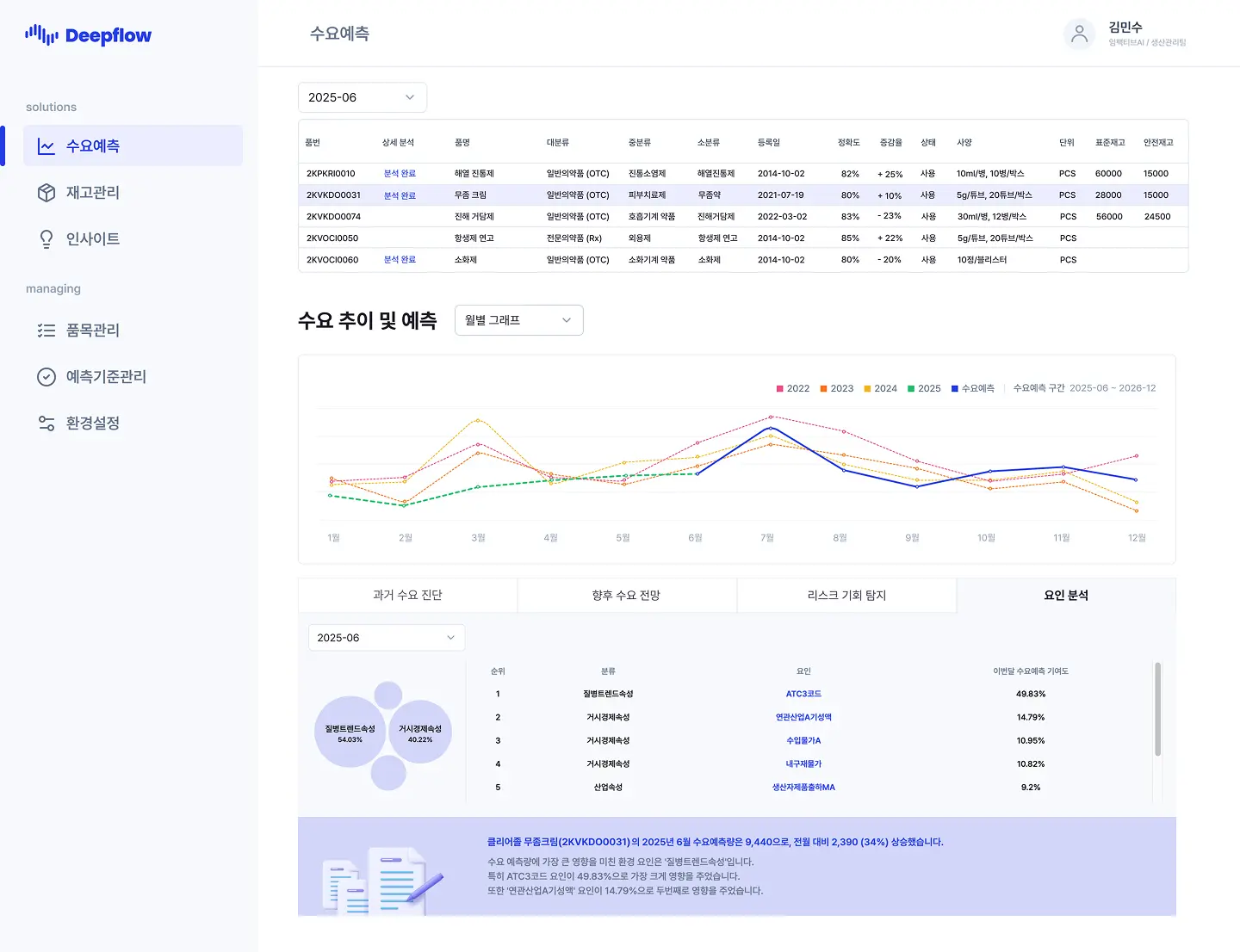
At its core, inventory optimization comes down to how accurately you can predict future demand. Statistical models based purely on experience and historical data can't keep pace with market dynamics — which is why AI-powered demand forecasting plays a pivotal role in elevating inventory management to the next level.
ImpactiveAI's Deepflow delivers SKU-level demand forecasts precisely calibrated to individual sales and shipment patterns, backed by over 200 advanced deep learning and machine learning models and 72 patented technologies. With Deepflow, companies can forecast product sales and shipment volumes 6–12 months out, integrate with base inventory data to manage days of supply, and automatically calculate optimal production volumes.
For companies considering AI-powered demand forecasting, ImpactiveAI's complimentary PoC service provides an opportunity to validate forecast accuracy and real-world improvement potential using your own data.
That said, deploying an AI tool alone doesn't solve everything overnight. Successfully applying forecast outputs in the field requires the data hygiene and operational standardization discussed earlier. Inventory management isn't a one-time system implementation — it's a living process that must be continuously updated to reflect changing market conditions and technological advances.
The Future of Inventory Management: Strategic Implications
Excess inventory may look like an asset on the balance sheet, but in practice, it functions more like an invisible liability that slowly erodes a company's growth potential. Conversely, companies that have improved inventory efficiency have protected operating margins even through economic downturns and strengthened their market positioning.
Resolving cash flow problems caused by excess inventory requires a foundation of data-driven, precision demand forecasting. Managing inventory accuracy at 99% or above is now a baseline operational capability that modern enterprises must possess — one that also serves as a shield protecting customer trust and brand value.
Looking ahead, inventory management is entering an era where AI and IoT converge to move beyond "forecasting" into "intelligent, autonomous optimization." The ability to detect market shifts in real time, adjust production volumes accordingly, and proactively identify and respond to supply chain risks is rapidly becoming a core competitive advantage.
Leadership must stop viewing inventory as a simple warehousing problem and start approaching it as a capital circulation optimization challenge. Ultimately, inventory optimization transcends cost reduction — it is the most powerful financial strategy a company has for securing sustainable growth.
.svg)


.svg)










%201.svg)
%202.svg)


.svg)