.svg)

.svg)
%202.svg)
%201.svg)
2026 Data Voucher Eligibility Self-Diagnosis Guide for Small Merchants, Startups, and SMEs
When preparing a Data Voucher demand-side company application, the first question you'll face is: "Does our company even qualify?" Eligibility criteria differ by business type, co-funding ratios vary, and past participation history can restrict your application entirely. ImpactiveAI has participated as a Data Voucher supply-side company for multiple years, supporting demand-side companies with data services that connect to AI-powered demand forecasting. Drawing from that experience, we've compiled the eligibility requirements that demand-side companies most commonly overlook during the application process.
Basic Eligibility Requirements by Business Type
SMEs must meet the criteria set forth under the Framework Act on Small and Medium Enterprises. At the time of application, an SME confirmation certificate valid within the designated period (April 1, 2025 – March 31, 2026) must either be automatically retrieved through the system or already issued.
Small merchants must meet the criteria under the Framework Act on Small Merchants. Those with annual revenue of KRW 104 million or less in 2025, classified as simplified tax filers, are categorized as "micro small merchants" and are eligible for quota-based allocation and co-funding reductions.
Pre-startups (including re-startups) must not hold any registered business under the applicant's name as of the announcement date, February 27, 2026. However, business registration must be completed before the agreement end date of November 30, 2026.
Youth-led companies are those where the CEO (or at least one co-CEO) is between the ages of 19 and 39 as of the announcement date (born between February 27, 1986 and February 27, 2007). These companies receive a 1-point bonus and co-funding reductions.
If You've Participated Before, Check Multi-Year Support Eligibility First
Companies that participated in the Data Voucher program between 2019 and 2025 should check this section first. Multi-year support is capped at three times, and applicants must meet at least one of the following conditions to apply for the 2026 program.
You are eligible if your company ranked in the top 20% of the 2025 program's performance evaluation, or if you participated in the 2025 program solely through the data product purchase track (note: standalone product-only purchases are not permitted in 2026), or if your company has past participation history and meets the youth-led company criteria as of the announcement date.
Companies that participated in the processing track between 2019 and 2025 and do not meet any of the above conditions are ineligible to apply.
Co-Funding Ratios Differ by Business Type
The Data Voucher program does not cover 100% of project costs through government funding. A portion of the total project budget must be matched through private co-funding, and the ratio depends on your business type.
SMEs are required to cover at least 25% of the total project cost. Of this co-funding amount, at least 10% must be paid in cash, while the remainder can be substituted with in-kind contributions such as personnel labor costs.
Small merchants are also required to cover at least 25% of the total project cost, but the entire amount can be substituted with in-kind contributions.
Micro small merchants and youth-led companies are required to cover only 10% or more of the total project cost, and the entire amount can be substituted with in-kind contributions.
Pre-startups are fully exempt from co-funding.
For small merchants or early-stage startups with limited cash reserves, it's important to confirm in advance whether in-kind substitution is available and what your exact co-funding ratio will be.
5 Disqualification Criteria to Resolve Before Applying
If any of the following apply, your application will be rejected. Some items can be resolved and documented within the application period, so review them in advance.
If the same representative holds multiple businesses, only one business entity may apply. Companies registered as 2026 Data Voucher supply-side companies — or their representatives — cannot apply as demand-side companies. Cross-applications where a former demand-side and supply-side company swap roles are also excluded.
Companies with tax arrears (national or local), outstanding debts with financial institutions, unpaid wages, suspended or closed business status, or those under sanctions for fraudulent conduct are ineligible. Projects whose content or deliverables are identical or substantially similar to those of other government-funded programs will also be disqualified.
Required Document Preparation Checklist
Common documents include the project execution plan and a presentation file (converted to PDF).
National and local tax payment certificates, business registration certificates, corporate registry transcripts, and SME/mid-sized enterprise confirmation certificates are automatically retrieved through the system. Verify in advance that retrieval works properly on a Windows 10 or later environment.
Pre-startups require additional documentation. You must submit a "Certificate of Facts" (confirming business registration status or total business registration history) issued through Hometax, along with a "Resident Registration Extract" (with the first six digits of the resident registration number visible and the remaining digits masked).
How to Design a Demand Forecasting Project Within the Data Voucher Framework
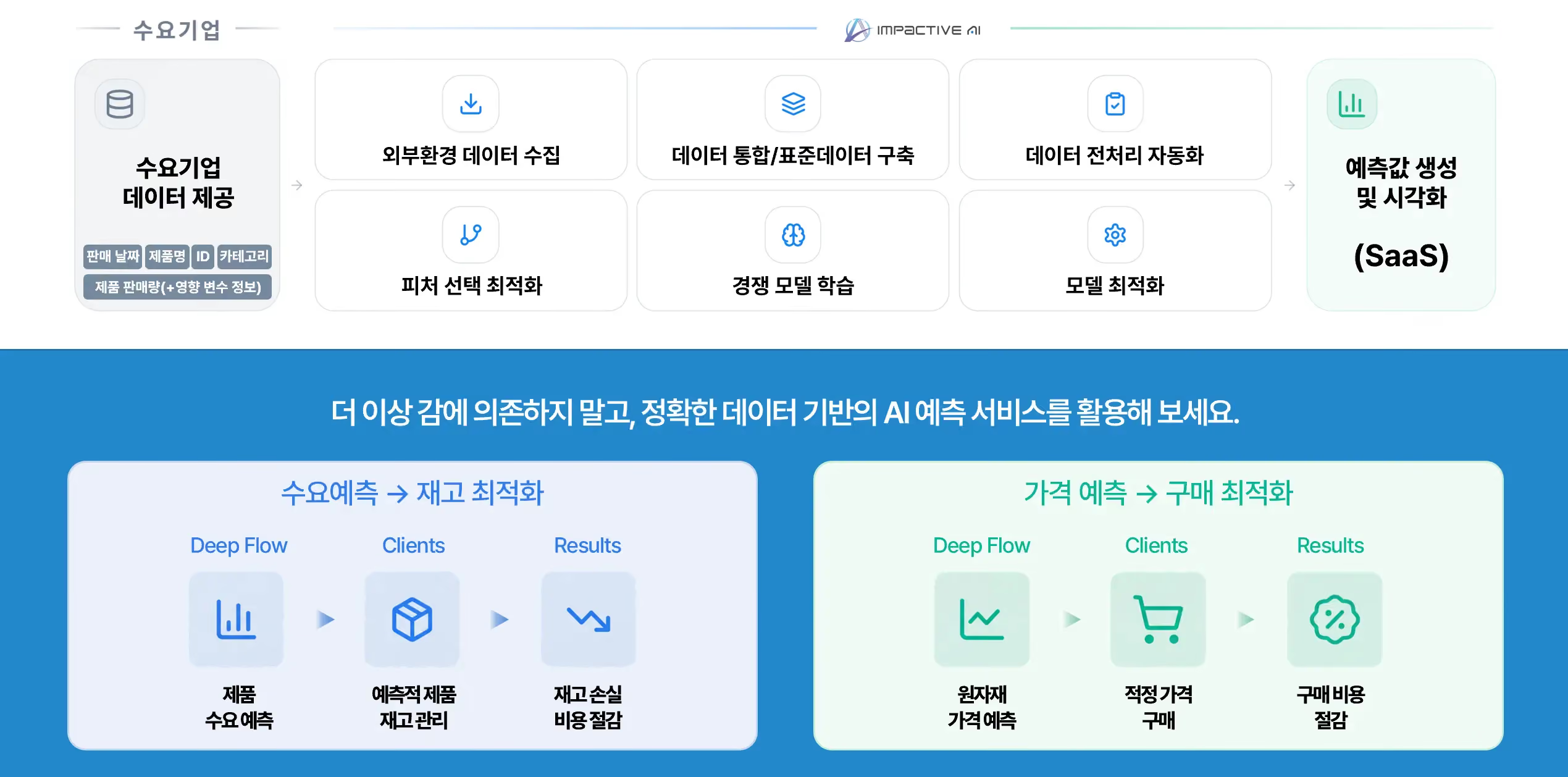
There is an important distinction that companies looking to build a demand or price forecasting capability should understand. The Data Voucher program covers only data provisioning and related services — it does not fund AI model development or AI solution purchases. The correct approach is to use the Data Voucher for data collection, integration, preprocessing, analysis, and visualization, while operating your AI demand forecasting service separately.
ImpactiveAI's Deepflow is a solution that delivers demand forecasting and raw material price forecasting services powered by over 224 AI models and backed by 72 patented technologies. It generates highly accurate forecasts for product sales volume, shipment quantity, and raw material prices over a 6- to 12-month horizon. Through the Data Voucher, companies can receive support for collecting, integrating, and preprocessing their data, then structuring it into a format ready for connection with Deepflow's analysis and visualization capabilities.
Inventory Optimization Through Demand Forecasting
The Data Voucher can support the following areas of work: collecting and integrating a company's sales, inventory, and product data; gathering external data (weather, oil prices, exchange rates, economic indicators) and linking it with internal data; automating data preprocessing and establishing standardized formats; and visualizing analytical results through a BI dashboard. Once this data infrastructure is in place, it becomes immediately ready for connection with a demand forecasting solution like Deepflow.
As a result, companies can maintain optimal inventory levels by understanding future demand at the SKU level, automatically calculate days-of-stock to reduce stockout risk, and prevent cost losses from excess inventory. Deepflow's BI dashboard provides a consolidated view of understocked and overstocked SKUs, while its LLM-powered analytical reports deliver tailored action strategies for sales, marketing, and SCM teams.
Procurement Optimization Through Raw Material Price Forecasting
For companies that purchase raw materials, price forecasting can help optimize procurement timing. The Data Voucher can support the following areas of work: collecting raw material price data, integrating global economic indicators and market data, preprocessing through feature selection optimization, and visualizing analytical results. Once this data foundation is established, it can be paired with a price forecasting solution like Deepflow to inform practical procurement decisions.
As a result, companies can reduce costs by procuring at the right moment before prices rise and make proactive decisions in response to price volatility. Deepflow's MI dashboard monitors exchange rates, interest rates, and raw material prices, while offering 3-month short-term AI forecasting for exchange rates and oil prices to help companies navigate market fluctuations.
Key Considerations for Writing Your Business Plan
Since the Data Voucher covers only data provisioning and related services, a few points must be made clear in your business plan. Define the project scope as data collection, integration, preprocessing, analysis, and visualization — and clearly distinguish this from AI model development or solution purchases. Presenting expected outcomes in measurable terms — such as inventory reduction rates, cost savings, and stockout rate improvements — works in your favor during the business viability evaluation.
Given that the project period is six months, it's important to set realistic goals that can be completed from data collection through visualization within that timeframe. During preliminary discussions with your supply-side partner, finalize a concrete timeline and deliverables, and reflect them in your business plan.
If You're Eligible, the Next Step Is a Concrete Business Plan
Meeting the eligibility requirements is just the starting point. Actual selection depends on how specific and feasible your business plan is. You need to clearly articulate why your company needs data, what data you plan to use, and how you intend to use it.
After checking the five areas covered in this guide — basic eligibility, multi-year support status, co-funding matching, disqualification criteria, and required documents — if everything is clear, shift your focus to writing the business plan. In particular, if you qualify as a micro small merchant (5% separate allocation), a youth-led company (1-point bonus + co-funding reduction), or a non-capital region business (regional quota), simply checking the relevant boxes on your application form can make a real difference in your chances of selection.
For exact schedules and detailed criteria, refer to the official announcement on the Korea Data Agency's Data Voucher Management System. ImpactiveAI has participated as a Data Voucher supply-side company for multiple years, working alongside demand-side companies from project planning through to connecting data workflows with AI-powered solutions. If you have questions about eligibility requirements or how to shape your business plan, don't hesitate to reach out.
👉🏻 What changed from last year? 3 Key Updates in the 2026 Data Voucher Program >> Click
.svg)


.svg)




%201.svg)
%202.svg)


.svg)