.svg)

.svg)
%202.svg)
%201.svg)
Why Do Procurement, Production, and Inventory Drift Apart? A Practical 5-Stage Guide to Supply Chain Management (SCM)
Supply chain management (SCM) ties everything from demand forecasting to procurement, production, inventory and logistics, and returns into a single flow. It's tempting to assume that better forecast accuracy will fix inventory problems on its own, but on the ground it rarely works that way. Even with a strong forecast, buyers often recalculate order quantities in their own spreadsheets, and the production team builds its plan on its own assumptions. Meanwhile, the physical stock sitting in the warehouse is tracked somewhere else entirely.
When every function moves on its own, the same month can see some items stock out while others pile up in the warehouse. Some products get padded with extra buffer just in case, while others are under-prepared against the forecast and miss sales. These look like opposite problems, but they share a single root cause. Different people own different items, set their numbers by different rules, and never properly share that information.
In the end, a forecast is only a starting point. If that number doesn't flow naturally into purchase orders, production, and inventory allocation, results will diverge no matter how accurate it is. The real work isn't the forecast itself. It's making sure the forecast carries through ordering, production, and allocation on the same basis.
This guide starts by defining the five stages SCM covers. From there, it walks through how to close the gap between plan and actual, how to assess risk, and what to prepare before implementing a system, all mapped to how the work actually gets done.
What is supply chain management (SCM)? A supply chain is, quite literally, the entire flow that runs from suppliers to customers. In practice, people often use "supply chain" and "supply chain management" interchangeably. The essence of SCM is to stop treating demand forecasting, procurement, production, inventory, and logistics as separate tasks and instead connect them under one overarching plan, running and improving them as an integrated whole.
The Five Stages of Supply Chain Management
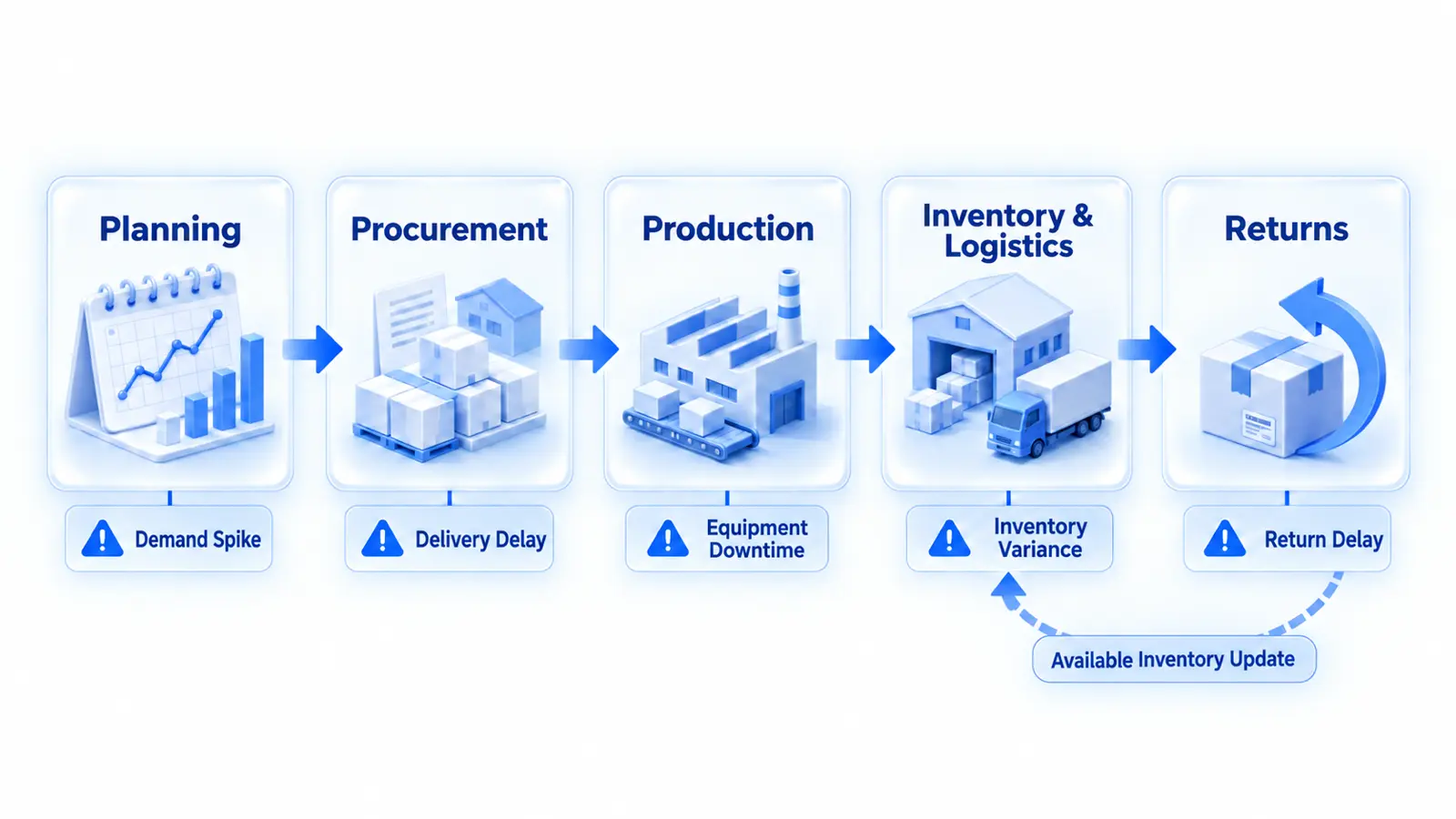
Supply chain management is generally broken into five stages, namely planning, procurement, production, inventory and logistics, and returns. At each stage, someone makes a key decision, and whenever that decision starts to wobble, warning signals appear. Because each stage's decisions feed straight into the next, when you catch those signals matters a great deal.
Planning | Where Every Number Starts
In planning, you set next quarter's production or purchase volumes based on the demand forecast, sales plan, and current inventory. Sales typically submits numbers shaped by its targets, while production submits numbers shaped by capacity utilization. If those two figures differ and nobody questions it, that's actually the more dangerous situation.
Procurement | Balancing Lead Time and MOQ
Procurement determines the supplier, order timing, and order quantity. The data that matters most here is item-level lead time, minimum order quantity (MOQ), and each supplier's delivery track record. If rush orders have become routine, either planning started too late or lead times were set shorter than they really are.
Production | Where Priorities Collide
Production sequences work by weighing capacity, inventory, and due dates. When plans change often, the existing sequence has to be reshuffled, and changeover time climbs accordingly. If every weekly meeting starts with counting how many changes came in, that's a sign pressure from upstream is spilling over into production.
Inventory and Logistics | Revisit Your Allocation Rules
Here, you look at available inventory, safety stock, and the shipping plan to decide which warehouse sends how much to which channel. If one warehouse is overflowing while another sits empty, review your reallocation rules before you look at delivery. It's also worth asking whether differences in demand across channels are being reflected at all.
Returns | The Variable That Shows Up Late
Returns get less attention, but they directly affect inventory accuracy. What matters most is when returned units are counted back into available inventory. If returns data lives in a separate file or hits the system late, even the most refined upstream plan ends up running on the wrong inventory numbers, because the baseline inventory data itself is off.
Managing the Gap Between Plan and Actual
In day-to-day SCM, more time goes into managing the gap between plan and actual than into building the plan in the first place. Real demand never moves exactly as expected. What matters is how quickly you catch the variance, and who adjusts it and by what rule.
What Demand Forecasting Is Really For
If you treat demand forecasting like an exam where the goal is to get the right answer, it will feel like you're failing every single month. The real value of a forecast lies elsewhere. It gives every department a shared starting point, a common baseline. Once that baseline is set, it's easy to see what changed and by how much when conditions shift. Without it, the same arguments start over from scratch every day and every month.
Reference Dates and Master Data
One thing that's surprisingly easy to overlook is the reference date. If sales works off the month-end close, purchasing works off weekly orders, and production works off a weekly plan, the numbers won't line up even when everyone is talking about the same month.
Master data works the same way. When item codes, units of measure, lead times, and safety stock rules vary by department, you can collect every number you want and still not be able to compare them. Simply aligning reference dates, aggregation units, and master data clears up a large share of unnecessary mismatches. These are the things to check before you change systems.
Four Things to Check in S&OP
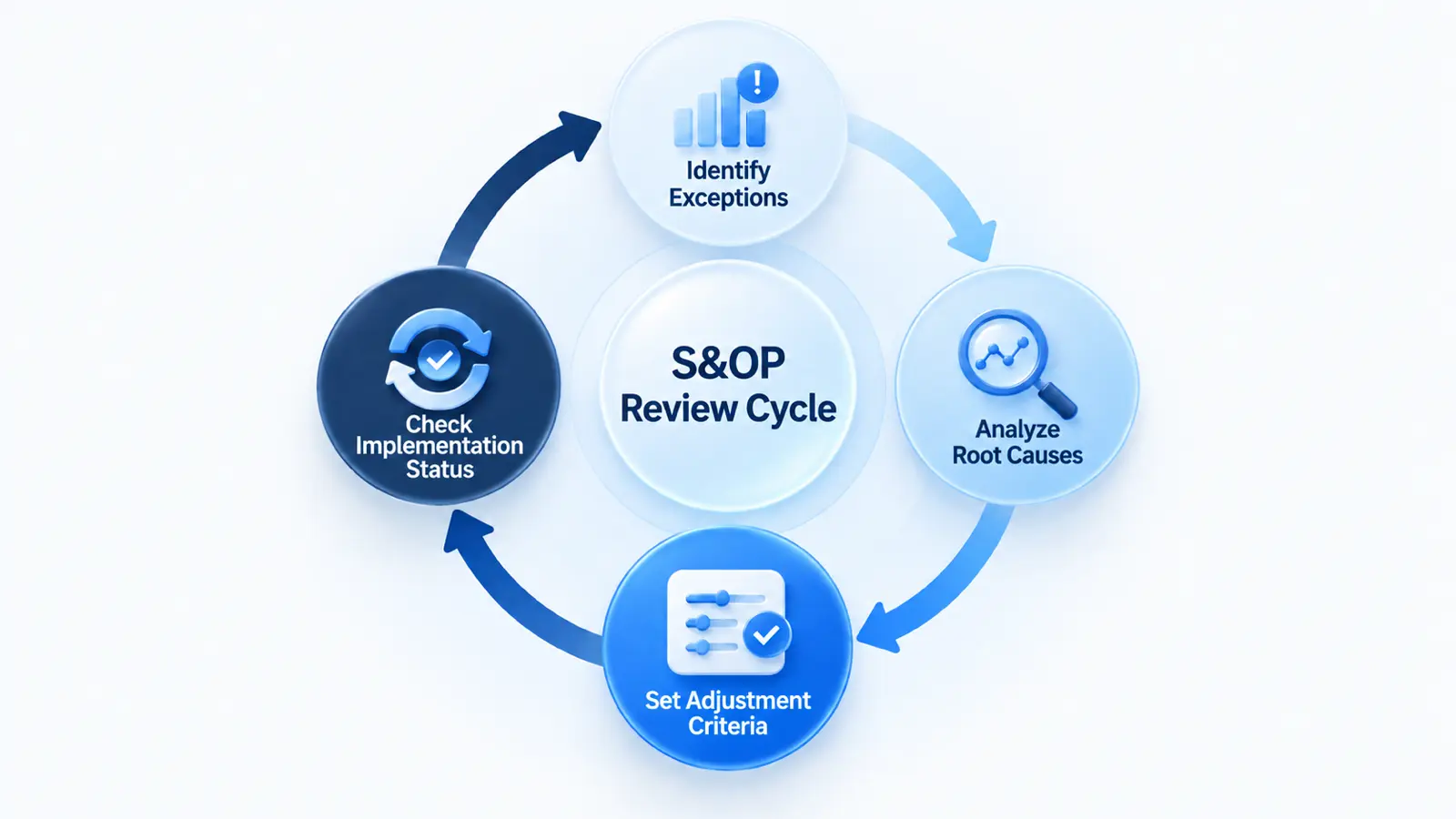
Sales and operations planning (S&OP) is the process of bringing departmental plans together and reconciling them. Holding the meeting isn't what counts. What gets reviewed in that meeting is what drives results.
First, identify where things deviated from the original plan. Next, look at why the variance happened, and then decide who will adjust it and by what rule. Finally, verify that the adjustments agreed at the previous meeting actually made it into the current plan. Skip this fourth step, and you'll keep having the same conversation every month.
Manage by Exception
Managing every item with the same intensity simply isn't realistic. It's far more efficient to focus on the exceptions, such as items at risk of stocking out, items already past due, items carrying too much stock, and items with sudden swings in demand. This also cuts meeting time considerably. Most items can be handled automatically against set rules, with people stepping in only where exceptions arise.
Supply Chain Risk Assessment and Self-Check
Supply chain issues at the national or industry level eventually land on each company's procurement and inventory. When concerns surface about heavy dependence on a particular country of origin, for example, teams on the ground end up hunting for alternative suppliers or resetting safety stock levels.
Structural Risk vs. Operational Risk
Different risks call for different responses. Heavy reliance on a single supplier or country, or production concentrated in one location, is structural risk, the kind that requires rethinking your sourcing strategy or how you work with suppliers.
Raw material price swings, delivery delays, and inventory skewed toward one location, on the other hand, are closer to operational risk, which you address by adjusting the working rules for demand, inventory, and ordering.
It's easy to treat these as separate issues, but in reality they're supply chain challenges that have to be managed at the same time. Changing structural direction takes a long time, and day-to-day operations have to keep running the whole way through.
How to Work Through a Risk Review
Adding suppliers takes time, so start by understanding how long it takes to identify and qualify new candidates. Safety stock and lead times should also be recalculated against actual data. If you manage lead times based only on what the contract says, they can drift away from real delivery performance. With regulatory, ESG, and traceability requirements on the rise, it's also worth checking whether you have a system for collecting and maintaining supplier documentation ahead of time. If you only start gathering documents once a request arrives, you may struggle to meet the deadline.
Self-Assessment Checklist
Read through the items below and check any that apply to your organization. The items you check will show which improvements are most urgent and where to start.
How to Read Your Results
Items 1 through 4 and item 6 are operational risks. Cleaning up reference dates and master data or keeping a history of decisions tends to pay off relatively quickly, so a process overhaul or system implementation is well worth considering.
Item 5 is a structural risk. Diversifying suppliers or relocating production sites requires investment and takes time, so it needs to move forward alongside executive decision-making. The realistic approach is to start the review and preparation early while tackling visible operational improvements one at a time.
Preparing to Implement an SCM System
When preparing for an SCM system, start by pinning down your operational challenges. Then, instead of jumping straight into product comparisons, get your own house in order first. It saves a great deal of rework later.
Define Processes and Owners
The first step is to clearly define processes and owners. Document who makes which decisions, and in what order, from plan creation all the way through PO confirmation. With that on paper, you can separate the work a system can take over from the steps that still need human approval.
If no one has been designated to sign off on the forecast and the final order, the system can generate numbers all day without them ever turning into decisions. This is also the stage to finalize the master data discussed earlier.
Scope Your First Project
Define the scope of your first project clearly as well. Decide whether the goal is to reduce stockouts or to reduce excess inventory. Starting with a specific team, category, or subset of SKUs rather than a company-wide rollout lets you see results faster and keeps things manageable. If the scope is too broad, it becomes hard to measure whether you got the impact you were expecting.
ERP, BI, and SCM Systems: Who Does What
It's also important to draw clear lines between ERP, BI, and SCM systems. ERP mainly handles execution and serves as the system of record, BI visualizes data, and SCM systems support planning and decision-making. If you roll out a visibility tool first without deciding in advance what you'll actually change based on what the dashboards show, you may simply end up with more checking to do.
Finally, clarifying the boundaries between SCM and adjacent disciplines up front makes future discussions go much more smoothly.
Deepflow in Practice
The Spreadsheet Work Left Over After the Forecast
Planners who receive demand forecasts tend to share the same frustration. Even with a forecast in hand, they have to open a fresh spreadsheet every time the S&OP cycle comes around. Order quantities, inventory, and production plans get adjusted item by item, and the reasoning behind those adjustments stays buried in the file. When the next cycle arrives, the same judgment calls get made all over again from scratch. This is the problem ImpactiveAI dug into most deeply when building Deepflow.
From Forecast to Order Quantity
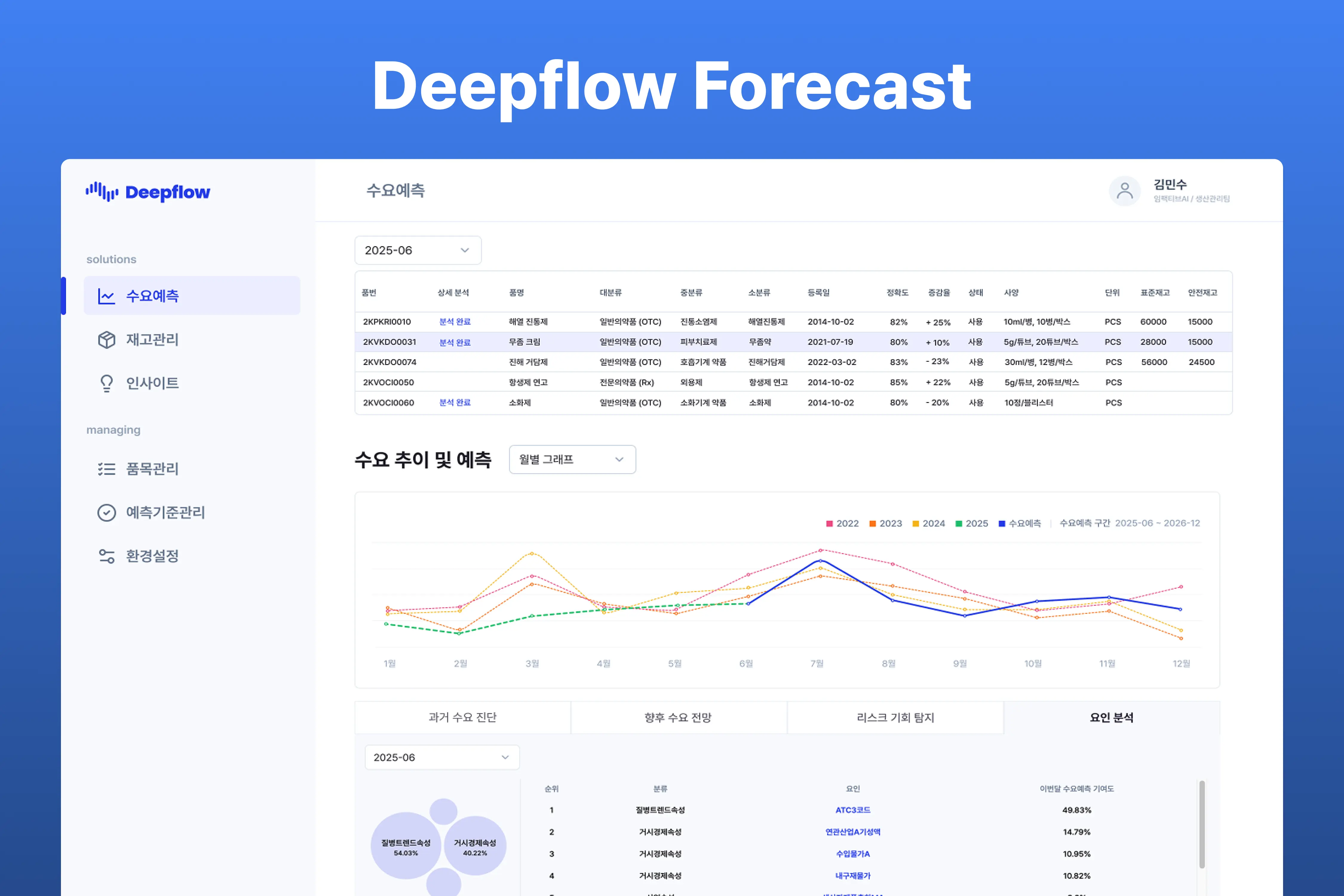
Deepflow Forecast uses AI to establish a demand baseline for each product. It doesn't stop there. It assesses inventory risk across every product and surfaces the highest-risk items first, which is the manage-by-exception approach described above, built right into the interface. It also recommends the right order quantity and purchase timing for each item, backed by specific rationale. Planners can approve those numbers as they are or adjust them before making the final call.
Raw Material Prices and Purchase Timing
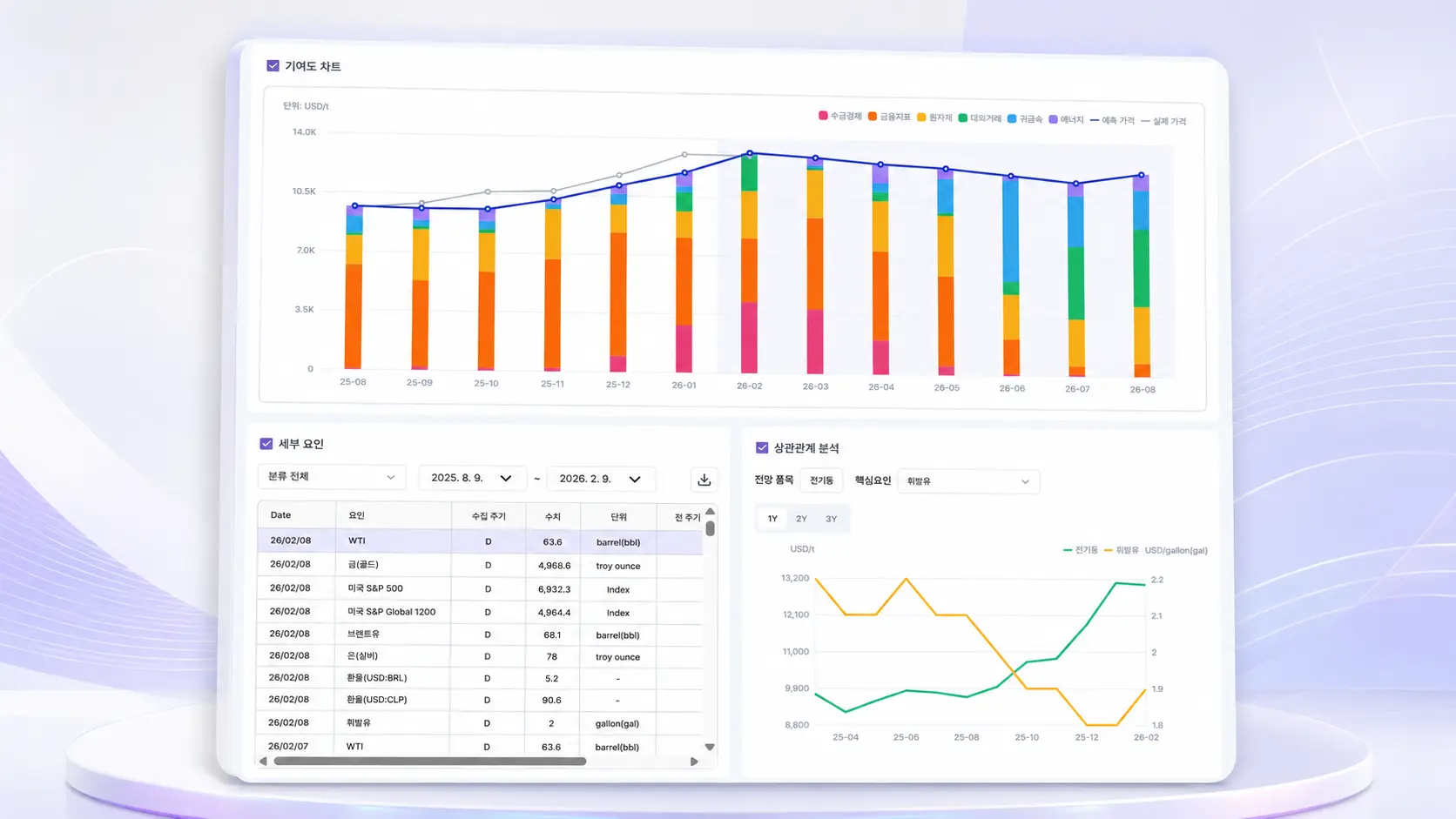
For buyers, Deepflow Materials shows where raw material prices are heading. A model trained on more than 200 market variables forecasts prices, and a value chain map visualizes how the drivers of price are shifting, from supply through demand. Layer in purchase volumes and lead times, and it becomes clear at a glance which materials to buy now, which can wait, and which are best bought in tranches. The output can go straight into executive briefings or purchase approval packages.
Building a Record of Decisions
Deepflow runs as a closed loop of forecast, consensus, execution, and validation. The reasons behind every approval or rejection are logged in the system, and at the next S&OP meeting you can see how close last cycle's confirmed order quantities came to actual results. Decision rationale no longer lives in an individual planner's spreadsheet. It accumulates as part of the company's official record, which is exactly what the last item on the checklist above is getting at.
How Deepflow Fits with Existing Systems
Implementation Roadmap
Implementation begins with a diagnostic phase. Over roughly two to four weeks, forecast results are validated in advance using your existing data. From there, Deepflow rolls out in earnest team by team, starting with groups such as demand planning or procurement.
The scope then expands step by step across SKUs, product categories, and eventually entire legal entities. Because forecast quality depends on how much historical sales and shipment data you have and how clean it is, a thorough master data review comes first, before implementation begins.
Supply Chain Management FAQ
What does supply chain management include?
It manages everything from demand planning through procurement, production, inventory, logistics, and returns as one continuous flow. The focus isn't on doing each function well in isolation but on making sure numbers and decisions connect across departments. Reviewing the gap between plan and actual and setting the rules for adjustment are also part of supply chain management.
What are the stages of the SCM process?
There are five, namely planning, procurement, production, inventory and logistics, and returns. Because each stage's decisions directly shape the next, unclear rules at the planning stage in particular can unsettle everything downstream. Defining the key decisions and warning signals for each stage in advance lets you respond quickly when problems arise.
How does SCM relate to logistics and production management?
Logistics management typically covers transportation and storage, while production management handles work sequencing inside the plant. SCM ties all of this together with demand planning and procurement into one overarching plan. For example, if logistics management is mainly focused on cutting logistics costs, rules such as how many units to hold in which warehouse are set at the SCM level.
Why is S&OP necessary?
When each department plans on its own, the numbers keep drifting apart. S&OP reviews what deviated from the plan, why it happened, what the new adjustment rules are, and whether previous adjustments were actually applied. Skip that last check, and the same discussion can repeat month after month.
When should we consider implementing an SCM system?
The right time is once your current processes are reasonably well organized and ownership, item codes, and lead-time master data are accurately in place. Pick one problem to solve first and start with a specific team or category, which makes the impact easier to measure. If you implement a system before your master data is in shape, it can be hard to trust the numbers you see on screen later on.
How do you assess supply chain risk?
Split it into two parts. One is a structural diagnosis of your dependence on suppliers, countries, and production sites, and the other is an operational review of forecast accuracy, inventory visibility, lead times, and other day-to-day conditions. Structural issues take a long time to change, so it's best to start reviewing them early. Operational reviews can run on a shorter cycle so you can track improvements as they happen.
Key Takeaways and Next Steps
Supply chain management is about weaving the numbers scattered across departments into a single flow. Align your planning reference dates, define warning signals for each stage, and follow through on adjustment results in S&OP, and the arguments that used to resurface every month will naturally die down.
If your sales, purchasing, production, and inventory data are still moving on separate tracks, take a moment to pinpoint where your company's flow needs attention first. ImpactiveAI analyzes the current state of your demand forecasting process using your own data and offers implementation consultations that include a data review. If you'd like to know how your company's data could be assessed, feel free to reach out anytime.
.svg)

.svg)





%201.svg)
%202.svg)


.svg)