.svg)

.svg)
Download Brouchure
%202.svg)
Oops! Something went wrong while submitting the form.
%201.svg)

What causes traditional demand forecasting to fail? In the past, we could reasonably predict the future based on historical data, but those days are long gone. The COVID-19 pandemic instantly transformed consumer channels and purchasing patterns, while the rapid emergence of omnichannel environments has made consumer behavior increasingly unpredictable. Combined with growing economic uncertainty and vastly different values across generations, the stable market patterns and consistency that traditional statistical models once relied upon have completely collapsed.
In these turbulent times, stubbornly clinging to outdated methods puts businesses at serious risk of inventory management failures, unnecessary cost increases, and lost opportunities. Without quickly reading the shifts in the market and responding proactively, businesses will inevitably find themselves lost in chaos.
This article takes a deep dive into the fundamental reasons why traditional demand forecasting is showing its limitations, and shares crucial insights about the direction companies should pursue in this era of increasingly complex consumption patterns. We hope you'll gain the wisdom to properly understand the rapidly changing market dynamics and elevate your business to the next level.
Most traditional forecasting models are built on a deterministic worldview. They start from the assumption that if you analyze three years of sales data and identify seasonal patterns, similar patterns will repeat next year. For example, if air conditioner sales increased by 30% every summer in the past, they'll do the same next year. If heating equipment demand surged below certain temperatures in winter, this relationship will continue.
However, this approach has a major flaw in that it overlooks the essential characteristics of markets: uncertainty and volatility. The moment you present demand as a single value, the full range of possibilities that actually exist simply vanishes.
Research from the Bank of Korea makes this problem even clearer. In the short term, 88% of fluctuations in private consumption can be explained by past inertia. However, when the forecast horizon extends beyond seven months, changes in macroeconomic conditions emerge as the dominant factor determining demand. Traditional models fail to properly decompose these elements of inertia and external environmental changes, simply extending past averages into the future. This is why they lead to demand forecasting failures.
The more fundamental problem is the non-stationarity of modern markets. In statistics, for time series data to be reliably predictable, the mean and variance must remain constant over time. However, modern markets completely violate this premise.
According to a 2024 OpenSurvey study, 77.3% of Korean consumers perceive the economy as being in crisis, and 63% expect conditions to worsen further. This represents a significant deterioration from 2019 levels. In an environment where consumer sentiment shifts so dramatically, three years of historical data simply cannot accurately explain the next year. The market's average itself is constantly moving.
Ultimately, demand forecasting failures using traditional methods have become an unavoidable reality. We now need a new approach that embraces the uncertainty of the present and future, rather than relying on the past.
We've examined why traditional demand forecasting models are no longer valid. Now let's conduct an in-depth analysis of three key structural changes in consumption patterns that intensify the reality of demand forecasting failures. Understanding these shifts provides essential insights for business survival today.
Economic anxiety goes beyond simply closing wallets. It fundamentally reorganizes consumers' spending priorities, serving as a major cause of demand forecasting failures.
From outdoor to home-centered consumption has become evident as recent consumption data shows significant decreases in dining out, cultural activities, and clothing purchases, while grocery and household goods purchases have increased. This means consumption has shifted from external activities to the home, with a strengthened focus on essential goods.
Convergence of consumption patterns across all age groups is particularly interesting. In the past, clear generational differences existed, with people in their 20s and 30s increasing spending on cultural activities and food delivery while those in their 50s and 60s maintained essential goods-focused consumption. However, since 2024, all age groups have converged toward similar patterns.
The effectiveness of age-based segment analysis used by traditional demand forecasting models is now rapidly declining. Historical demand models built around age demographics no longer explain current consumption pattern changes.

The consumption behavior of the MZ generation directly violates the assumption of rationality in traditional forecasting models, adding complexity to demand forecasting failures. They exhibit extreme duality, practicing extreme frugality one moment and making bold expenditures the next.
Meaning Out consumption is clearly evident as they minimize costs for daily meals while willingly paying premiums for special experiences or values they support. They actively use secondhand trading while generously investing in brands whose values they recognize.
Non-linear demand patterns emerge from MZ generation consumption that are difficult to capture with historical data. When a specific product becomes associated with certain values and goes viral on social media, demand explodes, but when the buzz fades, it rapidly cools. Price elasticity is also unpredictable. While demand typically decreases as prices rise, products whose value is recognized may maintain or even increase demand despite price increases.
The value judgments that modern consumers form and change undermine the stable preference systems assumed by traditional models. When a particular brand becomes embroiled in environmental controversies, it can become subject to boycotts within days. Conversely, when a social message resonates, sales can surge overnight. These extreme consumption pattern changes are important factors causing demand forecasting failures.
The omnichannel era fragments demand signals, making inventory management and demand forecasting even more difficult.
Fragmented customer journeys occur when a consumer searches for a product online, checks the actual item at an offline store, and makes the final purchase through a mobile app. Data generated at each touchpoint is stored in different systems. Online search logs go into web analytics tools, offline visits into store management systems, and final purchases into e-commerce platforms, making it difficult to understand the complete customer journey holistically.
Inventory visibility problems have a fatal impact on inventory management. If many customers examine a specific product at offline stores but don't purchase it, this could be a leading indicator of surging online orders. However, when systems aren't integrated, the paradoxical situation arises where offline stores accumulate inventory while online distribution centers face shortages. Inventory systems built by channel cannot grasp total demand, ultimately causing both excess and shortage simultaneously, leading to demand forecasting failures.
Looking at this situation, we can see that fragmented data and disconnected systems prevent companies from understanding true consumption pattern changes in the market. Integrated data analysis is desperately needed for effective inventory management.
We've explored in depth the limitations of traditional demand forecasting models and structural changes in rapidly changing consumption patterns. So what serious problems and losses do these demand forecasting failures lead to in actual business settings? This has become not just an inconvenience but a real threat to corporate survival.
The most intuitive problem starts with the difficulty of inventory management. Inaccurate demand forecasting leads to unnecessary excess inventory, generating massive operating costs including warehouse maintenance, insurance, and management personnel expenses while tying up precious capital.
For products with expiration dates or high sensitivity to trends, this ultimately leads to disposal losses, creating enormous financial burdens and directly reducing sales. Conversely, underestimating demand causes stockouts of popular products, resulting in lost sales opportunities.
This goes beyond customer dissatisfaction to cause loyal customer attrition, leading to long-term brand image damage. The harsh reality isn't simply complaining that we couldn't sell because we were out of stock, but actual sales decreases and deteriorating customer relationships.
Demand forecasting failures aren't limited to inventory problems. They cause inefficiency across core operational processes throughout the enterprise. For example, inaccurate forecasts disrupt production and workforce planning. When demand is forecasted lower than actual, rushing to expand production lines incurs additional costs. When forecasted higher, factories sit idle.
Throughout this process, workforce allocation becomes inefficient, inevitably leading to wasted labor costs. Furthermore, despite accumulating vast amounts of sales data, inventory data, and marketing data, deriving meaningful insights by integrating them is extremely difficult.

Most companies still rely on manual work using tools like Excel, but there are clear limitations in reflecting complex and extensive variables in real time. It's virtually impossible to manually input hundreds of external variables like exchange rates, interest rates, weather, competitor promotions, consumer sentiment, and social media trends into Excel and analyze their correlations. This ultimately delays decision-making and eliminates agile market response capabilities, weakening corporate competitiveness.
Of course, companies also rely on the intuition and experience of forecasting experts, but this approach is no longer valid in an era of determinism's collapse. Moreover, manual work inevitably increases the possibility of errors and consumes enormous time and manpower to constantly update forecasting models. This creates a vicious cycle where investment goes not toward better forecasting but merely to maintaining existing methods, only increasing costs.
Like the Black Swans defined by Nassim Taleb, unpredictable external shocks with extremely low probability that nonetheless shake entire systems when they occur are becoming increasingly frequent in modern markets, rendering forecasts based solely on historical data meaningless.
During the COVID-19 pandemic, extreme changes like surging demand for masks and hand sanitizers alongside plummeting restaurant demand were completely unpredictable with traditional models, leading to serious demand forecasting failures.
Events like supply chain disruptions from geopolitical tensions, rapid climate change, and global inflation have occurred consecutively, destabilizing the market's underlying conditions themselves. When raw material prices fluctuate wildly, forecasts based on historical average prices lose all effectiveness.
To overcome these limitations, ImpactivAI has developed the Black Swan methodology. It leverages the vast background knowledge of large language models to quantify the uncertainty of sudden events like wars, tariffs, and pandemics into Black Swan indices, converting them into time series variables for input into forecasting models. In predicting nickel and metal raw material prices, it captures the impact of events like wars or electric vehicle demand, combining with over 150 global indicators to significantly improve forecasting accuracy. Even in small and medium-sized manufacturing environments with limited data, it generates scenario-based quantitative data to provide more robust demand and inventory forecasting.
In this era of maximized uncertainty, leading companies are transitioning to machine learning-based forecasting systems to overcome demand forecasting failures.
While traditional models simply extend past averages into the future, machine learning differs fundamentally in that it learns hidden relationships within complex patterns, understands demand as probability distributions rather than single values, and simultaneously considers non-linear interactions among hundreds of variables. This more flexibly and accurately reflects rapidly changing market conditions, becoming the core driver that prevents repeating past demand forecasting failures.

The platform that systematizes this innovative approach is ImpactivAI's Deepflow. Deepflow's greatest characteristic lies in automation and comprehensiveness. The system automatically collects and integrates over 50,000 internal and external data points, including not only internal ERP data but also macroeconomic indicators like exchange rates, interest rates, and raw material prices, weather data, and competitor trends, securing a comprehensive market view.
By linking over 600,000 external environmental data points and over 5 million market environmental data points in real time, it enables a breadth of information analysis impossible for human capability. This establishes the foundation to minimize demand forecasting failures in modern markets where various factors work together in complex ways.
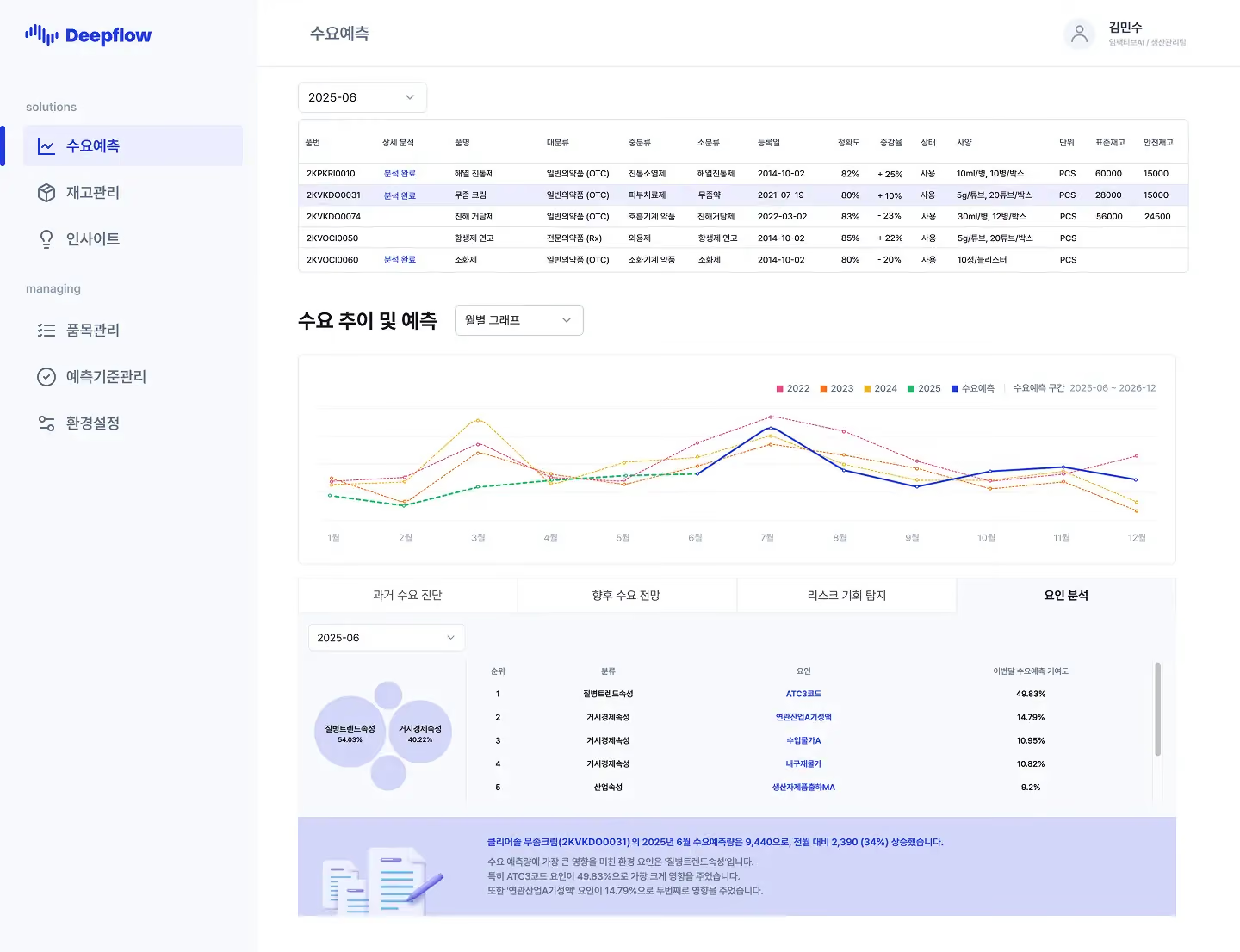
The model selection process is also a core strength of Deepflow. Deepflow possesses 224 machine learning models, utilizing diverse algorithms from cutting-edge transformer-based time series models like I-transformer and TFT to deep learning models like GRU, LSTM, and TCN.
What's particularly important is the competition method. The system explores 500 million possible combinations to select optimal features, simultaneously trains over 200 models, then automatically selects and applies the model showing the highest accuracy for each SKU's sales pattern. This results in different optimized forecasting models applied to each product category, maximizing overall forecasting accuracy and preventing demand forecasting failures for individual products.
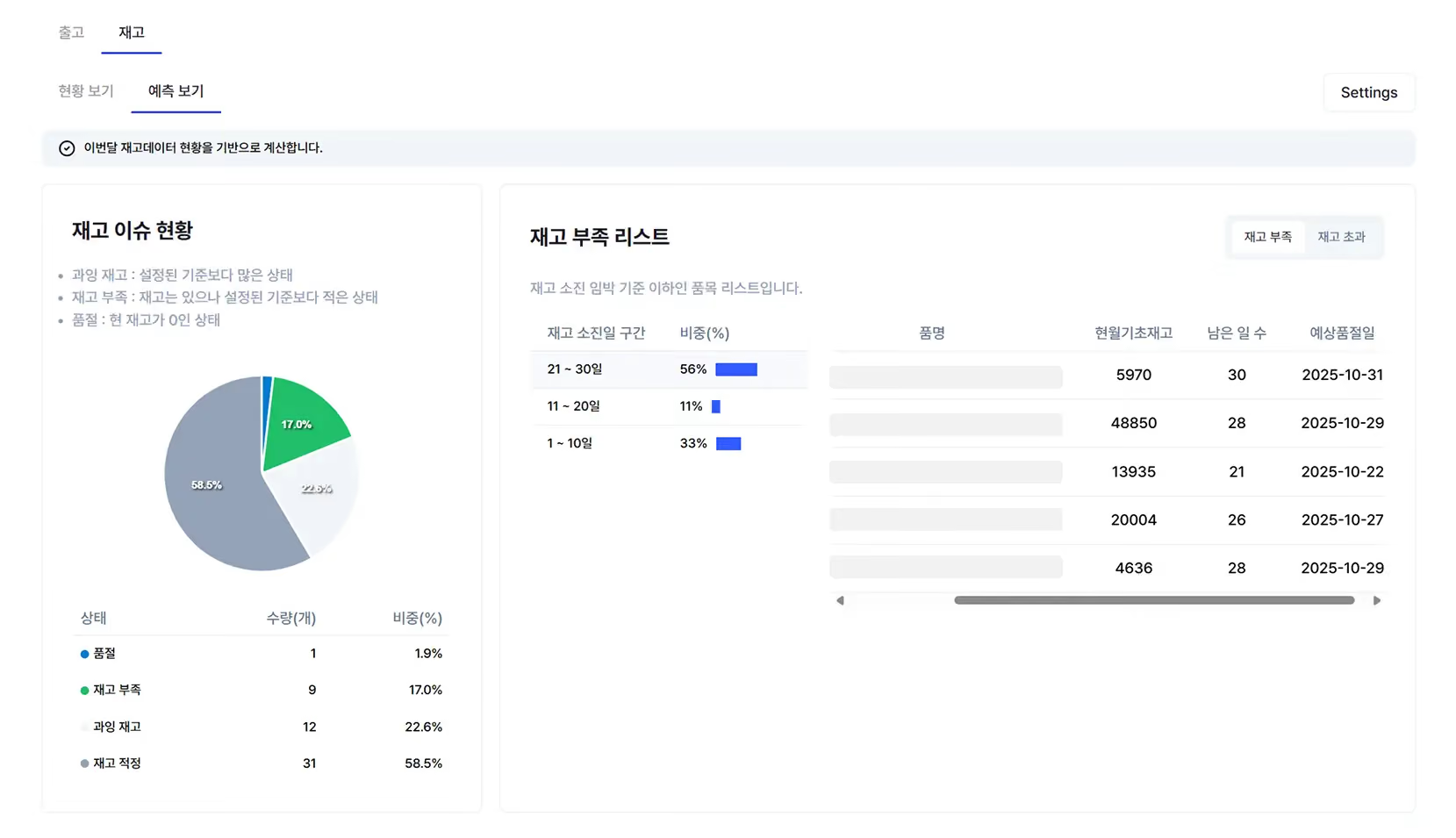
Deepflow's differentiation lies in being an integrated decision support system that goes beyond simple forecasting. LLM-based insight reports automatically analyze the rationale behind forecast values and present customized action plans for sales, marketing, and SCM departments.
The BI dashboard shows at a glance which SKUs are experiencing shortages or excess, automatically calculating days of inventory supply reflecting future sales changes and appropriate production volumes to support efficient inventory management. Additionally, the MI dashboard provides three-month short-term AI forecasts for exchange rates and oil prices, enabling companies to proactively respond to market volatility.
Most importantly, Deepflow possesses learning and evolution capabilities. Unlike traditional models that repeatedly apply fixed formulas, Deepflow relearns patterns and improves forecasting methods whenever new data is input. It provides exceptional flexibility to quickly adapt and recover forecasting accuracy even when unexpected external shocks occur, continuously reducing the risk of future demand forecasting failures.
Traditional demand forecasting failures don't stem from outdated technology. They occur because the market environment itself has fundamentally changed. The era when the past explained the future is over. Economic anxiety has reorganized consumption priorities, the MZ generation's value-based consumption has created non-linear patterns, and omnichannel environments have fragmented demand signals. With increasingly frequent unpredictable external shocks, deterministic forecasting models have reached their limits.
The solution is clear. We need systems that understand demand as probability distributions, learn complex variables in real time, and simultaneously consider diverse scenarios. Machine learning-based forecasting doesn't simply provide more accurate numbers. It provides the ability to flexibly adapt amid uncertainty. To survive in an ever-changing market, we need systems that constantly evolve rather than repeat the past. This is no longer a matter of choice but a matter of survival.
.svg)

.svg)
.svg)






%201.svg)
%202.svg)


