.svg)

.svg)
%202.svg)
%201.svg)
Commodity Price Spikes and Drops: 7 Procurement Checks Before the Meeting
On a morning when word spreads that a commodity price has moved sharply, questions from every department pile up at the buyer's desk. Sales wants to know whether an open quote can still go out as written. Production asks whether next month's input volume is secured, and finance asks whether the quarter's cash plan needs to be redone. In the executive meeting, the first question is usually some version of "shouldn't we be buying ahead right now?"
The problem is that the evidence needed to answer isn't gathered in one place. Price clauses sit in the contracts. Quantities not yet received are tracked separately by the logistics owner. Projected requirements live in the production plan, and each customer's price-adjustment terms live in the sales files. The buyer has to assemble all of it mentally and reach a conclusion within half a day. And that decision gets called back months later — in inventory valuation or cost reviews — where the question isn't what the price chart did, but why you decided the way you did that day.
Whichever way you decide, some burden remains. Rush to buy ahead, and if the price snaps back you are left holding high-cost inventory, storage costs, and tied-up working capital. Put the decision off, and fast-burning items soon push you into emergency sourcing and delivery renegotiations.
So what a spike-or-drop day really requires is not conviction about market direction but decision criteria: which items are actually affected, by when a decision is due, and how much to secure on what terms. The sequence below is how to assemble those criteria onto a single page before the executive meeting.
Why the Market Price and Your Delivered Cost Are Different
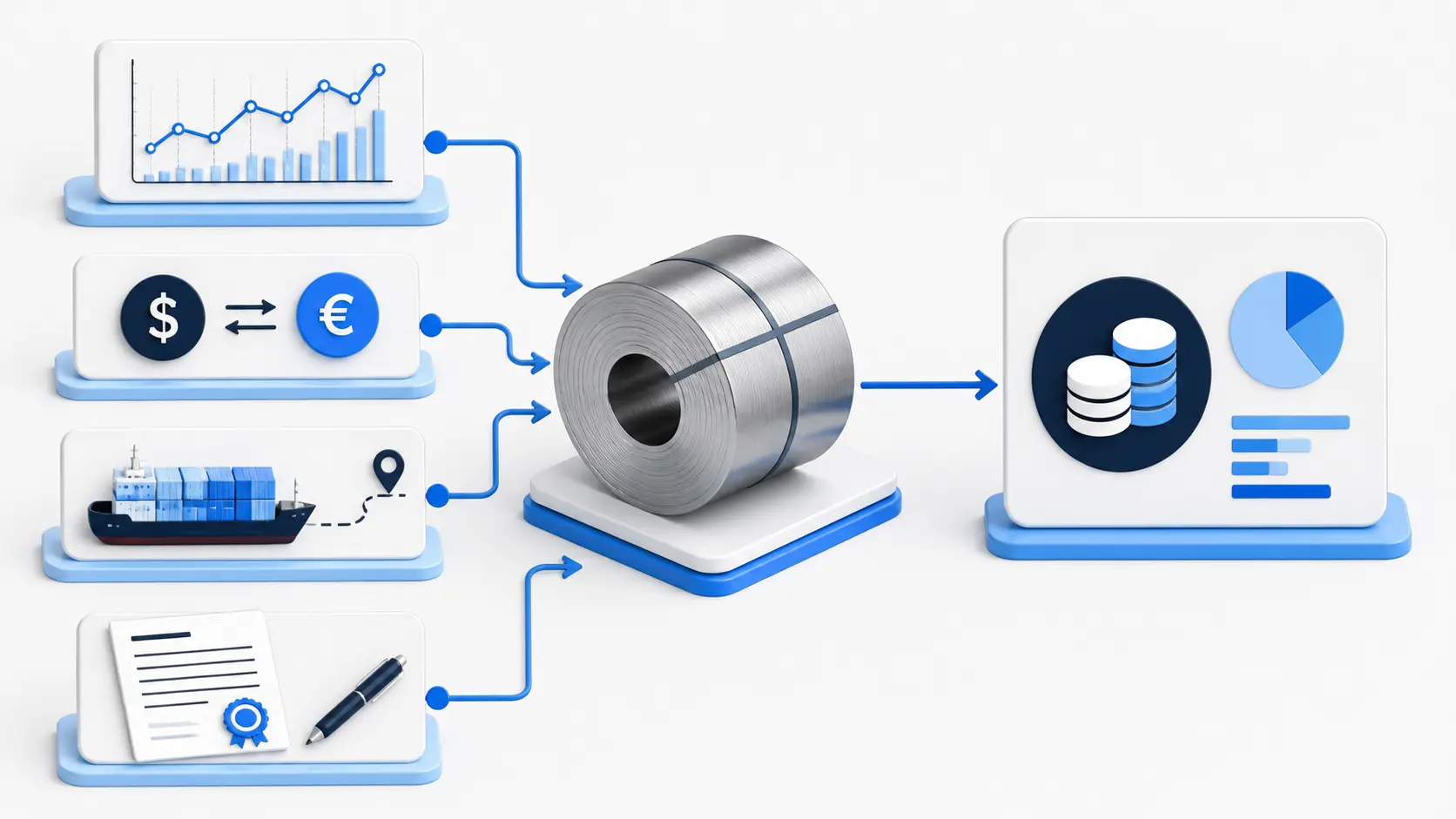
The delivered cost a procurement team actually pays is not set by the market quote alone. A regional or grade premium is added on top of the international or regional benchmark price; for prices denominated in foreign currency, exchange-rate moves change the local-currency amount; and freight and ancillary charges are layered on top. A premium is the amount added to the benchmark for a specific region, grade, or delivery condition.
How far the ancillary charges reach depends on the delivery terms (Incoterms). Who bears duties, insurance, customs and handling fees, and inland freight differs contract by contract, and discounts and rebates are not handled the same way either. So on a day when prices move, comparing only the four price components is not enough. You also have to confirm which delivery terms apply to each quote and which costs are baked into that unit price — otherwise the numbers in the meeting deck will not match the actual delivered cost.
The price components do not always move in the same direction, either. Even if the benchmark falls, delivered cost rises when your currency weakens or freight climbs. In a quiet market, a supply squeeze in one specific grade can send its premium sharply higher. If the meeting deck says only "the market went up," these differences never surface. What you need to establish is what changed, and from which contracts and which inbound shipments that change starts to apply.
The 7-Point Commodity Price Volatility Checklist for Procurement
1. Verify the benchmark price and the supplier's price-change notice
Break the quote into one line each for benchmark price, premium, exchange rate, freight, and delivery-terms-driven ancillary charges, and set it side by side with the previous quote. Where the contract does not require the supplier to disclose its full cost structure, focus first on the basis for the price adjustment rather than the complete cost breakdown.
To do that, lay out the price formula specified in the contract and reconcile it line by line against the numbers in the supplier's price-change notice. Which benchmark price or contractual price reference did they use, and from which source? Does the period applied match the contract? On what basis were the premium, exchange rate, and freight each calculated? This process reveals whether the change simply reflects the market as a whole, or a problem specific to one supplier, grade, or shipping condition. If you have already separated what adjusts automatically under the contract from what requires separate agreement, you can put only the items that genuinely need adjustment on the negotiation table instead of arguing over the entire price move.
Even for the same raw material, the actual impact varies widely with settlement currency, sourcing region, and delivery terms. With that in mind, laying out the affected items and related contracts in a table goes a long way toward keeping the meeting from sliding into "everything we buy is going up."
2. When contract prices actually adjust
The market may move today, but your contract price does not change today. Items to re-check in the contract:
- The benchmark price used for the unit price and its reference point (prior-month average, shipment date, contract signing date, and so on)
- The repricing frequency and the next adjustment date
- Caps and floors, adjustment grace periods, and renegotiation clauses
- The point at which volumes become firm and the range within which they can still be canceled or adjusted
Alongside these, write down the price-fixing date, delivery date, title-transfer date, and payment date for each item. These dates rarely all line up. If the contract prices at the shipment-month average, the price is effectively locked before the goods even arrive. With a letter of credit or open-account terms, the payment date falls well after delivery. Conversely, even before goods arrive, your right to adjust quantities may already be gone.
That is why counting only the days left until delivery makes it easy to believe a price that is already fixed can still be negotiated. What to confirm here is: until what point can you change what? Organize these dates by item, and you avoid unnecessary emergency purchases while concentrating people and cash on the items where time is genuinely short.
3. A consistent basis for coverage (days of supply)
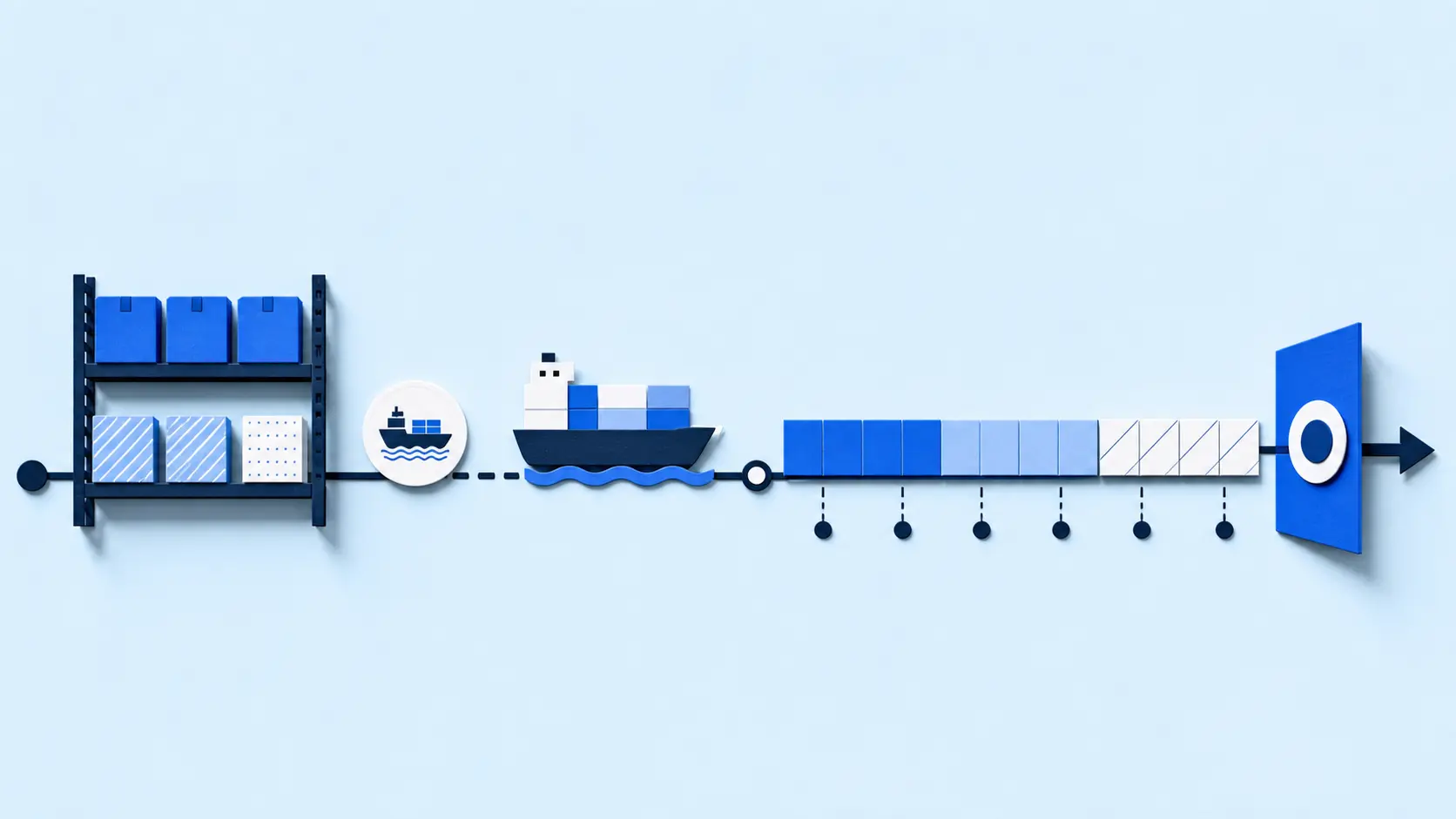
Coverage — the coverage period, or days of supply — is how long you can run on the volume you have actually secured. Counting everything sitting in the warehouse can make the position look more comfortable than it is, so first subtract the inventory that cannot actually be used right now. Stock on quality hold or awaiting inspection, and stock already earmarked for a specific customer or project, cannot simply be redirected, so it comes out.
Volume that has not yet arrived, or that is under contract but not effectively receivable, does not count as secured either. And any volume you could still cancel or reduce yourself is closer to optionality than to secured supply.
What remains can then be screened on four criteria. Check whether the ship date and expected arrival fit the point of need, and whether the supplier has confirmed allocation against your order. Establish when title and risk transfer to your side. And check whether the demand you are comparing against sits in a frozen window of the production plan or is still a movable sales forecast.
Compare only the volume that survives this screen against projected requirements as of the same reference date, and departments stop showing up to the meeting with different numbers.
Once the calculation basis is aligned, item-level conclusions separate naturally. Items whose coverage is close to the internal threshold gain a case for additional buying, while items with room to spare — in the same market conditions — get split purchases or a decision to simply wait.
4. The volume you carry at cost before selling prices adjust
Price pass-through is the process of reflecting a cost change in your product prices. With the sales team, it is not enough to confirm whether a price-adjustment clause exists. Even where a clause exists, when and how much actually reaches prices depends on four factors.
Those factors are: which month's raw-material price serves as the reference, how many days' notice a price increase requires, whether it can be applied retroactively to volume already shipped, and how much fixed-price customer commitment remains that cannot be reopened.
For example, if the reference month is the average of two months ago and the notice period is 30 days, today's sudden spike does not reach an invoice until the one issued at the end of the quarter. The cost increase on everything shipped in between is ultimately absorbed by the company.
Running this calculation in advance helps procurement judge how far to act preemptively. Rather than committing against the entire forecast volume at once, start with the order book already locked at fixed prices and the raw materials with the shortest coverage.
If commodity prices are dropping sharply instead, the checks flip: when, and under which contracts, will customers demand price reductions? The reference month and notice period apply just as much to reduction requests. Working out in advance when those reductions take effect helps you minimize the gap between the point your purchase cost falls and the point your selling price adjusts.
5. The substitute-material qualification timeline
Having a list of substitutes does not mean you can use them right away. Qualification, production trials, customer approval, and supplier registration each need a defined process and a named owner before a substitute is genuinely usable.
If you start the approval process now, will it finish before the purchase decision is due? You also need to confirm the substitute fits existing equipment and quality standards. It is worth checking whether products that require customer approval are separated from those usable on internal approval alone. And have you actually compared the alternate source's minimum order quantity (MOQ), lead time, payment terms, and delivery terms?
On the day of a sharp price move, it is hard to assert that a substitute is simply available. The realistic work that day is to pick the items worth running qualification on in parallel and assign owners. That alone expands the options available the next time prices move.
6. Setting a pre-buy limit
Deciding how much to buy ahead on projected savings alone is not easy, because the savings themselves shift with several conditions. Work through them step by step with finance and logistics.
The first thing to check is how firm the demand behind the savings estimate is. If actual requirements come in below forecast, the cheaply bought volume simply sits as inventory. Look at order units as well: if the minimum order quantity (MOQ) forces you to buy more than you need, it is safer to decide in advance how the excess will be handled.
Next, ask whether this is an item you genuinely cannot obtain later if you do not buy now. If alternate sources exist and lead times have slack, there is less reason to rush. If, on the other hand, your current supplier's delivery performance or credit is shaky, first verify that pre-bought volume will actually arrive on time.
Also consider whether the item can be stored for long. Materials with short shelf lives lose usable quantity in storage, and items with frequent design changes strand inventory when the specification moves. Factor in the warehouse too — not only the added storage cost, but the burden of that space being unavailable to other items.
Last is cash. Review with your finance partner whether there is cash to tie up now, whether it fits within credit limits, and whether it satisfies internal price- and currency-risk management policies.
Work through all of this and the basis for a limit falls into place. Set the limit in whichever unit best captures that material's characteristics — value, volume, or storage duration — and state it in the approval document. With a limit agreed in advance, a price-rise signal leads to buying in several tranches rather than all at once. And when the decision is revisited later, it becomes much easier to see which condition changed and led to a loss.
7. Execution triggers and review criteria
If the record says only "securing volume because prices are expected to rise," there is nothing left to revise the judgment against when conditions change. Write the conditions concretely enough that another person looking at the same data can easily verify them.
For example: the supplier's lead time exceeds the internal threshold, coverage has reached the minimum, or the contract-adjustment deadline is imminent — criteria anyone can confirm objectively.
It is also good practice to include the conditions for stopping further purchases in the same document. For example, if supply has normalized, or the demand outlook has softened and coverage exceeds the internal maximum, you can hold any remaining purchases and instead review whether the contract can be adjusted. Keep in mind, too, that a single price-only trigger makes it hard to respond when the market turns quickly.
What Procurement Checks First When Commodity Prices Drop
A sharp drop is often read as a buying opportunity. But the high-cost inventory you already hold, customer pressure for price cuts, and lowest-price clauses buried in long-term contracts are all likely to weigh on you at the same time. The playbook from a rising market cannot simply be run in reverse.
When inventory valuation comes up, one point is worth settling clearly: a fall in the raw-material price does not by itself register a loss. An inventory write-down comes under review only when the net realizable value of the finished goods made from that stock falls below their carrying cost. Net realizable value is the expected selling price minus the remaining costs to complete and sell. If selling prices are falling alongside the raw material, that condition may apply.
Procurement's part is to compile, by item, how purchase cost, the current market price, and selling-price trends are moving, and hand it over. The judgment and accounting treatment that follow are handled by finance, in line with the company's accounting standards and policies.
How to Pull Commodity Price Data Together Fast
The seven checks above are not difficult in themselves — you may well have been thinking, as you read, that you already do this. The catch is that the conditions and criteria to be decided are scattered across different files and departments, which makes it genuinely hard to assemble them onto one page within the day. So when prices swing suddenly, the work falls back on individual memory and extra hours, and the basis for important decisions naturally dissipates once the meeting ends.
Deepflow Materials from ImpactiveAI brings internal data such as sales, inventory, and order history together with external data such as commodity prices, exchange rates, and freight, and helps connect price forecasts and projected requirements to purchasing decisions. Materials whose prices move in different ways — copper, nickel, iron ore, coking coal, scrap — are each analyzed according to their own price structure. On top of that, you can see how much supply, demand, inventories, and economic conditions contributed to a given price move, and check coverage and contract deadlines in the same place.
Deepflow does not make purchasing decisions for you. The forecast is evidence that narrows the day's options; how much to secure, and on what terms, is decided by people. But simply having the whole procurement team decide from the same data helps reduce missed checks and cross-department inconsistencies, and leaves a systematic record of the basis for each decision.
Get Ready Before the Next Commodity Price Swing
Start with the items that carry the largest share of cost, and prepare the seven checks above in advance. Then, on the day sudden price news lands, the meeting naturally shifts from a debate over market direction to a review of conditions and actions. Contact ImpactiveAI and we will arrange a solution demo experience built on your company's own internal data. Use the solution demo experience to see how your procurement work can run more efficiently.
.svg)


.svg)





%201.svg)
%202.svg)


.svg)