.svg)

.svg)
%202.svg)
%201.svg)
Why AI Forecasting Tools Are Essential in an Era of Commodity Price Volatility
.jpg)

The Russia-Ukraine war, instability across the Middle East, and escalating tensions between the U.S. and China have collectively driven commodity market volatility to unprecedented levels. Yet Korean companies remain significantly behind their global peers in their ability to respond. CME Group data tells the story clearly—hedging ratios among Korean firms are roughly half those of their Japanese and Chinese counterparts.
The deeper concern is that many companies are still purchasing raw materials with virtually no forecasting in place. Taewon Yoo, a director at ImpactiveAI and former CME Group Asia-Pacific specialist with over 20 years of experience, puts it bluntly: "Trading commodities without forecasting is essentially speculation."
So why do Korean companies continue to fall short when it comes to forecast-driven decision-making? What are the inherent limitations of traditional forecasting methods, and how can AI technology address these challenges?
To explore these questions, we sat down with Director Taewon Yoo, whose career spans leadership roles as head of overseas derivatives at Samsung Futures and specialist advisor at the Korea Agro-Fisheries & Food Trade Corporation before serving as a CME Group specialist, and who now works with the Strategic Business Team at ImpactiveAI. Through this conversation, we gained a deeper understanding of how Korean companies actually manage commodity risk, along with a detailed look at how AI-powered strategies can reshape their approach.
The Current State of Commodity Price Forecasting Among Korean Companies
As commodity price volatility intensifies, the gap in risk management capabilities between companies grows ever wider. Large corporations respond proactively with dedicated teams and sophisticated systems, while small and mid-sized enterprises are often left exposed. Where do Korean companies stand in reality, and how do they measure up against global benchmarks?
The Capability Gap Between Large Enterprises and SMEs
Q. From a global perspective, where do Korean companies stand in terms of commodity risk management? Is the capability gap between large enterprises and small-to-mid-sized companies something you've observed firsthand?
There is a clear capability gap between large corporations and mid-sized firms. The energy commodity space, in particular, is dominated by major players. In the agricultural sector, while many smaller companies are involved, domestic agricultural imports are largely structured as joint purchases. Because individual companies end up paying the same import price through this collective buying mechanism, the incentive to actively hedge prices has been dulled. For non-ferrous metals, the gap varies significantly depending on the company.
Q. How do the hedging ratios and trading volumes of Korean companies compare to those of their Japanese and Chinese counterparts?
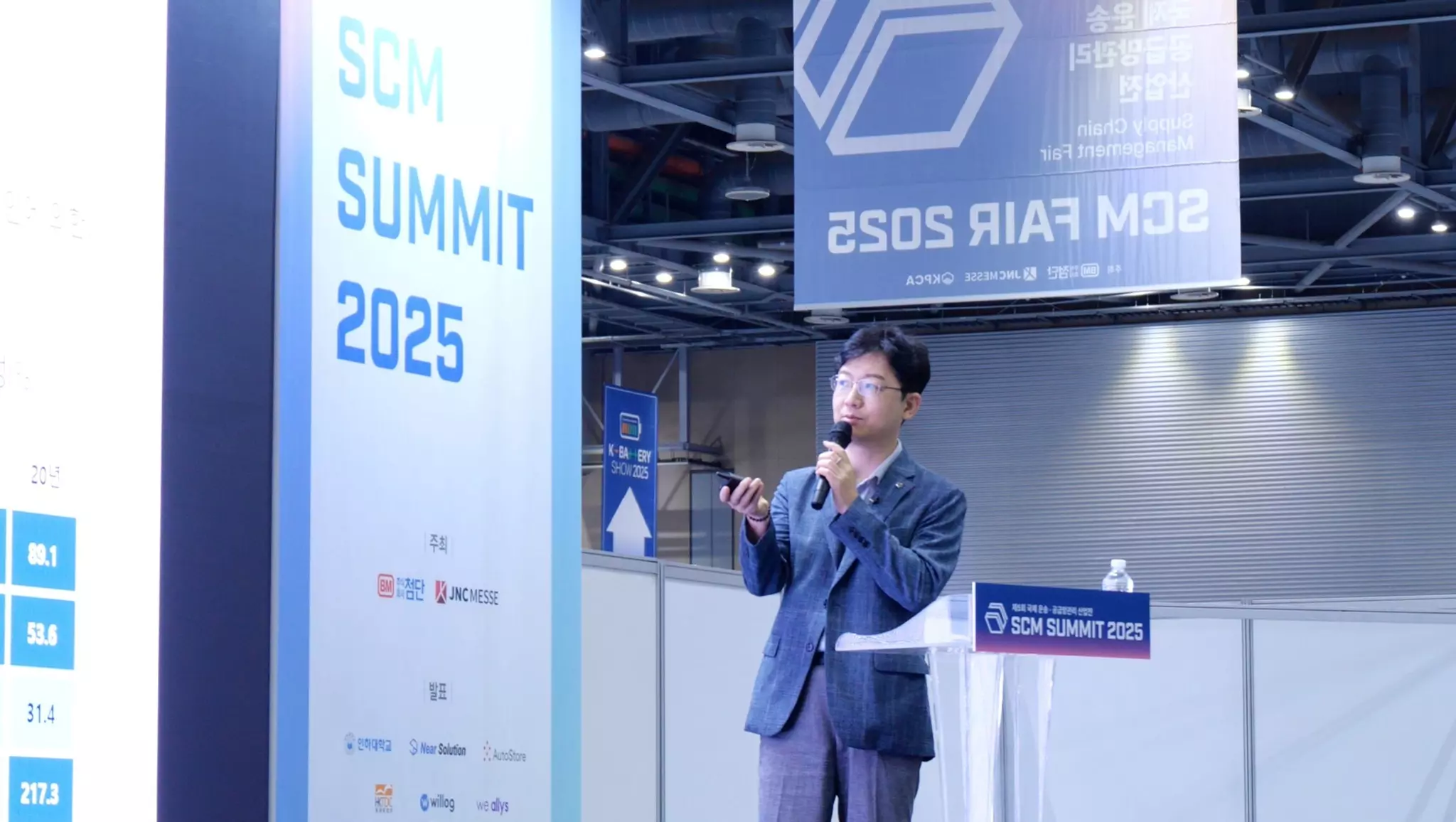
Compared to Japanese and Chinese firms, the Korean market is heavily skewed toward large corporations. As a result, small and mid-sized companies—especially tier-one and tier-two vendors handling raw materials—have limited options for hedging. Large companies employ a variety of strategies, such as taking out insurance to reduce exposure to price swings, even when commodity prices don't have a massive impact on their bottom line. But smaller firms simply don't have the resources to follow suit.
What's interesting is that Korea is actually a major global player in certain commodity sectors. In agriculture, for instance, Korea ranks as the third-largest importer from the U.S. on a single-country basis. Korea also leads the market in the battery industry. On the other hand, the country has notable weaknesses in traditional energy markets like crude oil and natural gas. Still, with renewable energy-related commodities attracting increasing attention, new opportunities are expected to open up going forward.
Myths and Realities of Futures Trading

The capability gap is only part of the problem. An equally serious issue is the fundamental misunderstanding of futures trading. Many companies still equate futures with speculation and believe that spot trading is the only safe approach. Industry experts, however, see it the other way around entirely.
Q. Many companies still rely exclusively on spot trading. Some even view futures trading as speculative. Could you explain how physical trading and futures trading can be complementary?
While spot and futures markets are not identical, they function almost like mirror images of each other. The futures market already reflects prices based on expectations about the future, so trades are made against those expectations. What matters is that spot and futures can be used in a complementary way.
Q. What does it mean for a company to trade commodities without any forecasting?
For a company that holds physical inventory but remains exposed to price risk, operating without forecast-based decisions is tantamount to speculation. Accurate forecasts are what drive action—forecasting is not something you do only when you can get it right; it is something you must do regardless. Futures trading and hedging are simply the tools through which those forecasts are executed.
The Potential of AI-Powered Commodity Price Forecasting
Even if everyone agrees that forecasting is essential, producing accurate forecasts is far from easy. Commodity prices are influenced by dozens of variables—supply and demand dynamics, exchange rates, interest rates, geopolitical risks, and climate change, to name a few. In the past, companies relied on the experience and intuition of veteran traders, but in today's era of extreme volatility, that alone is no longer sufficient. This is precisely why a derivatives specialist with two decades of experience made the move to an AI-based forecasting company.
The Limitations of Traditional Forecasting
Q. Traditionally, what indicators and signals did you consider most important when determining trading positions or timing hedging decisions?
Accurate market judgment requires extensive information gathering. You have to continuously monitor markets and assess the factors driving prices. But as scenarios shift rapidly, companies need to secure multiple supply sources and identify substitute commodities in case of logistics disruptions or supply issues. We've reached a point where it's more important than ever to have access to a broader range of information sources and diverse hedging tools.
Q. When you factor in newer variables like climate change and geopolitical risks, doesn't traditional analysis alone fall short?
Absolutely. There are cases where forecasts miss the mark, and a scenario-based approach is also necessary. To enhance the reliability of AI-generated forecasts, the system needs to present results that incorporate a comprehensive assessment of historical precedents and current supply-demand conditions.
Traditional methods are inherently constrained by human processing capacity. Simultaneously monitoring multiple markets, analyzing the correlations among dozens of variables, and simulating various scenarios is simply impossible for a single person. This is especially true for small and mid-sized companies that lack dedicated teams.
The Importance of Diverse Modeling
So why did a seasoned derivatives expert make the leap to an AI company? Director Yoo's reasons for joining ImpactiveAI reveal the fundamental challenges of commodity forecasting.
Q. Moving from being a commodity derivatives specialist to an AI-based forecasting company must have been a major turning point. What was it about ImpactiveAI that convinced a 20-year veteran to make the switch?

I believed that if you could combine a thorough understanding of markets with hard-earned field experience and channel that into forecasting, it would make the downstream work—developing hedging strategies and making investment decisions—far more effective. I saw the technology and the vision to enable that kind of decision-making at ImpactiveAI, and I was convinced it was the best place to put my 20 years of experience to work. That's what drove my decision to join.
Q. What do companies that excel at commodity risk management have in common? Are there differences in organizational structure or decision-making processes?
From an organizational standpoint, the team handling physical trading and the team responsible for market analysis and hedging must be clearly separated. This separation is essential. Just like a car needs bumpers to absorb impact, companies need mechanisms in place to absorb risk.
Forecasting ultimately serves to cushion the shock of cost impacts and outcomes when companies make decisions or enter into contracts. At the execution stage, you need to actively leverage a variety of trading methods, including lagging and leading—adjusting internal settlement dates to manage risk.
The key concept here is the "bumper." Forecasting acts as a bumper that absorbs shocks. Building on those forecasts, the real risk management happens through deploying a range of tools—futures trading, hedging, lagging (delaying settlement dates), and leading (accelerating settlement dates). But all of it starts with accurate forecasting.
Commodity Price Forecasting with DeepFlow
While the need for accurate forecasting is widely acknowledged, putting it into practice is another matter—especially for small and mid-sized companies that lack dedicated risk management departments. They face shortages in data, analytical talent, and systems infrastructure. This is exactly where the value of AI-powered forecasting solutions becomes clear. How does ImpactiveAI's DeepFlow tackle this problem?
What 224 Forecasting Models Really Mean
Q. If a company wants to enhance its commodity risk management and price forecasting capabilities, what role can a tool like DeepFlow play?
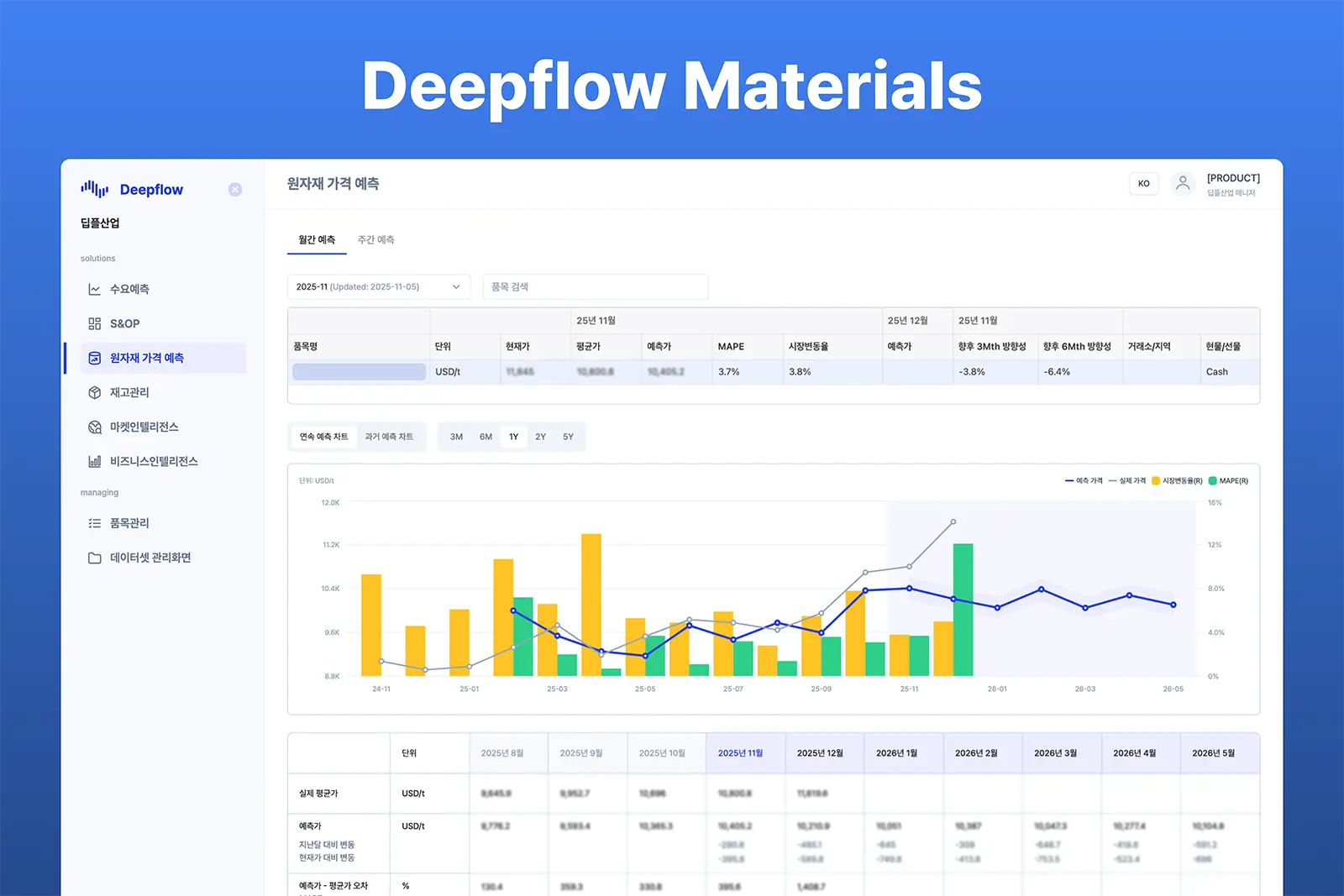
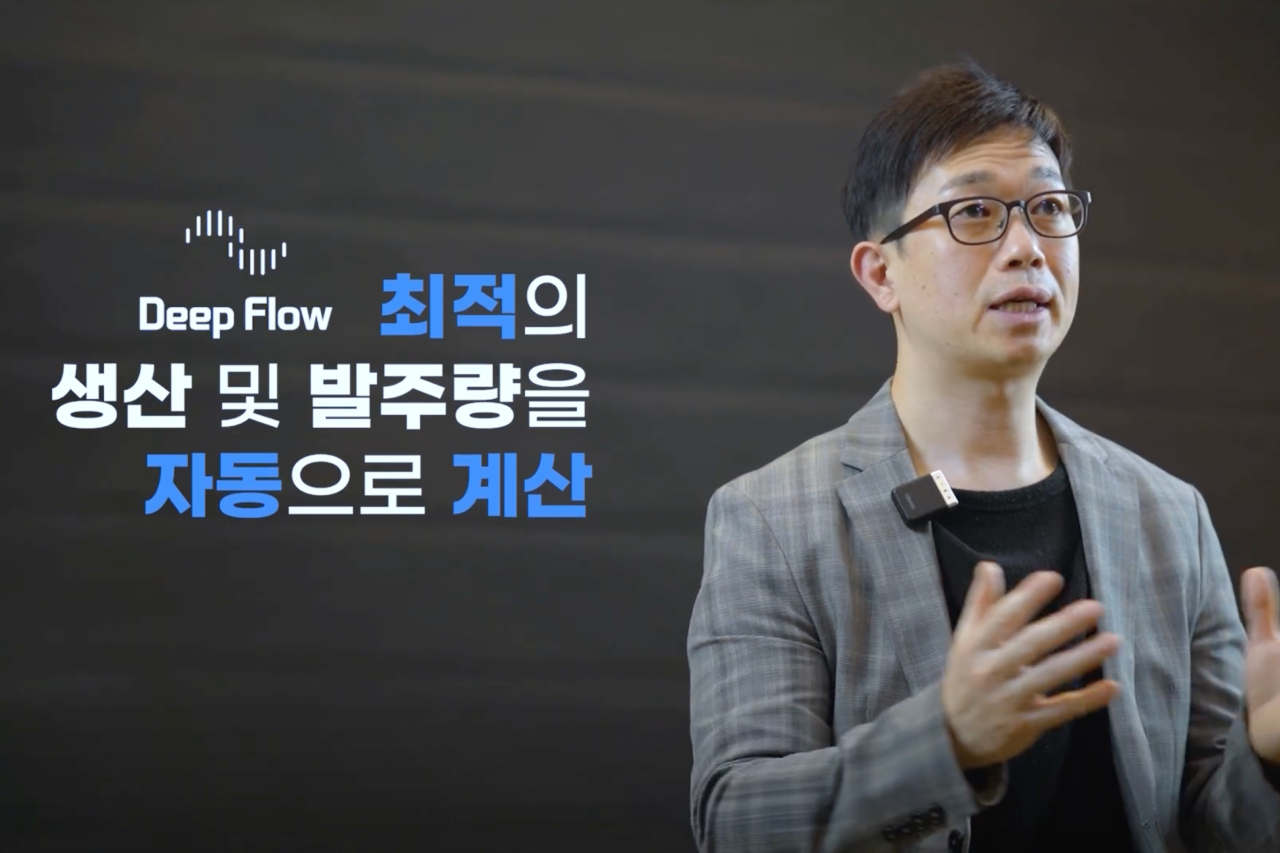
DeepFlow's greatest advantage is the sheer number of forecasting models it offers compared to other companies and AI forecasting providers. With 224 different forecasting models currently available, companies can compare predictions across multiple models and evaluate different price forecasts.
Another major benefit is that adopting a solution like ImpactiveAI's DeepFlow significantly reduces the time that would otherwise be spent on model development and research. The practical experience and know-how that accumulate through using the platform can be naturally internalized within the organization, making it an incredibly valuable resource for businesses.
Q. I understand that DeepFlow's MI Dashboard integrates analysis of exchange rates, interest rates, commodity prices, and global economic indicators. Why is this kind of multi-variable analysis so important in practice?
Commodity markets are influenced by a wide range of external variables. Exchange rate fluctuations, interest rate changes, and global economic indicators all interact in complex ways. There are real limits to how well any individual can simultaneously track and analyze all of these factors. How you leverage data can become a powerful means of amplifying expected outcomes.
The significance of having 224 models goes far beyond the number itself. The optimal forecasting model differs depending on the commodity, market conditions, and the specific characteristics of each company. A model designed to predict copper prices needs to examine entirely different variables than one forecasting wheat prices. DeepFlow covers this diversity through its 224 models and automatically selects the best-fit model based on each company's data profile.
Expected Benefits in Practice
Even the best model is meaningless if practitioners can't actually use it. What sets DeepFlow apart is that it doesn't just deliver forecasted values—it provides actionable insights that practitioners can immediately put to work.
Q. Everyone talks about the importance of commodity risk management, but for mid-sized and smaller companies without dedicated teams, it can't be easy.
That's right. While the importance of commodity risk management is widely discussed, it's far from an easy option for mid-sized and smaller companies that lack dedicated departments. But we've reached a point where how you leverage data makes all the difference.
Q. I've heard that DeepFlow's LLM-based analytical reports deliver customized execution strategies tailored to different departments—procurement, SCM, sales, and so on. Why is it important for different teams within an organization to interpret and apply the same data in different ways?
Practitioners need to go beyond simply reviewing forecast values—they need to secure actionable insights. DeepFlow's LLM-based analytical reports use generative AI to automatically produce analyses of historical sales trends and seasonal patterns, future demand outlooks with supporting rationale, and customized execution strategies for each department. It systematically presents key risks and opportunity factors for practitioners across sales, marketing, SCM, and other functions, delivering action plans optimized for each team. This allows practitioners to save time that would otherwise be spent on complex data interpretation and report writing, and focus instead on strategic decision-making.
Consider a procurement manager at a mid-sized company. This person has neither the ability nor the time to develop a commodity price forecasting model. But DeepFlow can deliver a specific action plan like this: "Copper prices are projected to rise 15% over the next three months, driven primarily by China's infrastructure investment expansion and mining strikes in South America. The procurement team is advised to secure 30% of volume through purchase contracts early next month, with the remainder acquired through a staggered buying strategy."
When the sales team sees the same forecast data, it translates into a message like: "With raw material cost increases expected, prepare for price-increase negotiations within the quarter." For the SCM team, the same data becomes: "Inventory depletion days are projected to drop to 45 days—reassess safety stock levels." A single forecast is essentially translated into each department's language.
Beyond Forecasting: Commodity Procurement and Decision-Making Strategy
Forecasting is only the starting point. Even the most accurate predictions are useless if they can't be translated into action. The same applies to AI forecasting—no prediction is perfect, and sometimes it will miss the mark. What truly matters is how you use the forecast and how you respond when it turns out to be wrong.
The Imperative of Forecast-Based Decision-Making
Q. Realistically, AI forecasting can't be perfect either. In what situations might AI predictions go wrong, and how should companies respond?
There are cases where forecasts miss when market conditions shift abruptly. A scenario-based approach is necessary, and forecasting should be pursued as a tool with multiple contingency measures in mind. To improve the reliability of AI-generated predictions, the system needs to present results based on a comprehensive assessment of historical precedents and current supply-demand conditions.
In the case of DeepFlow, its BI Dashboard enables companies to identify inventory shortages and excess SKUs at a glance, while automatically calculating inventory depletion days and optimal production volumes based on projected sales changes. This helps companies reduce unnecessary costs and stockout risks in inventory management, while practitioners can instantly assess the current situation through visual reporting.
Q. If a company were to use DeepFlow's 3-month short-term AI forecasts as a supplementary indicator for purchase contract decisions or hedging timing, what would that look like in specific scenarios?
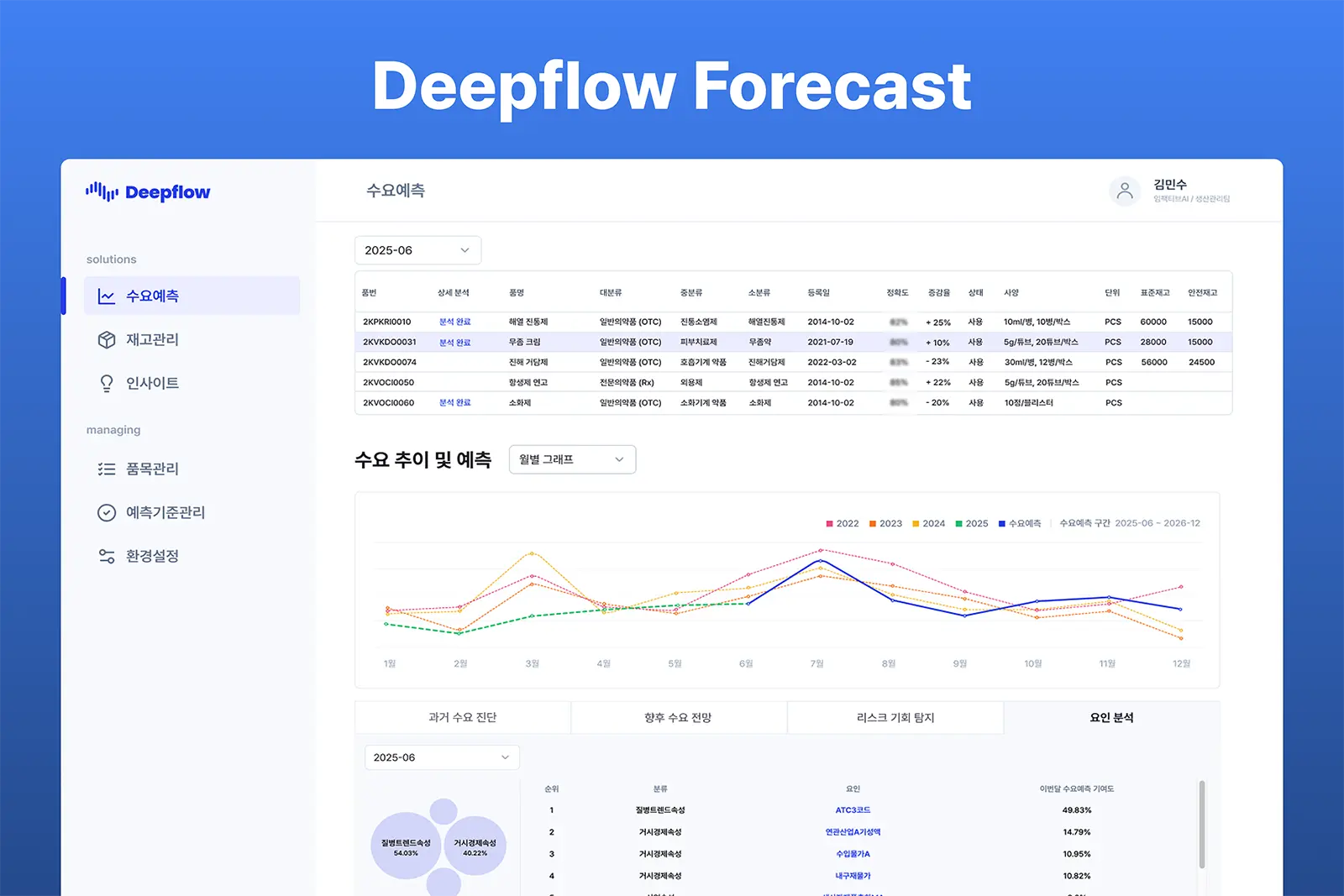
The MI Dashboard provides external environment data including exchange rates, interest rates, commodity prices, and global economic indicators. Through features like the 3-month short-term AI forecast (beta), it supports companies in proactively responding to market volatility. Based on this forecasting intelligence, companies can develop hedging strategies with more precise timing.
The critical point is that companies should prepare multiple scenarios under the assumption that forecasts can be wrong. DeepFlow doesn't deliver a single predicted value—it can present optimistic, neutral, and pessimistic scenarios together, along with recommended response strategies for each. Even when a forecast misses, the contingency plan is already in place.
A Practical Approach to Leveraging AI
Q. What differentiates ImpactiveAI's technology in practical terms?

ImpactiveAI leverages over 200 advanced deep learning and machine learning models to generate highly accurate forecasts for shipment volumes and sales figures. Our patented technology provides the technical foundation that underpins the accuracy and stability of these forecasting models. A key differentiator is the ability to train AI models tailored to the unique data characteristics of each company across diverse industries, including manufacturing, distribution, and food services.
Q. Any final words for procurement managers and SCM professionals who are struggling with commodity price volatility?
It's important not to set your expectations for AI unrealistically high. Depending on how you use it, you might actually achieve results beyond what you expected. Forecasting tools are right at your fingertips, ready to be used at any time. I strongly encourage you to seize this opportunity and put them to active use.
Ultimately, the right approach is to view AI as a practical tool rather than a silver bullet. Making decisions informed by forecasts will always lead to better outcomes than making decisions without them. Whether or not to adopt these tools is now entirely up to the companies themselves.
DeepFlow's New Paradigm for Commodity Price Forecasting
ImpactiveAI's DeepFlow is evolving beyond simply providing forecast values into a comprehensive decision-support tool for both practitioners and executives. As an AI solution that automates complex demand forecasting processes and supports inventory management optimization and data-driven decision-making, it is focused on solving the real-world challenges faced by practitioners who need to analyze the rationale behind forecasts and develop action plans.
The analysis delivered in report format uses generative AI to automatically produce historical sales trend and seasonal pattern analyses, future demand outlooks with supporting rationale, and customized execution strategies by department. Through this, companies can go beyond simply reviewing forecast values to secure actionable, execution-ready insights.
In a time of heightened commodity price volatility, accurate forecasting and the execution strategies built upon it are no longer optional—they are essential. AI-powered forecasting tools like DeepFlow will play a pivotal role in helping companies overcome these challenges and secure a competitive edge.
.svg)
.svg)







See It for Yourself.
%201.svg)
%202.svg)


.svg)