.svg)

.svg)
%202.svg)
%201.svg)
AI Demand Forecasting: Is Higher Accuracy Enough?
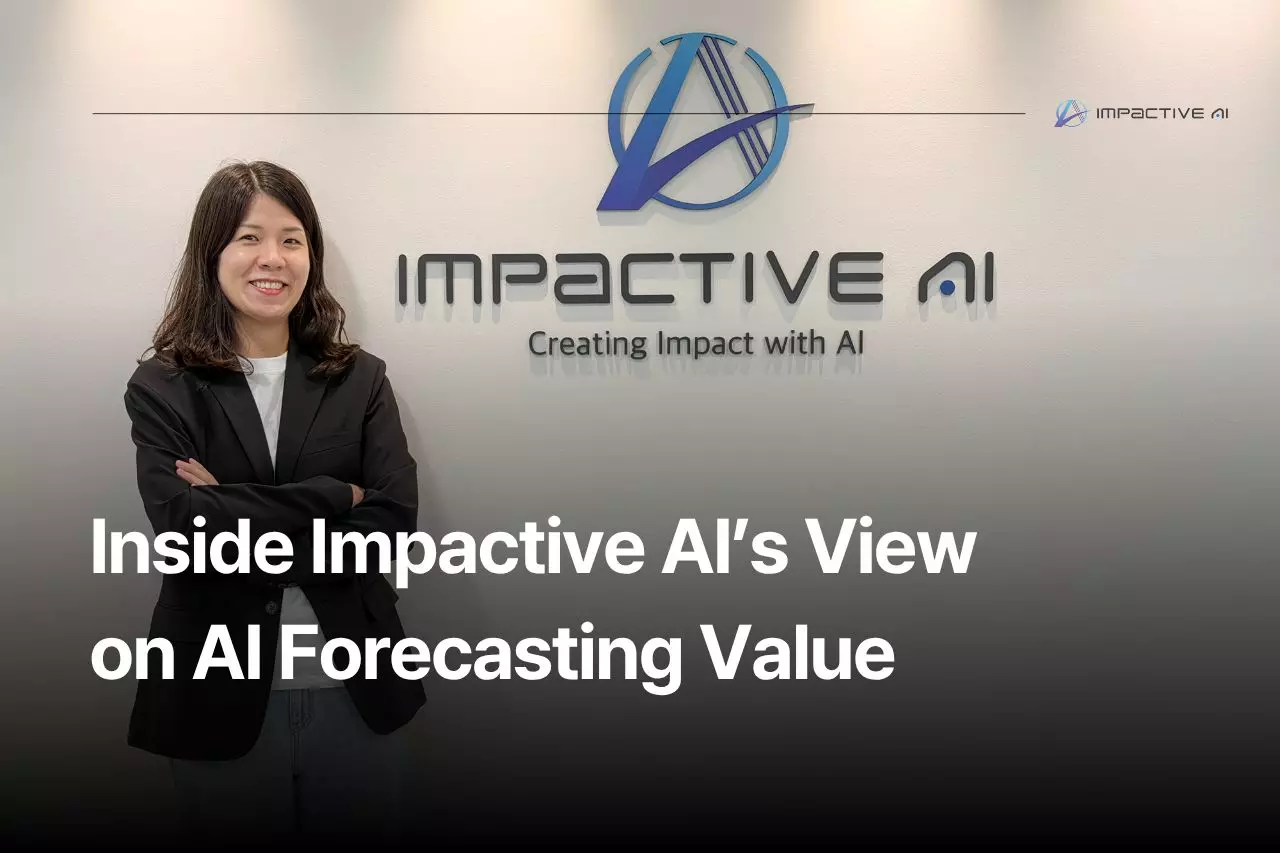

Say "AI demand forecasting" and most people picture a complex algorithm or an elaborate data model. The person who turns that technology into a real product and puts it in front of a company's teams tends to see it differently.
For this piece we sat down with a service planner at Impactive AI who majored in logistics, began a career as an IT consultant in purchasing and SCM, moved through B2B service planning in fields like healthcare and speech recognition, and then came back to the SCM domain. Through his work designing Deepflow, Impactive AI's AI demand forecasting solution, we asked what a forecast — a single number — actually means once it reaches the people running a business.
What can AI demand forecasting actually change? Beyond accuracy, it raises the speed and consistency of the sales, production, and purchasing decisions that follow. Instead of just cutting the time spent collecting and cleaning data, it surfaces the reasoning behind a forecast and the issues worth checking, so planners have time left to judge. The deeper goal is to turn work that used to depend on one person's experience into a process anyone can run the same way.
What a service planner does at Deepflow
What is your role at Impactive AI?
I've been a service planner for about six years. Right now, customers mostly adopt Deepflow for demand forecasting and raw material price forecasting. My focus is figuring out how AI can be applied so that the hard parts of a customer's workflow get solved as an IT service.
Your path so far reads a little differently from demand forecasting. What brought you into this field?
If I trace it back to the start, moving into demand forecasting was actually a natural progression. I majored in logistics in university and started my career as a consultant at a company working in purchasing and SCM. Even then, my role was to analyze a customer's workflow and, when a solution was introduced, propose how to redesign the process and where to improve it.
After that I built practical experience across B2B service planning in logistics, healthcare, and speech recognition, and eventually came back to SCM to focus on demand forecasting. Along that route, I've kept contributing to planning IT products that make enterprise customers' work more efficient.
What to look at before forecast accuracy
When you first came into demand forecasting, was there something you'd never have understood from the outside?

When people hear "demand forecasting," they all treat accuracy as the thing that matters most. Our customers do, and so do we internally. But once I was working on it from the inside, I saw that hitting the number is only as important as the workflow that picks the number up. Teams use that value to build a sales plan, set a production plan, and optimize inventory. So it really matters to look ahead to the work and the cross-team communication that follow the forecast, and to design things so the person can carry the next step through smoothly.
So what the service planning team treats as important sits somewhere other than accuracy.
Accuracy is, of course, the task we care about most. But that's the ground the data science team — our research team — digs into technically. The planning team's angle is a little different. Rather than have someone pour time into producing the forecast itself, we hand over that value and let them spend the time they save on more valuable decisions. That's the service value we're after.
What happens on the ground when an AI demand forecast misses
Could you explain, in terms a non-expert would follow, why demand forecasting matters?
The easiest way in is to picture what happens when a forecast misses. Take a seasonal product like an air conditioner. Say it's the peak of summer and we forecast sales far lower than they turn out to be, but orders come in well above the forecast. Now the shortfall has to be produced in a hurry, so the plant runs on short notice and overtime piles up. Since that line makes more than just this one product, other production schedules slip too.
It sounds like this would hit materials sourcing as well.
It does. You need materials on hand to make the product, and when something unexpected like this comes up, sourcing them takes time. On top of that, once you're the one scrambling to buy, you're in a weaker spot on price. Even if you push output as high as it will go, if you still can't meet demand, you end up with orders you took but can't fill — a stockout that costs you revenue.
Forecasting on spreadsheets and one person's experience
Plenty of teams still lean on spreadsheets and a planner's experience. How does forecasting usually work there?
With the traditional approach, you look at how the items you're responsible for have sold over time. Of all that history, the one-year cycle plays the biggest role. You check how much sold this season or in the same month last year, and if the graph shows a product picking up, you weave that trend into your read of next month's demand — all in your head. That leaves the whole thing resting on the individual planner's experience and skill.
Structurally, what problem does that lead to?
Leaning on one person is fine when that person is experienced, but the moment they aren't, it becomes a problem. If the planner is away, or their know-how isn't passed on to someone else at the same level, the company struggles to manage forecasts at an even quality. And systematically factoring in outside variables that move sales — exchange rates, oil prices, weather — is a heavy load for even a seasoned planner to carry on individual capability alone.
How Deepflow's AI demand forecasting tackles this
How does Deepflow approach the problem?
First, we focus on raising forecast accuracy through AI model research. The time-series information and past trends I mentioned are the baseline. On top of that, we collect the outside variables a planner used to only estimate in their head — exchange rates, oil prices, weather — as data and bring them into the modeling. That cuts the time spent gathering the inputs compared with doing it by hand, and it saves a lot of the time in producing the result itself.
However many forecasts you run, they only matter if they lead to "so what do I do now?" How are you designing that link?
Right. We don't stop at handing over the forecast value — we treat providing the reasoning behind it as part of the value. So we put a lot of research into content that explains why a forecast came out the way it did. Instead of a black-box AI you can't see into, we lay out "why we judged it this way" in a form the planner can use directly when they report. We keep thinking about how to take even that write-up work off their plate.
How do you provide the answer to "what do I do now"?
Based on the forecast, we work on showing the planner which issues they need to resolve right now. First you have to define what counts as an exception, and then, among those exceptions, be able to say "this one is an issue." Once the issues are narrowed down, we prioritize them and suggest what to handle first. That way the planner can manage things separately — what has to be done immediately, what isn't urgent but has some runway, and what's less important but quick to clear.
The AI Assistant, the feature practitioners find most useful
If you had to pick the single most useful feature for a practitioner, what would it be?
The AI Assistant, which is the most recent addition. For example, if we've provided this month's demand forecast and it's mid-July, it shows progress as of the moment you check — how actual results are tracking against the forecast for that period.
Are there other AI-driven features?
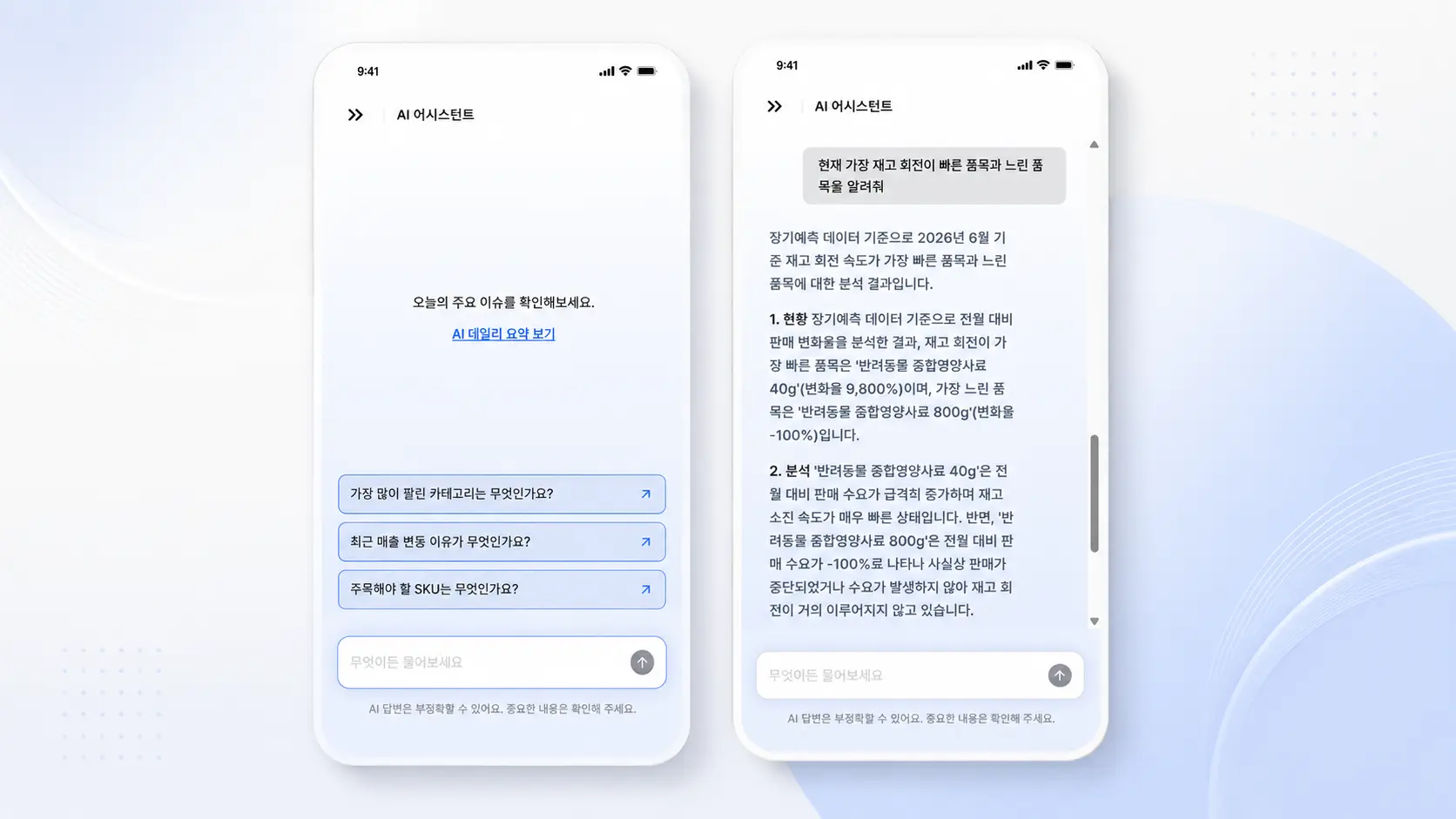
There's also related news curation. You set keywords that fit the customer, and on a schedule you set, it picks out industry trends and news worth watching and packages them in an AI summary. It's information that helps a practitioner get ahead of shifts in the market.
How work changes before and after Deepflow
Have you had feedback that the way people work changed before and after Deepflow?
Sales and inventory data usually already sits in an internal system like ERP. The problem is turning that data into a form you can actually use for forecasting. In the past, a planner spent most of their time downloading sales records, pulling them together, shaping them in a spreadsheet, and then adding their own experience to land on a forecast. There wasn't much capacity left to think about how to use the number.
Now Deepflow handles that process and attaches the reasoning behind the value, so the planner concentrates on discussing what to decide based on the result. The biggest change, I think, is that time goes into decisions and productive debate rather than into building the materials.
When you build the service, what value do you weigh most — UX, design, or features?
I put the weight on UX. If someone can use the product so naturally they barely notice any friction, I see that as the best usability. There are products you can use start to finish without once thinking "this is off." I try to build products people can use that smoothly, without even being aware of it.
The S&OP work I took on, a foundation for decisions
Which features have you worked on directly since joining?
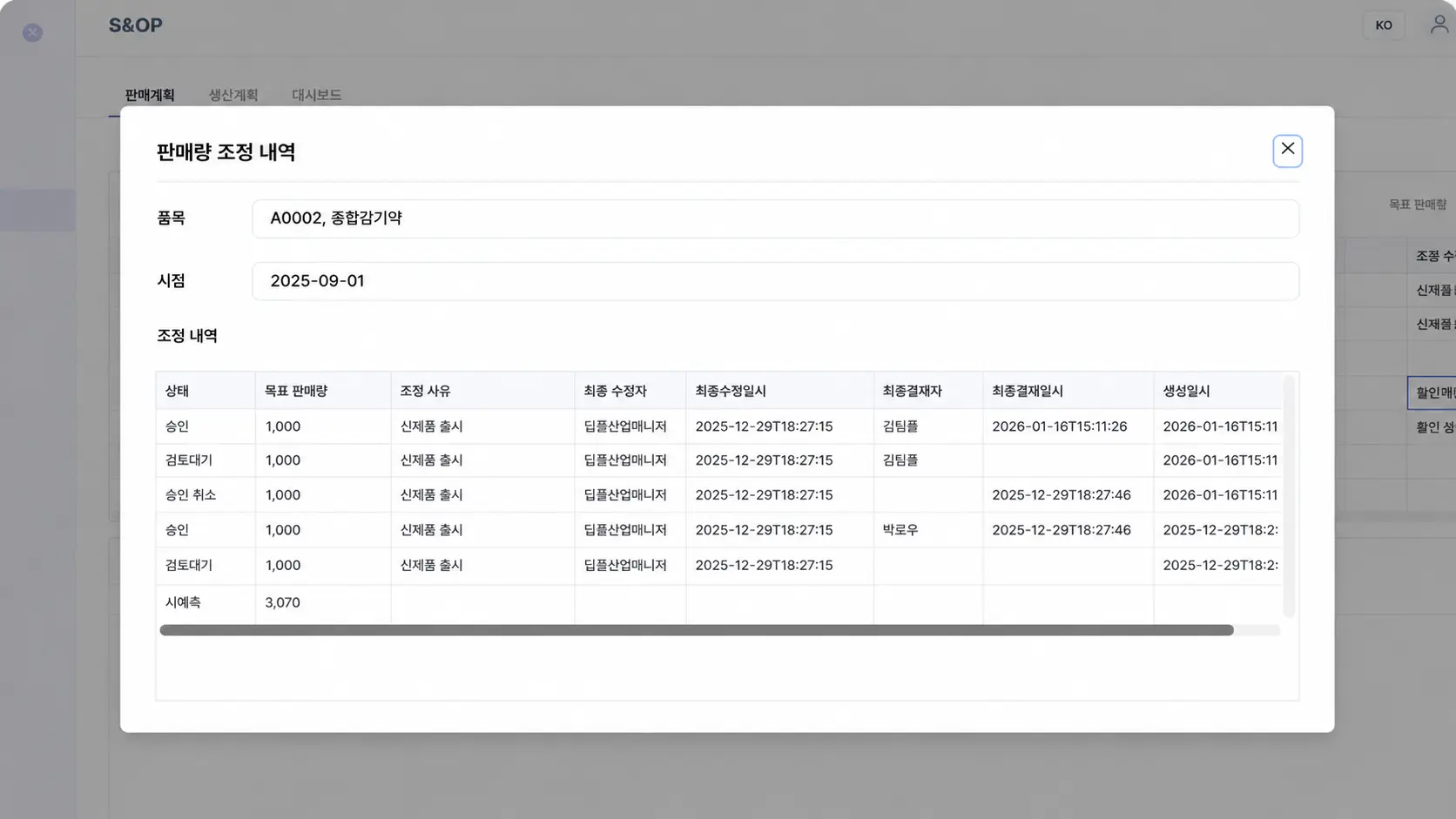
The first thing I took on was the S&OP feature, which is now in beta. It's a screen that lets a company line up its sales plan and production plan in one view — a base layer for decisions. Sales and production are geared into each other, but on the ground, departments often build their plans on different documents and different standards.
The S&OP screen sets demand forecasting by item as the reference and lets you place each department's actual plan alongside it and record it. You can see at a glance how far the forecast and the plans have drifted apart, and that gap becomes the starting point for aligning across departments.
Can you also look back on forecasts later?
Yes, you can review them. It's a feature that, for the first time, gives you the material to look back on whether we forecasted well and, if it didn't go well, to discuss how to improve. In a sense, we're preparing the raw material for that discussion.
SCM practitioners and decision-makers see different screens
Who uses Deepflow day to day?
Mainly the SCM department, along with people in sales or marketing who plan sales. People at the plant who build production or ordering plans themselves also use Deepflow a lot.
Practitioners and decision-makers want to see different things. How do you think about that gap?
A practitioner looks fairly closely at the forecast values and the numbers for individual products. A manager, on the other hand, wants materials they can take in at a glance through metrics or graphs, rather than combing through the detail. So instead of showing everyone the same screen, I think it matters to read the purpose behind the view and shape the same data to fit the role. Right now we're preparing a dashboard for executives and managers — one that lets them survey how the company is running at a glance and see what's working and what isn't.
How long does it usually take for a customer to trust the forecast results?
We plan for a PoC of roughly two to three months. Early on there's a point where we share forecast results once. We look at those together, get to know the customer better, improve the model, and show the forecast getting better a second time. Through that, the customer confirms Deepflow's forecasting performance and builds trust step by step.
Connecting AI demand forecasting and raw material price forecasting
Deepflow also provides raw material price forecasting. What does that mean for a buyer's work?
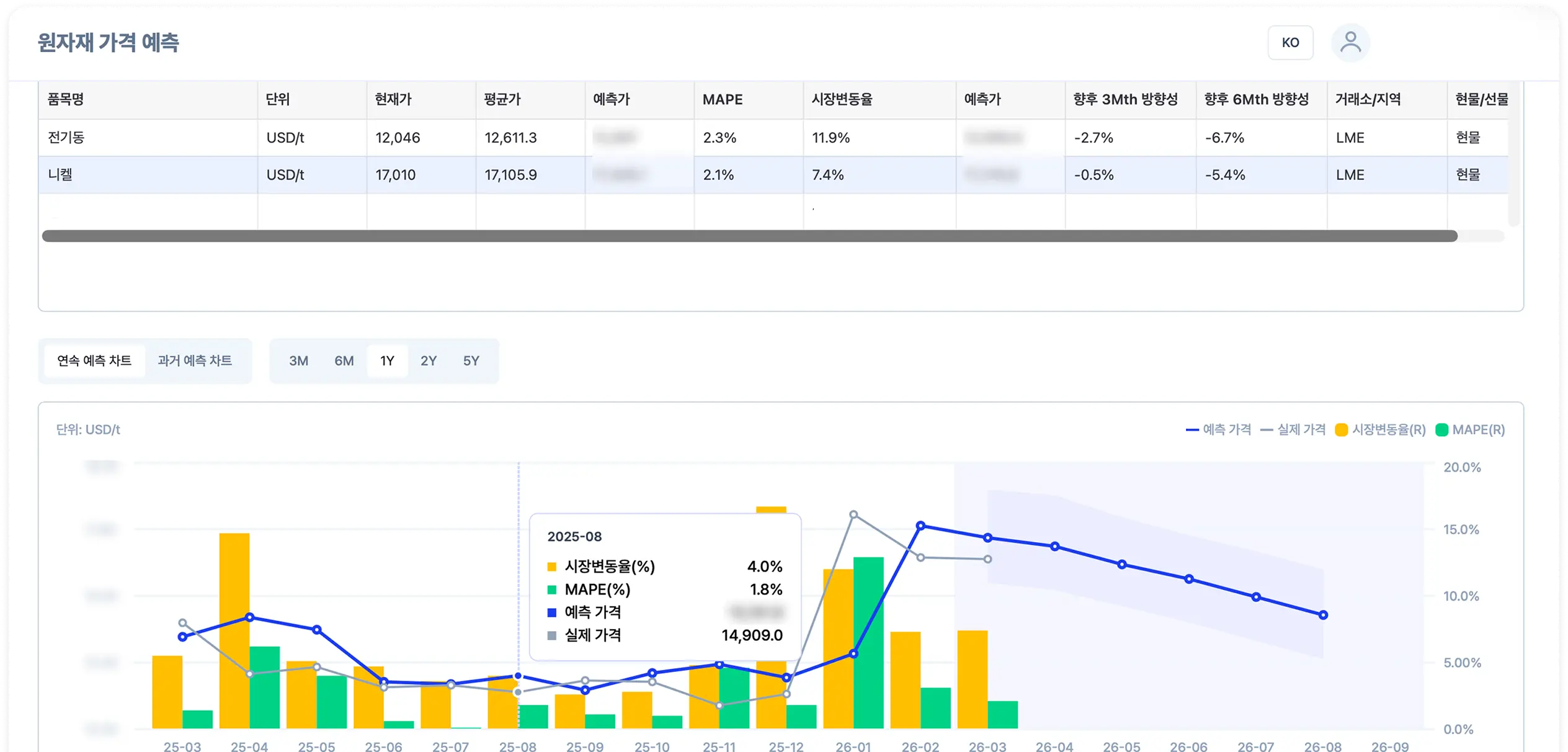
Raw material price forecasting ties into demand forecasting as one flow. A company that buys raw materials directly is always weighing when and how much to buy so it can produce most efficiently, while watching where prices are headed. The same volume costs differently depending on when you buy it, and that difference feeds straight into profitability.
It has a slightly different character from demand forecasting, but in the end it's the same in that it becomes the underlying basis for a company to sell more product and turn a profit.
When raw material prices swing sharply, what usually happens in the purchasing team?
Normally there's a purchase quantity you've planned against annual targets. But if the price spikes this month for some unexpected reason, you adjust the volume. You buy a little for now, cutting the amount, and as the price settles, you push the rest of the planned quantity back and buy it later.
The approach is to find the optimal point within several constraints — buying as cheaply as possible on the total while keeping storage costs from getting out of hand.
Is there anything you'd like to try across these two areas going forward?
Early on I mainly worked on demand forecasting, and lately I've been covering the raw material side as well, and there's a lot I'd like to improve. One of them is that the link between demand forecasting and raw material price forecasting is still weak. Beyond just showing raw material prices, we're discussing internally whether to provide a simulation of how much more it would be worth buying at a given point.
There's also room to add market intelligence — flagging news and where indicators are trending — on top of demand forecasting. There are almost no benchmark cases in Korea that connect these two areas, so taking on something rarely attempted is a topic I personally find interesting.
If that link expands, how does it help the customer?
It gives them more material to judge with. Right now demand forecasting is closer to providing a value, but once you attach raw material prices and market conditions, we can explain the reasoning too — "these factors are in play, and because of their effect we expect demand to rise or fall going forward." From the sales plan all the way to judging when to buy, more comprehensive decisions become possible.
AI demand forecasting and people, the boundary of a decision
However good a forecast AI produces, a person still has to judge. Where do you place the line between AI and people?
I don't think AI can take over everything either. AI's role goes as far as handing over good material; adding judgment on top of that material is the person's part. Above all, being accountable for that judgment is uniquely a person's domain. So even when I plan the service, we don't just show the value and stop there.
Say AI suggests around a thousand units will sell. We let the planner build and simulate their own plan near that figure. They can leave a judgment — "I see it differently" — and write down why they read it that way, and AI can help with writing that explanation too. The final call, I see as something the person makes on top of all that.
Have you ever built the case where a person corrects the AI forecast into the product design?
Yes, it's in the S&OP feature I mentioned. When Deepflow presents a forecast value, the planner doesn't have to use it as is — they can enter the number they judged right next to it in the table. And they don't just change the value; we had it set up so they also leave the reasoning for why they saw it differently. People on the ground often know context the AI couldn't capture, like a planned promotion or a situation with a specific account.
Placing both values side by side on one screen lets you look back on where the person added judgment and, in the end, which one turned out more accurate. You take the AI forecast as a starting point, but the final number and the reason for it are left to the person.
How do you close the gap between the hope that AI will just do it all and the parts that don't actually work that way?
The AI Assistant I mentioned is a good example. You can ask it anything, and when there's something AI can't do, it matters to say so clearly or offer an alternative. Being honest that we can't do absolutely everything is, I think, what builds trust instead.
Trial and error, and what a forecasting service planner needs
Given the nature of demand forecasting, is there a skill this domain asks of a planner in particular?
Understanding the customer's workflow and knowing, technically, how forecasting is done — those are the basics. But what matters more in this domain is understanding how the customer makes decisions. In the end, understanding people well is the foundation for planning this service well.
Starting from the forecast, you need the habit of finding out what conversations this planner has with other departments, what decisions they make, and what material we ought to be giving them but haven't yet.
The reward and growth in planning Deepflow
Has there been a moment that felt most rewarding while planning Deepflow?
Even when it isn't something I built with my own hands, it's when a customer actually uses a feature our company planned and it genuinely improves their workflow. Hearing that kind of feedback, the whole team feels it. When a customer says they used to be tied up in non-essential busywork while forecasting and can now focus on the work that actually matters, I think that's the moment the service's value shows most clearly.
Was there a moment you felt you'd grown a step as a planner?
As the company brings in AI, we're trying ways of working we'd never tried before. Researching alongside the team, correcting course through trial and error when we're wrong, we're reshaping how we work itself. Being able to build the capabilities the current era calls for, inside the company, has helped my own growth a great deal.
Toward explainable AI: the direction Deepflow is heading
What would you like Deepflow to become for customers going forward?
When Deepflow first launched, it started from showing forecast results and where raw material prices were headed. Now we're taking a step beyond that. We've set our direction as becoming a platform that supports a company's decisions. How do we support them? By becoming an explainable AI. That's the vision we're moving toward.
Finally, a word for the practitioners at companies struggling with demand forecasting.
I see demand forecasting less as pinning down the future exactly and more as finding good ways to respond to it — that's the more realistic direction. Rather than pouring energy into a perfect forecast, it's better in the long run to use the forecast to smooth collaboration within the company and to settle a system where the judgment doesn't hinge on one person's ability, so anyone can decide consistently and quickly.
.svg)
.svg)
.jpg)







See It for Yourself.
%201.svg)
%202.svg)


.svg)