.svg)

.svg)
%202.svg)
%201.svg)
How to Time Raw Material Purchases: A Practitioner's Guide to Procurement Intelligence

As global supply chain uncertainty intensifies, sharp swings in raw material prices are no longer one-off events — they've become a standing operational risk. Fail to secure materials when prices are low, and you're exposed to spiraling costs when they spike. Rush to buy when prices are high, and you're sitting on losses when they correct. Optimizing purchase timing is a strategic judgment call that simultaneously affects cash flow, supply chain resilience, and end-product price competitiveness. This article systematically covers the analytical techniques and strategic tools that procurement practitioners actually use in the field.
Reading Price Direction Through Macro Indicator Analysis
Before deciding when to buy, you need to understand which way the market is moving. Procurement practitioners typically rely on fundamental analysis anchored in macroeconomic indicators to read these market currents.
PPI as a Leading Indicator of Supply-Side Cost Pressure
The Producer Price Index (PPI) is a leading indicator of cost pressure on the supply side. PPI tends to move ahead of the Consumer Price Index (CPI), so when PPI for a specific commodity starts climbing, it's a strong signal that suppliers are likely to push through price increases in the near term. Procurement teams that pick up on this signal move preemptively — securing volumes or locking in long-term contract prices before the official price hike notices arrive.
The Dollar Index and Its Inverse Relationship with Commodities
The U.S. Dollar Index is another critical reference point for commodity markets. International raw material transactions are predominantly denominated in dollars. When the dollar strengthens, commodity prices tend to fall; when the dollar weakens, it's read as a bullish signal for commodities. If PPI and supply chain disruption indicators are rising simultaneously, it signals a broad-based increase in supply costs — a scenario where forward purchasing deserves serious consideration.
Once macro indicators have confirmed the market's general direction, the next step is pinpointing the specific moment to act within that trend.
Technical Analysis for Determining Entry Points
Technical analysis examines price charts and historical patterns to gauge market participant psychology and trend strength. If macro indicators tell you the direction, technical indicators help you fine-tune the exact entry point.
Moving Averages and RSI
Procurement practitioners commonly use moving averages (MA) to assess price trends. A "golden cross" — where the short-term MA crosses above the long-term MA — is interpreted as a technical signal of strengthening upward momentum and is sometimes used as an entry trigger for bulk purchases.
The Relative Strength Index (RSI) quantifies overbought and oversold conditions on a 0-to-100 scale. When RSI drops below 30, it signals an oversold zone — a cue to begin scaling into positions. When RSI pushes above 70, practitioners typically hold off on additional purchases and wait for a pullback.
MACD and Support/Resistance Levels
The Moving Average Convergence Divergence (MACD) captures trend reversals by tracking the relationship between two moving averages. When the MACD line crosses above the signal line, it suggests the downtrend is fading — many practitioners use this crossover as their trigger to initiate purchases.
Technical analysis is most effective when combined with macro indicators. When fundamentals point to rising prices and RSI simultaneously enters oversold territory, that convergence produces the highest-conviction entry signal. Cross-referencing with recurring seasonal price patterns for specific commodities adds another layer of precision to purchase timing.
Seasonal Price Patterns and Optimal Purchase Windows by Commodity
Commodity markets exhibit recurring seasonality driven by natural cycles and economic activity cycles. Understanding these patterns allows procurement teams to systematically target periods when prices are relatively depressed.
Grains, Energy, and Industrial Metals
Grains like corn and soybeans tend to hit price floors during the North American harvest season (September through November) when supply peaks. Conversely, prices typically reach their highest levels during the planting window (April through June), when uncertainty about crop yields is at its peak. Timing purchases around the harvest period can yield meaningful cost advantages.
Among energy commodities, natural gas demand concentrates around winter heating season and summer electricity generation for air conditioning. Prices tend to be relatively low during peak-demand months — July and January — while seasonal transition periods in April through June and October often see price increases.
Crude oil and gasoline purchases are commonly front-loaded early in the year ahead of the summer driving season (May through August). Industrial metals like copper tend to see temporary price corrections in April and July through August, when construction activity slows.
That said, climate change is increasingly disrupting historical seasonal patterns in unpredictable ways. Seasonal analysis works best not as a standalone framework but as a cross-validation layer alongside macro and technical indicators. Once purchase timing is reasonably established, the next step is designing the contract structure to distribute price risk.
Portfolio Procurement Strategies for Distributing Price Risk
Buying everything on the spot market or locking in 100% of volume through long-term contracts both carry extreme risk profiles. Experienced procurement professionals deploy a portfolio strategy that balances spot purchases, forward contracts, and options contracts.
The Roles of Spot, Forward, and Options Contracts
Forward contracts commit to receiving raw materials at a predetermined price on a future date. They're highly effective at locking in costs during rising markets, but forgo the benefit if market prices subsequently fall. They're primarily used for base load volumes — the fixed quantities a company consistently requires.
Options contracts involve paying a premium for the right to buy or sell at a specified price. Call options set a price ceiling — if prices rise, you can buy at the lower contracted price. Put options set a price floor, protecting the value of inventory already held. If prices move favorably, you simply don't exercise the option and trade at better spot market conditions — offering significant flexibility.
Spot buying meets immediate needs at current market prices. It's advantageous in falling markets but leaves companies exposed during sharp rallies.
The practical approach is to adjust the portfolio mix based on market conditions: when markets show overheating signals, reduce spot exposure and increase options weighting to defend the downside; when prices appear to be near a trough, increase forward contract allocation to lock in favorable rates.
Futures Hedging for Price Risk Management
Separately from physical procurement, taking an opposing position in the futures market can offset price volatility risk. Futures contracts on exchanges like the London Metal Exchange (LME) or Chicago Mercantile Exchange (CME) ensure that when spot prices rise, the gains from futures positions offset the increased cost of physical purchases. Combining futures hedging with diversified contract structures creates a risk management framework that can adapt flexibly to changing market conditions.
With the portfolio strategy and contract architecture in place, the final piece is adding technology tools that accelerate analysis and improve accuracy — completing the system.
AI-Powered Procurement Intelligence for Advanced Price Forecasting
The variables influencing raw material prices are enormously diverse — macroeconomic indicators, exchange rates, weather data, geopolitical events, and more. As these variables interact in complex ways, human-driven analysis of price patterns hits its limits. AI-powered price forecasting solutions are evolving to process these compound variables simultaneously, combining historical patterns with real-time data to deliver more sophisticated price outlooks.
ImpactiveAI's Deepflow: Commodity Price Forecasting in Practice
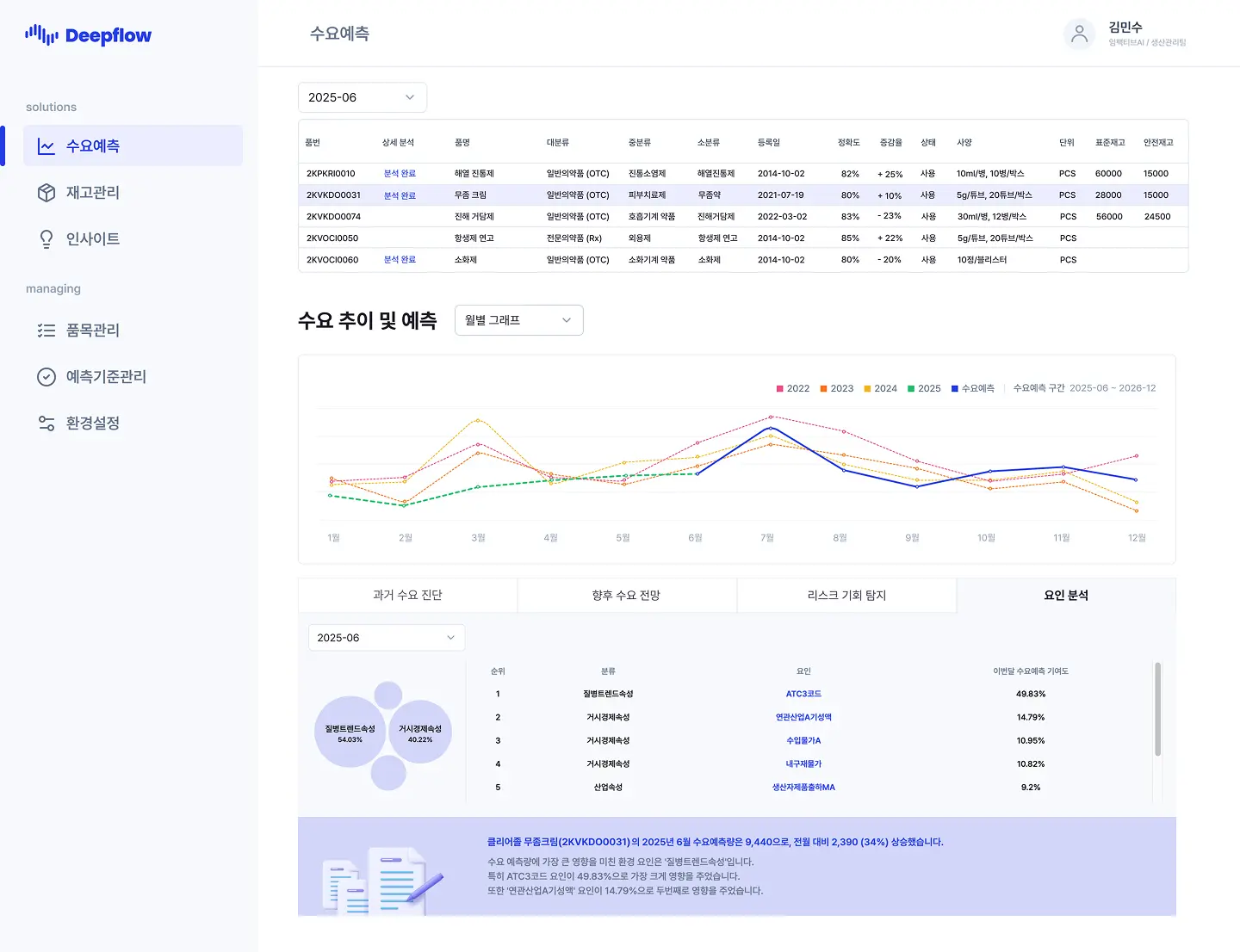
ImpactiveAI's Deepflow is a commodity price forecasting solution powered by over 224 machine learning and deep learning models and backed by 72 patents. It forecasts future prices across a wide range of commodities — minerals, agricultural products, construction materials, and more. The system comprehensively incorporates external environment variables such as exchange rates, interest rates, and global economic indicators, and its MI (Market Intelligence) dashboard enables at-a-glance monitoring of market volatility. For forex and crude oil, Deepflow also provides 3-month short-term AI forecasts, enabling procurement teams to make proactive purchase timing decisions.
Deepflow also features LLM-powered analytics reporting. It auto-generates reports analyzing historical price trends, seasonal patterns, and forward-looking demand outlook, and systematically organizes key risk and opportunity factors. The core design philosophy is to reduce the time spent on complex data interpretation and report writing, creating an environment where practitioners can focus on strategic decision-making.
In an Era of Price Volatility, Data-Driven Procurement Capability Is the Differentiator
A practitioner's ability to navigate raw material price increases can't be built on any single analytical methodology. Long-term market direction is read through macro indicators like PPI and the Dollar Index. Specific entry timing is refined through moving averages, RSI, MACD, and seasonal pattern analysis. Layer on a portfolio strategy combining spot, forward, and options contracts with futures hedging, and you've built a dual safety net for risk management.
AI-powered forecasting solutions serve as the backbone that elevates speed and accuracy across this entire framework. As data volumes grow and market complexity deepens, the limitations of procurement approaches that rely solely on intuition and experience become increasingly stark. The procurement professionals who read the market's rhythm and deploy the right tools and strategies with agility will be the ones protecting corporate profitability in an environment where price volatility is the new normal.
.svg)


.svg)









%201.svg)
%202.svg)


.svg)