.svg)

.svg)
Download Brouchure
%202.svg)
Oops! Something went wrong while submitting the form.
%201.svg)
Forecast accuracy in the food and beverage industry directly determines waste rates, inventory efficiency, and ultimately, profitability. This article examines the unique forecasting challenges facing F&B companies and walks through how AI-powered forecasting can address them, step by step.
Compared to other manufacturing sectors, demand forecasting in F&B is exceptionally difficult. Several characteristics inherent to the industry make it so.
A significant portion of F&B products — fresh foods, dairy, ready-to-eat meals — have short shelf lives. Produce more than the market demands, and you absorb spoilage losses. Produce less, and you leave revenue on the table through stockouts. The shorter the shelf life, the higher the stakes for forecast precision.
F&B companies typically manage anywhere from hundreds to thousands of SKUs simultaneously. Each item follows its own sales pattern, and demand fluctuates significantly with seasonality, weather, day of the week, and promotional activity.
Even identical products exhibit entirely different demand profiles depending on the sales channel. Hypermarkets see bulk purchases concentrated on weekends and during promotional events. Convenience stores experience peak demand for ready-to-eat items during weekday lunch hours. Online channels show strong subscription and bundle-buying patterns. Factor in supermarkets, department store food halls, and B2B accounts, and the same SKU requires a completely different forecast for each channel.
Layer in promotional variables, and complexity rises sharply. Convenience stores rotate buy-one-get-one and buy-two-get-one deals on a monthly basis. Hypermarkets run holiday gift sets, seasonal specials, and co-branded credit card discounts on a rolling schedule. These promotions generate sharp demand spikes followed by post-promotion dips, requiring forecasts that account for both the run-up and the falloff.
Consider a summer beverage product whose sales are highly sensitive to temperature. Add a convenience store BOGO promotion on top of that, and demand can jump several-fold above baseline. In an environment where channel, promotion, seasonality, and weather all interact simultaneously, generating accurate SKU-level forecasts is a tall order.
Health-oriented foods, alternative proteins, zero-calorie beverages — trends in the F&B market move fast. Historical sales data alone cannot capture emerging consumption patterns, and for new product launches, there may be no historical reference data at all.
When these characteristics converge, inventory planners at F&B companies find themselves perpetually walking a tightrope between spoilage and stockouts.
At many F&B companies, demand forecasting still relies heavily on spreadsheet-based manual processes. A planner reviews past sales performance, calculates projected demand for the coming month or quarter, applies experienced judgment, and finalizes order quantities.
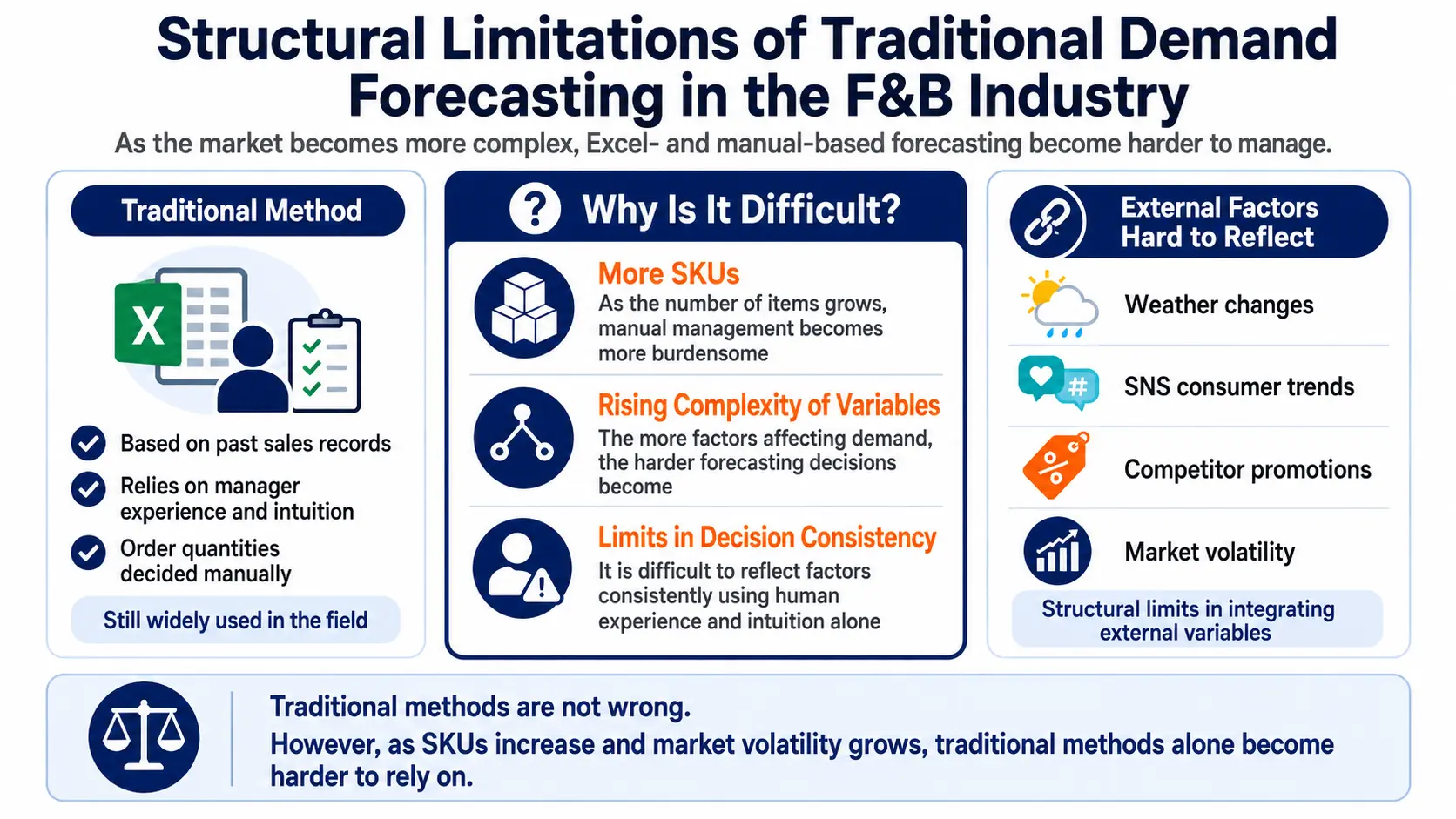
This approach has been field-tested over many years, and it works — up to a point. But as the operating environment grows more complex, its structural limitations become harder to ignore. First, manually forecasting and managing hundreds of SKUs at once runs into hard time constraints. In one documented case, a food flavoring procurement company spent 15 days each month processing purchase orders for 1,500 items — totaling roughly 180 working days per year on ordering alone.
Spreadsheets and legacy planning systems are effective at extending simple trends from historical sales data, but they were not designed to integrate external variables like weather shifts, trending products on social media, or competitor promotions in a unified way. As the number of variables influencing demand grows, maintaining consistency through human experience and intuition alone becomes increasingly difficult.
This is not to say that traditional methods are wrong. However, it is worth recognizing that as F&B markets become more volatile and product portfolios more complex, relying solely on conventional approaches leaves growing gaps.
AI-powered demand forecasting is gaining particular traction in the F&B sector because the industry's unique forecasting challenges are precisely the kind that traditional methods struggle to solve.
In most manufacturing industries, a missed forecast means excess inventory sits in a warehouse. In F&B, the consequences are different. Dairy products must sell within days; ready-to-eat items within weeks. If they don't, they're written off. Forecast error converts directly into spoilage loss.
AI can factor in each item's shelf life alongside its sell-through rate to predict days of inventory remaining. This enables more precise answers to the question: "How much of this product will sell, and by when?" The shorter the shelf life, the more critical it is to respond to demand fluctuations in near-real time — a scenario where AI's speed consistently outperforms manual judgment.
F&B products are far more directly affected by external variables than products in most other industries. A temperature increase of just one or two degrees can visibly shift sales volumes for beverages and ice cream. During monsoon season, demand for soups and hot-pot products rises.
When holiday gift sets, large-scale discount events, and convenience store BOGO promotions are layered on top, the number of variable combinations makes manual scenario planning in spreadsheets impractical. AI models learn from weather data, promotional calendars, day-of-week patterns, and seasonality simultaneously, generating differentiated forecasts at the item level even in this multi-variable environment.
The F&B market is uniquely fast-moving when it comes to consumer trends. Zero-calorie beverages, protein-enriched convenience foods, and plant-based alternatives are emerging in shorter and shorter cycles. When a recipe or ingredient goes viral on social media, related product demand can surge within days. Because these trends are not reflected in historical sales data, traditional time-series analysis alone cannot detect demand shifts early enough.
AI can incorporate real-time consumer signals — social media mention volume, search trends, consumer review data — into its forecasting models, enabling faster detection of demand spikes for trending products. For new product launches, AI can also estimate initial demand by learning from the post-launch sales trajectories of comparable products within the same category.
The accuracy of AI demand forecasting ultimately depends on what data is available and how systematically it's used. The data F&B companies can leverage falls into two broad categories: internal and external.
Internal data is the information a company already possesses. Historical sales and shipment records serve as the most fundamental input for demand forecasting. Combining these with POS (Point of Sale) data enables more granular analysis of sales patterns by store and time of day. Current inventory levels and inbound/outbound logs are essential for predicting days of inventory on hand, while promotion and discount history helps the model distinguish between organic demand and artificially driven spikes.
External data — information sourced from outside the organization — can take forecast accuracy to the next level. Weather data is particularly effective for predicting demand in weather-sensitive categories like beverages, ice cream, and soups. Consumer trend indicators such as search volume shifts and social media mention rates help detect demand surges for new or trending products early. Economic indicators like the consumer price index and income fluctuations can be used to factor in medium- to long-term consumption trends.
Many F&B companies already possess a substantial portion of this data, but it often sits siloed across departments or isn't systematically connected to any forecasting model. An AI demand forecasting system integrates these data streams into a single pipeline, automatically identifying the most influential variables for each item and incorporating them into the forecast.
Many practitioners are curious about how AI demand forecasting actually works under the hood. Before diving into algorithmic details, here's a look at the core principles.
An AI demand forecasting model learns the relationships between historical sales patterns and relevant variables to estimate future demand. The key insight is that no single model applies uniformly to every product. The best-fit model varies depending on each item's sales characteristics. Products with strong seasonality, products highly sensitive to promotions, and products with relatively stable demand each perform better under different model architectures.
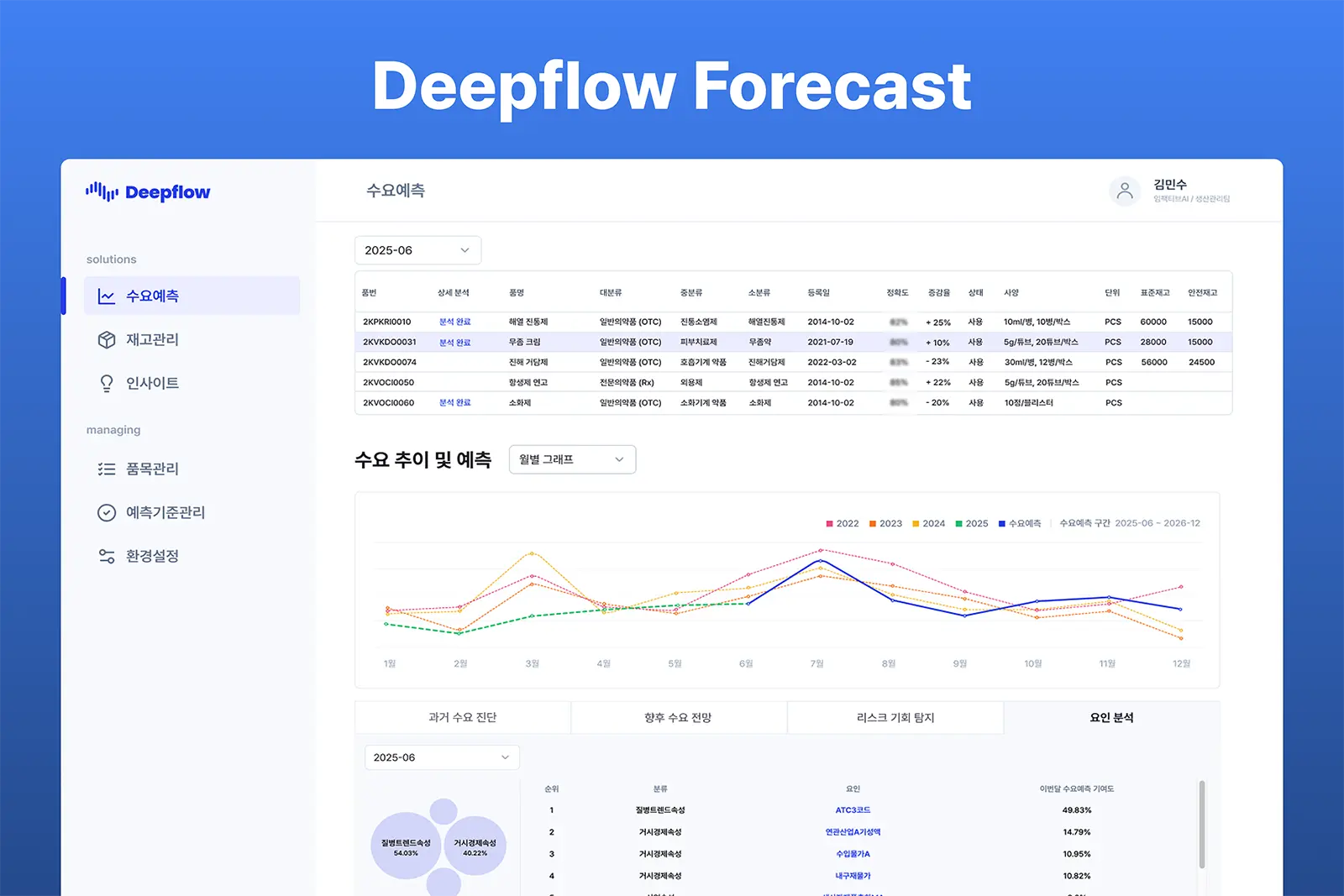
Deepflow, the AI demand forecasting platform developed by ImpactiveAI, puts these principles into practice. The platform is equipped with over 224 machine learning and deep learning models — ranging from transformer-based time-series models like iTransformer and TFT to GRU, LSTM, and TCN architectures — and holds 72 AI-related patents.
The critical differentiator is that Deepflow automatically selects and applies the most suitable model for each SKU's sales pattern. Planners don't need to choose models or tune parameters manually. The system identifies the optimal model for each item and generates the forecast accordingly.
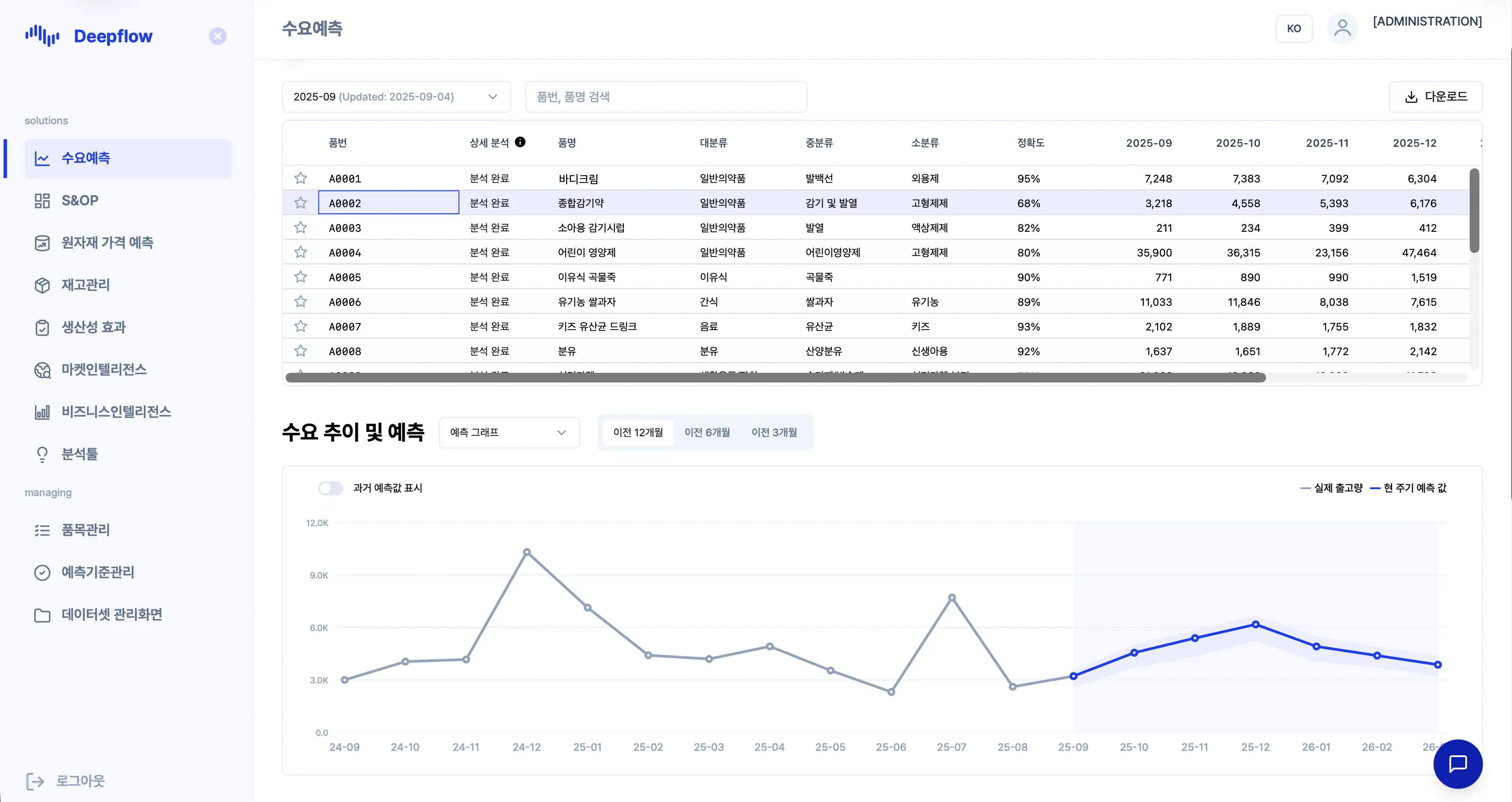
Deepflow goes beyond delivering raw forecast numbers. The platform provides a suite of features designed to let practitioners act on forecast results immediately. It predicts sales or shipment volumes at the item level over a 6- to 12-month horizon, giving a clear view of future demand trends. Integration with base inventory data enables days-of-stock management.
An LLM-powered analytics reporting feature generates in-depth analysis of forecast outputs along with department-specific action plans for sales, marketing, and supply chain teams. This reduces the time planners spend on data interpretation and report writing, freeing them to focus on strategic decision-making.
A BI (Business Intelligence) dashboard provides at-a-glance visibility into SKUs projected to face shortages or excess inventory, along with automatically calculated optimal production volumes that reflect anticipated sales changes. Practitioners can assess the current situation immediately through visualized data without any additional formatting work.
New product demand forecasting is an especially critical capability for F&B companies. Even for new products with no historical data, Deepflow learns from the post-launch sales patterns of comparable products in the same category to pre-forecast first-quarter sales volume after launch. The system can also identify product profiles with a high probability of becoming hits. This contributes to better decision-making quality during the product planning stage.
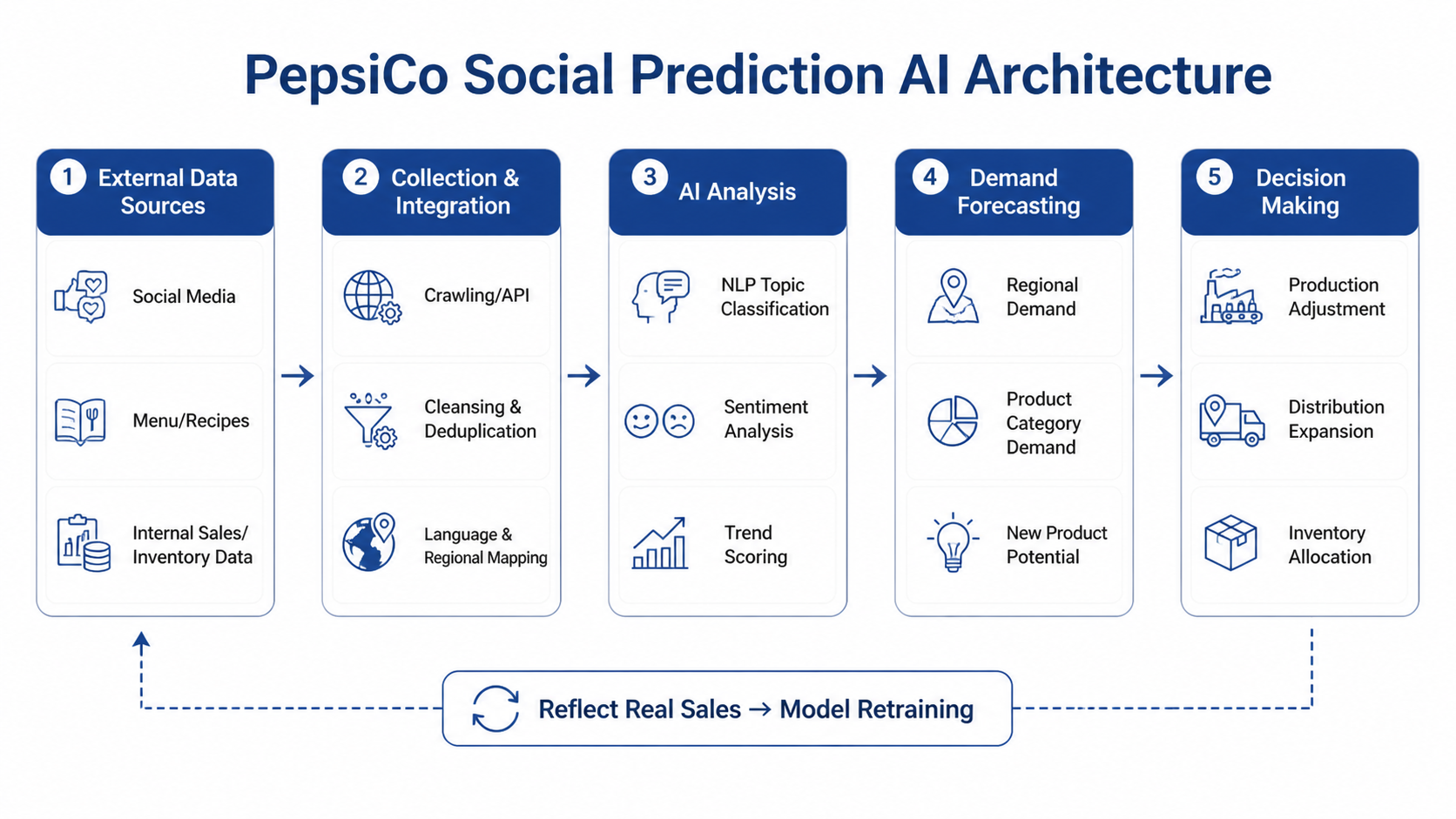
AI is more than a simple forecasting model — it serves as a tool for capturing early demand signals by synthesizing purchase history, channel orders, social media responses, and promotional impact. This enables companies to scale up production for categories where demand is expected to grow — such as plant-based products, fresh foods, and personalized nutrition — while adjusting operations to reduce inventory and waste.
In other words, AI doesn't just predict "how much will sell." It reads "where, which products, and when demand will increase," connecting those insights directly to production and logistics decisions.
Global F&B players are already incorporating social data and consumer sentiment into their demand forecasting. PepsiCo, for example, is known to analyze weather, events, social trends, and consumer behavior data as part of its AI-driven forecasting process to anticipate demand changes.
Social data-based analysis can capture consumer interest faster and more broadly than traditional surveys or market research. This makes it especially valuable in F&B categories where trends are short-lived and shifts happen quickly.
These types of models typically supplement standard time-series forecasting with text-based demand indicators as additional features — variables like the rate of increase in social mentions, sentiment scores, regional concentration of specific keywords, and the frequency of recipe or menu appearances.
The goal is to read trends early and proactively scale production and distribution. PepsiCo uses this approach to gauge new product potential early on and make allocation decisions for specific regions and channels.
F&B companies that adopt AI-powered demand forecasting can expect measurable improvements across four key areas.
Higher forecast accuracy means less overproduction-driven spoilage and fewer stockouts from underproduction. For F&B products with short shelf lives, this effect is especially pronounced.
Ildong Foodis, after implementing Deepflow, achieved a reduction in inventory risk of over 26% — demonstrating that AI-driven forecasting can deliver meaningful results in real-world F&B operations.
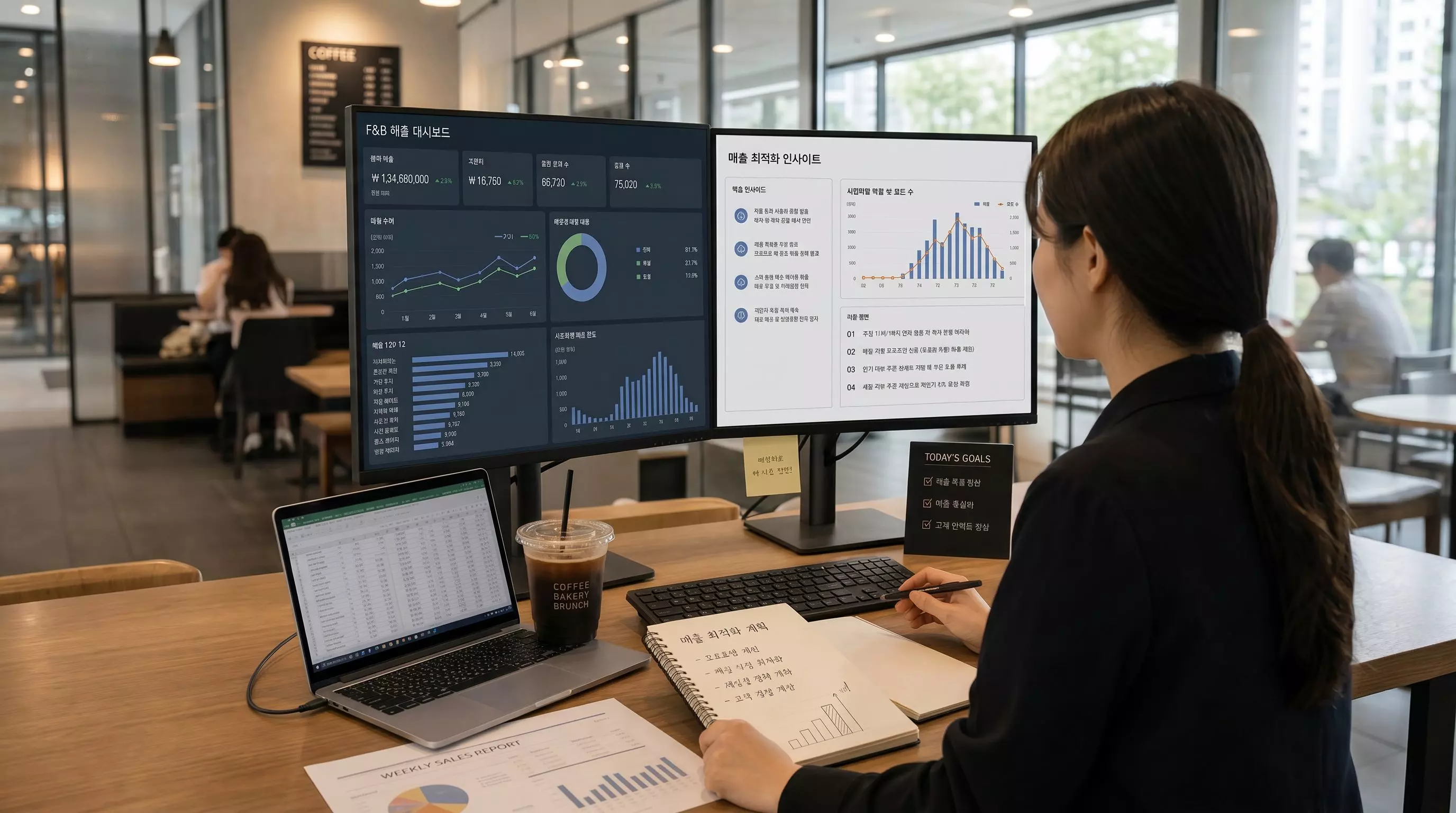
When an AI system automates forecast generation and drafts initial purchase orders, the burden of repetitive work on planning teams drops significantly. One food flavoring procurement company previously spent 15 days each month processing orders for 1,500 items. After deploying Deepflow, initial order drafts were generated automatically within 7 minutes — a dramatic improvement in workflow efficiency.
Month-over-month comparisons also showed the AI model outperforming the existing planner-driven forecasts across all metrics, with model accuracy trending upward each month — creating a virtuous cycle of continuously improving performance.
Demand forecasting is the starting point for S&OP (Sales and Operations Planning), the process through which sales, production, and procurement teams align around a shared set of numbers. When AI-generated forecasts serve as the baseline data for S&OP, narrowing the gap between departmental perspectives and reaching data-driven consensus becomes significantly easier.
Deepflow's LLM-powered analytics reports organize key risks and opportunities by department, making them directly usable as reference material in S&OP meetings.
Inventory reduction leads to lower warehousing costs, reduced waste disposal expenses, and fewer emergency orders — all of which contribute directly to improving an F&B company's cost structure.
If you're evaluating AI demand forecasting, it's worth reviewing the following considerations before getting started.
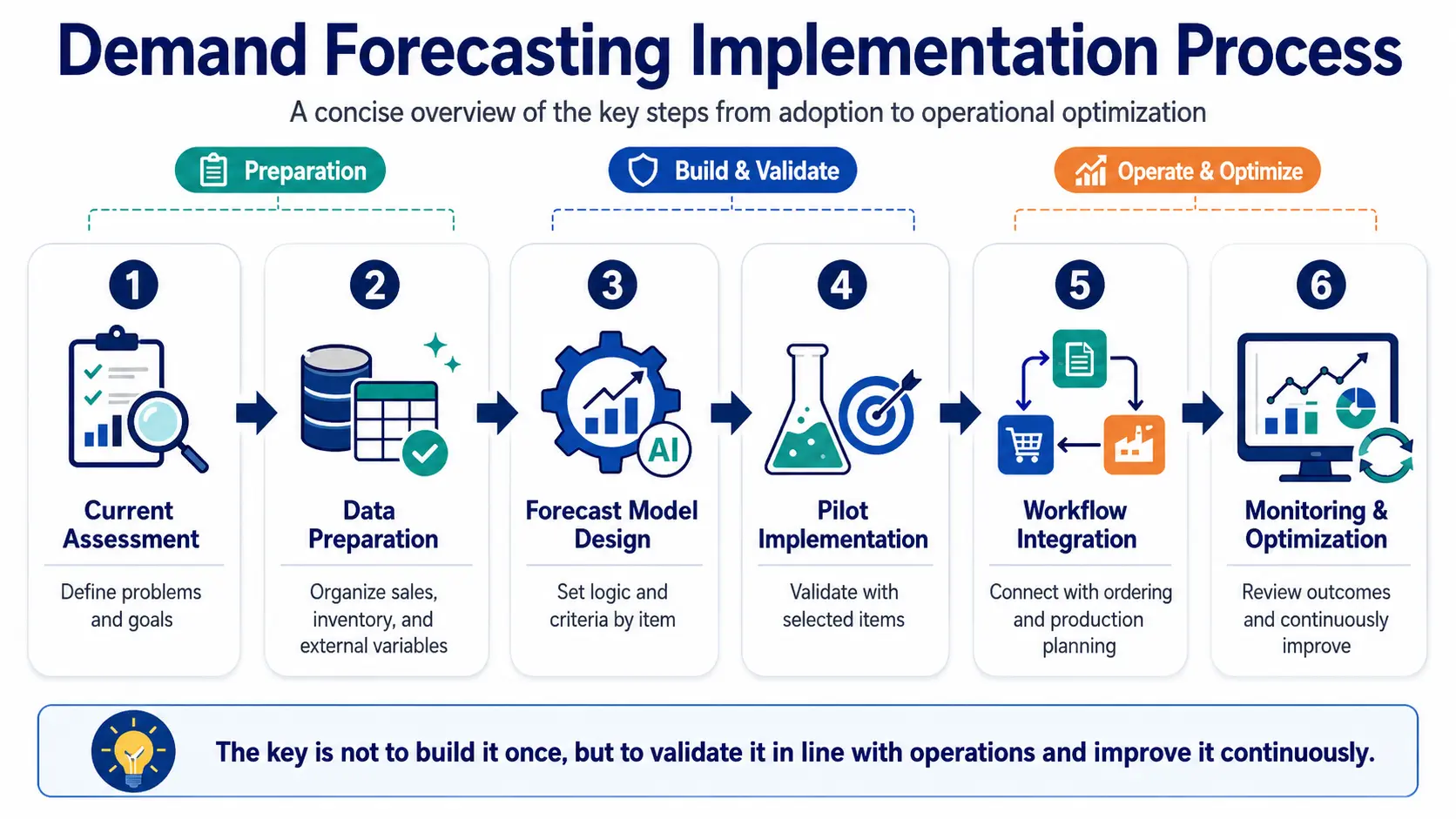
The first thing to assess is your data readiness. AI models learn from data, so you'll need to confirm that at least one to two years of historical sales or shipment data is available. Quality matters as much as quantity. Excessive missing values or inconsistent item codes can impair model training. Performing basic data cleansing up front will maximize the impact of your deployment.
Second, consider your cross-functional collaboration structure. Demand forecasting affects sales, production, procurement, and logistics. It delivers the greatest value when it serves as a shared decision-making foundation across departments rather than a tool owned by a single team. Getting buy-in and building alignment among relevant stakeholders from the outset is critical. If an S&OP process is already in place, integrating AI forecasts becomes significantly smoother.
Third, evaluate system integration feasibility. Understanding how your current ERP, order management, and production management systems will connect with the AI forecasting solution will streamline the deployment process. Since integration scope varies by company, it's best to address specifics during the pre-deployment consultation phase.
Fourth, define your rollout scope. Rather than going enterprise-wide from day one, selecting a specific product category to validate results before scaling incrementally is a more practical approach. In practice, many companies start with items that are hardest to forecast or carry the highest spoilage risk. This allows you to demonstrate results quickly and build organizational trust in AI forecasting over time.
Forecast accuracy depends on item characteristics, data quality, and the degree of external variable influence. Companies using Deepflow have reported accuracy levels (measured as 100 minus MAPE) ranging from the high 70s to the low 90s depending on the industry, with accuracy improving incrementally as more data is accumulated.
Yes. AI models learn from the post-launch sales patterns of comparable products within the same category to estimate initial sales volumes for new items. Deepflow provides functionality to pre-forecast first-quarter sales after launch during the product planning stage and to identify product profiles most likely to succeed.
Typically, forecast improvements become visible within one to three months. After six months or more, the cumulative learning effect produces more stable and reliable predictions. Timelines may vary depending on the company's data environment and rollout scope.
No. AI demand forecasting solutions are not designed to replace existing systems. They function as a layer that provides forecast intelligence and decision support on top of your current infrastructure. Deepflow can run alongside existing ERP or spreadsheet-based workflows without requiring system replacement.
AI demand forecasting delivers the most visible impact at companies with large SKU counts and high demand volatility. However, by scoping the deployment to specific product categories, even small and mid-sized F&B companies can benefit. What matters more than company size is the quality and historical depth of data for the items being forecast.
The competitive landscape in F&B is growing more complex by the year. Consumer preferences shift rapidly. Raw material price volatility is increasing. And ESG-driven expectations around waste reduction continue to rise. In this environment, precise, data-driven demand forecasting is no longer a nice-to-have — it's becoming a core competitive advantage.
ImpactiveAI's Deepflow has been validated across a range of industries including semiconductors, apparel, pharmaceuticals, and building materials, and is now delivering measurable inventory risk reduction and operational efficiency gains in the food industry as well. If you're looking to explore how AI demand forecasting could work for your business, we recommend reaching out to the Deepflow team for a tailored assessment.
.svg)

.svg)
.svg)




%201.svg)
%202.svg)


