.svg)

.svg)
Download Brouchure
%202.svg)
Oops! Something went wrong while submitting the form.
%201.svg)
Convenience stores and hypermarkets carry anywhere from thousands to tens of thousands of products. What retail companies really need to get right isn't just predicting sales volume — it's deciding which products to place in which stores, and in what quantities. Where manufacturing demand forecasting centers on production planning, retail demand forecasting focuses on allocating products and inventory to the locations where they're needed most. This distinction drives critical decisions on the ground.
Add online channels into the mix, and the complexity rises by an entire order of magnitude. This article examines what makes retail demand forecasting fundamentally different from other industries and how AI technology addresses that complexity from a practical, operational standpoint.
The difficulty of retail demand forecasting goes beyond answering "how much will sell." It stems from the need to simultaneously determine which store, through which channel, and at what point in time a product will sell. Even identical items exhibit entirely different demand depending on location and timing, so a nationwide aggregate forecast cannot fill the shelves of an individual store.
Demand forecasting at retail companies is typically performed by the merchandising team at headquarters. The standard workflow involves analyzing national sales data, building an order plan, and then distributing allocations to individual stores. The problem is that a significant gap exists between the national averages visible to HQ and the demand each store actually experiences.
A store in an office district sees high turnover for office supplies and convenience items during the lunch hour, while a store in a residential area sees sales of detergent and baby products concentrated on weekends. Capturing these micro-level differences from macro-level HQ data alone is, realistically, very difficult.
The result is a recurring pattern where some items at a given store are understocked and others are overstocked relative to what headquarters allocated.
In retail, promotions are the single most disruptive variable to demand patterns. Year-end mega sales, holiday specials, buy-one-get-one deals, co-branded credit card discounts — promotions of varying scale run nearly every week across the retail landscape.
The challenge is that the impact of promotions on demand is not a simple proportional relationship. The same 20% discount produces different demand responses depending on whether it runs on a weekday or weekend, whether it's a standalone event or coincides with a competitor's promotion, and whether it falls at the beginning or the end of a season.
Moreover, whether the demand generated during a promotion represents pulled-forward purchases or genuinely new demand completely changes the post-promotion inventory strategy. Generalizing these complex dynamics from just a handful of past promotional events is extremely difficult.
In the era of brick-and-mortar-only retail, demand occurred within physical spaces. Today, demand for the same inventory pool arises simultaneously across owned e-commerce sites, open marketplaces, quick commerce, live commerce, and more. When a single influencer review goes live on one channel, online orders for that product can surge within hours — and that volume can eat into the inventory allocated to physical stores.
If inventory pools are fully separated by channel, the result is stockouts on one side and excess on the other. If a unified inventory pool is used instead, a new challenge emerges: responding to cross-channel demand conflicts in real time. The omnichannel environment has fundamentally changed the dimensionality of demand forecasting.
The forecasting approach that has long been standard in retail combines statistical models that extend historical sales trends with manual adjustments based on the ordering team's experience. This method has functioned adequately in relatively stable demand environments, but as retail complexity increases, its structural limitations are surfacing more frequently.
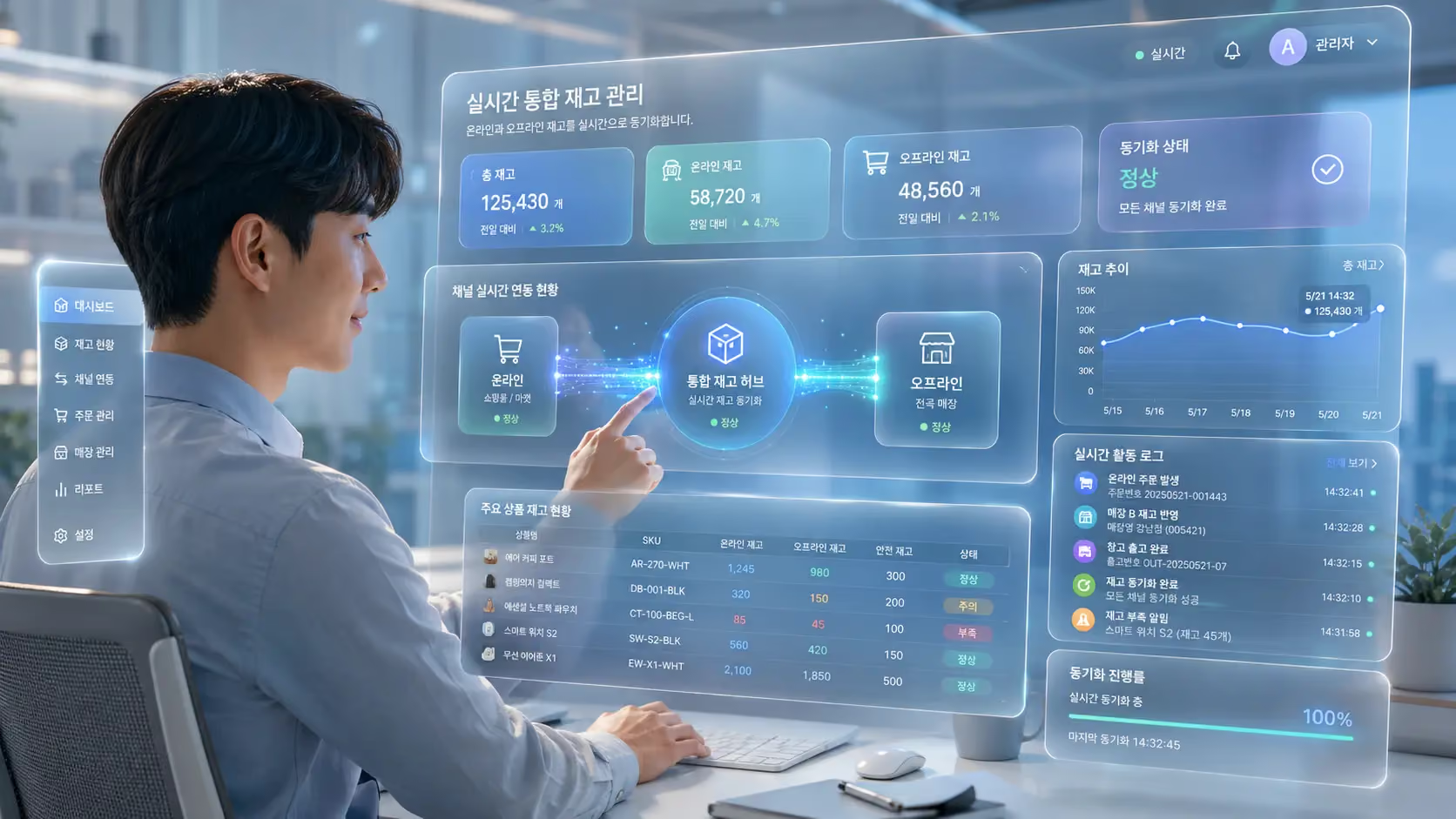
The most fundamental issue is that the unit of forecasting and the unit of execution don't match. Traditional time-series models are effective for aggregate-level forecasting where patterns are relatively stable, but they can struggle to capture the variability at the daily, SKU-level, and store-level granularity that retail operations actually require. To bridge this gap, ordering staff often perform manual corrections — but adjusting forecast values one by one for tens of thousands of SKUs while factoring in weather, local events, and promotional effects is an enormous operational burden.
The downstream impact of these manual adjustments also warrants attention. When a store requests a larger safety buffer out of stockout concerns, the distribution center tries to secure more volume to match, which in turn can trigger over-ordering from suppliers. This amplification of small forecast errors at the retail level as they propagate upstream through the supply chain creates unnecessary inventory costs and working capital pressure.
It's also worth noting that legacy systems may face structural limitations when it comes to integrating external variables comprehensively. A sudden temperature spike drives demand surges for sunscreen and dehumidifiers; a competitor launching a large-scale discount event can reduce foot traffic at your own stores. The external variables that influence retail demand are numerous and diverse, but incorporating them consistently within a traditional forecasting framework involves significant technical complexity.
The value of AI in retail demand forecasting isn't limited to "delivering a more accurate number." It lies in AI's ability to handle the inherent complexity of retail — the need to manage demand simultaneously across three dimensions: space, time, and channel.
No matter how accurate a national average is, it doesn't help fill the shelves of an individual store. AI models learn from each store's sales history, trade area characteristics, foot traffic patterns, and local competitive landscape to estimate demand at the store level.
How many tumblers and laptop accessories will sell on a Monday at a store near a university campus, versus how many camping gear and home décor items will sell on a weekend at a store in a new residential development — these are entirely different problems. AI can analyze these differences automatically across massive store-SKU combinations. This is a scale problem that no human team can solve by inspecting stores one by one.
Weekly or monthly planning cycles make it difficult to respond to situations like a demand spike immediately after a promotion launch, a sudden cold snap driving up sales of hand warmers and electric blankets, or a flood of orders after a product goes viral on social media.
AI models can periodically recalibrate forecasts by incorporating recent changes in sell-through velocity, depending on the data integration cadence. Minimizing the lag between when a plan is set and when it's executed is one of the most tangible differences AI delivers in retail.
Online demand and offline demand are not independent phenomena. When a major discount launches on the owned e-commerce site, online orders can surge while physical store visits decline. Conversely, a store-exclusive event can drive increased search volume online.
AI learns from sales data across channels holistically, structurally understanding how a demand shift in one channel affects others. This enables more sophisticated decision-making around cross-channel inventory allocation.
Retail companies generate massive volumes of data every day through their stores and online channels. The performance of AI demand forecasting depends heavily on how systematically this data is connected to the model.
A retail company's most powerful asset is store-level POS transaction data — a daily record of which products sold at which stores, at what times, and at what prices.
Layered on top of this are online channel order and cart conversion histories, real-time inventory levels by store and distribution center, promotional calendars with discount rate histories, and return and exchange logs. Together, these form the foundation for learning historical demand patterns.
Promotional data is particularly critical in retail, more so than in most other industries. Because demand responses vary based on the granular details of each promotion — event type, discount depth, duration, applicable channels, and whether concurrent promotions are running — the more structured this information is, the better the forecasting model performs.
Internal data alone can support baseline forecasting, but incorporating external environmental information helps sharpen precision further.
Regional weather data is valuable for predicting demand in weather-sensitive categories such as sunscreen, umbrellas, dehumidifiers, and hand warmers. Local event schedules and public holiday calendars help anticipate demand spikes tied to specific periods.
Changes in a store's surrounding trade area are another external data point uniquely important in retail forecasting. A large apartment complex opening nearby, a new competitor store entering the area, or increased office vacancy due to building renovations can all have medium- to long-term effects on a store's demand profile.
Macroeconomic indicators can also serve as indirect reference points for gauging shifts in consumer sentiment.
Retail companies already possess substantial volumes of data. However, POS data sits in store operations systems, online data lives in e-commerce platforms, and logistics data resides in the WMS — each in isolation. Without integrating these into a single forecasting model, the full potential of the data goes untapped.
An AI demand forecasting system consolidates these fragmented data streams into a unified pipeline, automatically identifying the most influential variables for each item and incorporating them into the forecast.
Understanding that AI demand forecasting is conceptually necessary is one thing. Making it work in a live retail environment is an entirely different challenge. Forecasting tens of thousands of SKUs across hundreds of stores simultaneously requires not just model accuracy but a system architecture capable of handling operational scale.
AI demand forecasting models learn recurring patterns from historical sales data and identify relationships with external variables to estimate future demand. Rather than applying the same model uniformly to every item, selecting the most suitable model based on each item's characteristics is what determines accuracy.
Products with strong seasonality, products that react sharply to promotions, and long-tail items with intermittent sales each perform better under different model types. Advanced architectures like TFT (Temporal Fusion Transformer) can also be used to interpret the influence of key variables in the forecasting process, enabling practitioners to understand the rationale behind a given prediction.
Deepflow, the AI demand forecasting platform developed by ImpactiveAI, is equipped with over 224 ML/DL models — from transformer-based time-series architectures like iTransformer and TFT to GRU, LSTM, and TCN — and holds 72 filed and registered AI-related patents.
What sets Deepflow's approach apart is automatic model matching at the SKU level. The system analyzes sales patterns for each of tens of thousands of items and automatically selects and applies the model with the highest fit. Ordering teams don't need to choose models or tune parameters manually — the system handles the scale problem through technology.
Deepflow delivers AI-powered demand forecasting in retail environments where high SKU diversity and rapidly shifting consumer trends coexist. Companies that have deployed the platform have reduced dead stock and stockout risk on the strength of improved forecast accuracy, with some achieving average improvements of over 30% across key operational metrics.
In trend-sensitive fashion, for example, Deepflow has helped companies predict shifts in target customer demand and product lifecycle trajectories, meaningfully reducing end-of-season surplus inventory. On D2C platforms managing thousands of SKUs, daily and weekly multi-channel precision forecasting has prevented stockouts of core products and reduced customer churn. In the furniture industry, where large product dimensions make storage risk a significant concern, the platform has helped prevent unnecessary overproduction, improving warehouse space efficiency and reducing logistics costs.
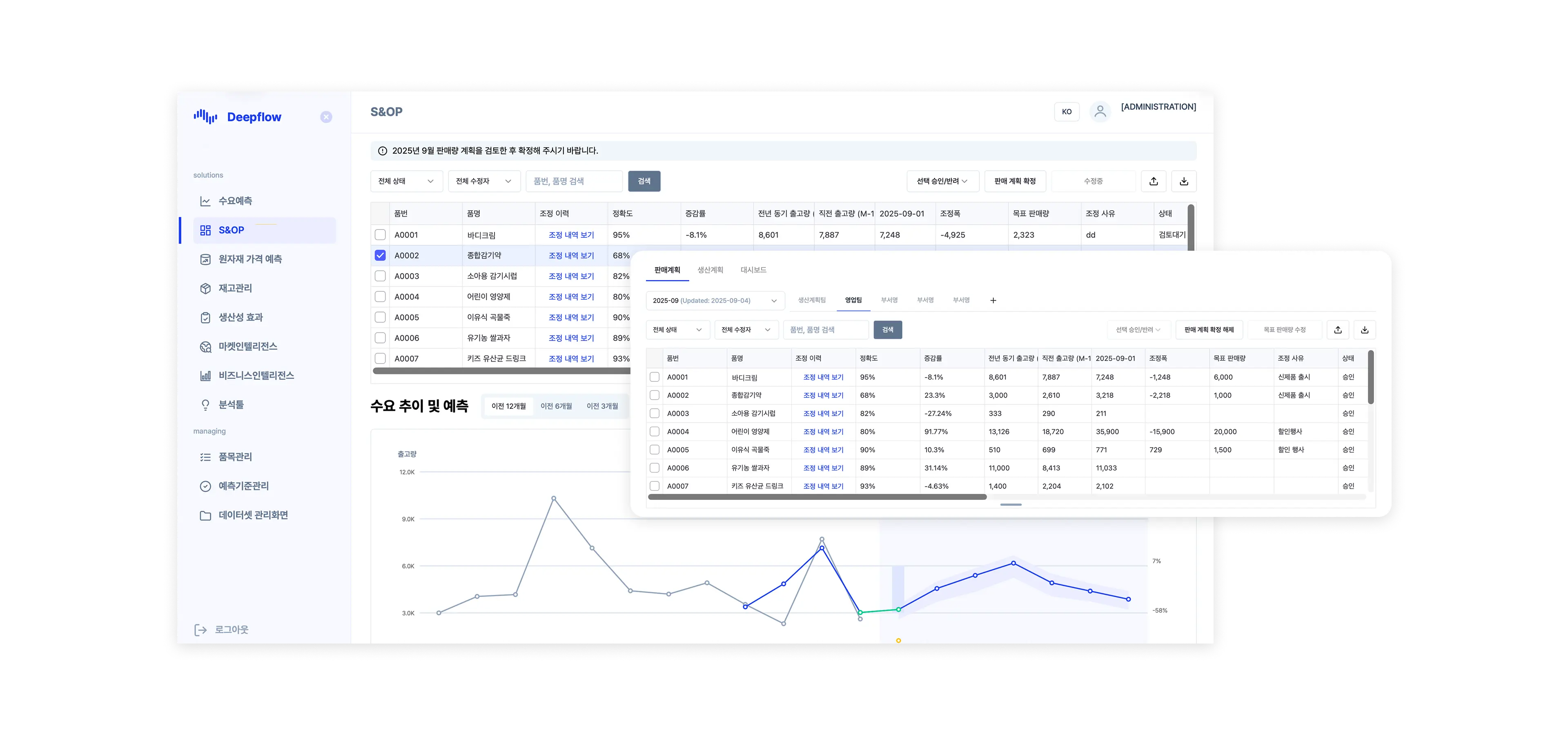
Deepflow provides item-level sales and shipment volume forecasts over a 6- to 12-month horizon. This enables retail companies to understand medium- to long-term demand flows across online and offline channels and to build channel-specific inventory allocation strategies grounded in data. An MI (Market Intelligence) dashboard also allows monitoring of external variables such as exchange rates, interest rates, and raw material prices — serving as a valuable procurement decision reference for retailers with a high share of imported goods.
Retail companies that adopt AI-powered demand forecasting can expect operational efficiency improvements across several areas. That said, specific outcomes will vary depending on each company's data environment, SKU mix, and channel structure, so the following should be considered as general expected benefits.
The ultimate goal of demand forecasting is ensuring customers can buy what they came for. When store-level precision forecasting becomes possible, inventory is allocated based on each store's actual demand, reducing the frequency of stockouts.
Over-ordering out of stockout concerns increases warehousing costs and locks up working capital. As AI forecast accuracy improves, safety stock levels can be set more rationally, lowering the cost burden of excess inventory. This is especially impactful for highly seasonal items, which face steep markdowns or disposal costs once the season passes.
Stockouts during a promotion undercut the event's effectiveness; large volumes of unsold inventory afterward erode margins. When an AI model learns demand response patterns by promotion type, it can calculate more precise event volumes — reducing risk at both extremes simultaneously.
When AI forecast values serve as the baseline for ordering, the coordination process between HQ merchandisers and store managers is streamlined. Discussions around "why was this quantity sent" or "why is this quantity short" shift from gut feel to data, reducing inter-organizational communication costs and accelerating decision-making.
When evaluating an AI demand forecasting solution, reviewing the following items in advance will make the deployment process significantly smoother.
global.avif)
Data integration maturity is the first item to assess. Confirm whether store-level POS data is consolidated into a single system and whether online and offline channel sales data is managed under consistent standards. If each store runs a different POS setup, data cleansing and standardization must come before feeding anything into an AI model. At least two to three years of historical sales data is recommended for stable model training.
Inventory data connectivity between online and offline channels is a particularly important checkpoint for retail companies. If cross-channel inventory is synchronized in real time, the benefits of omnichannel integrated forecasting are maximized. If it's not, understanding the feasible level of integration ahead of time is worthwhile.
The level of structure in promotional data also deserves scrutiny. The more systematically promotion details — event type, discount rate, duration, applicable channels — are recorded, the more accurately the AI model can learn promotional effects. If this information exists only in individual planners' memories or scattered files, investing in data structuring alongside the deployment will improve outcomes.
Integration with the existing ordering process should also be designed in advance. AI demand forecasting solutions don't replace existing systems — they function as a decision-support layer on top of current operations. Leveraging ERP or other core systems is one approach, but the key is ensuring that AI-generated forecasts flow naturally into actual order execution.
Finally, defining a phased rollout scope is the most practical approach. Rather than a full-scale enterprise-wide launch, selecting high-difficulty categories or high-stockout-risk flagship stores for a pilot, validating results, and then expanding incrementally is operationally sound.
Yes. AI models learn from each store's sales history and trade area characteristics to generate store-level forecasts. Deepflow automatically applies optimized models at the SKU and store level, supporting granular nationwide forecasting.
The model learns from event types, discount rates, timing, and demand responses from similar past promotions to reflect demand fluctuations when a new promotion is planned. Pre-loading the promotional calendar enables forecasts that account for demand patterns before, during, and after each event.
When sales data across channels is consolidated for training, integrated forecasting that captures cross-channel demand shifts becomes possible. The higher the level of cross-channel inventory data integration, the greater the forecast accuracy.
No. AI demand forecasting solutions don't replace existing systems — they provide forecast outputs and actionable insights on top of your current operating environment. You can start by using AI forecasts as reference information alongside your existing ordering process.
Starting with categories that have high demand volatility or significant stockout risk is the fastest path to demonstrating results. In practice, many companies select product groups with frequent promotions or categories where demand variance across stores is large as their pilot scope.
The optimal approach to retail demand forecasting varies depending on a company's store count, channel structure, and SKU scale. Deepflow builds store-level and channel-level forecasting environments tailored to each company's data characteristics through customized AI modeling.
If you'd like to see what level of forecasting is achievable with your company's data, reach out through the link to request a PoC consultation.
➡️ Apply for free PoC for demand forecasting
.svg)

.svg)
.svg)






%201.svg)
%202.svg)


