.svg)

.svg)
%202.svg)
%201.svg)
Out-of-Stock Prevention: The Process That Stops Customer Churn
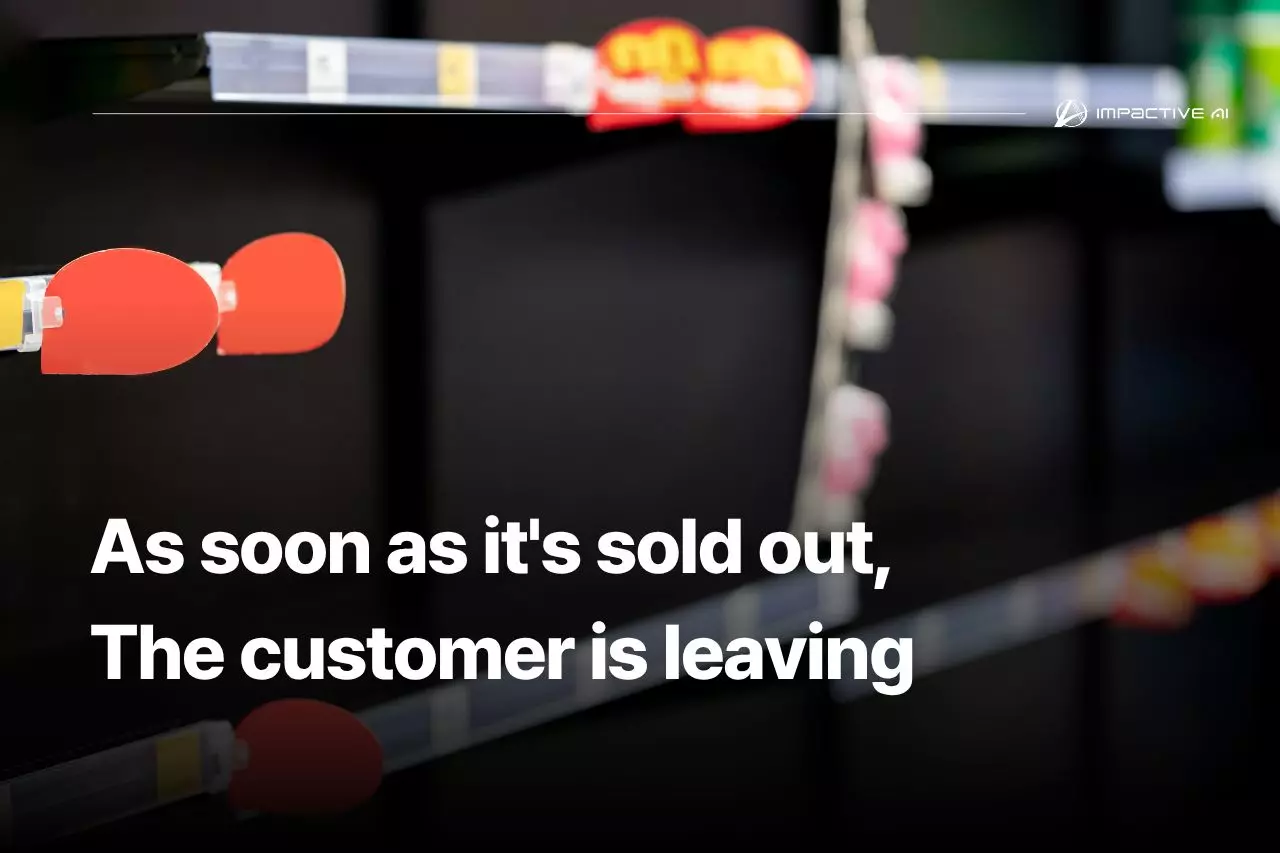
We've all been there — you're about to check out, and the item in your cart suddenly flips to "out of stock." Most shoppers don't wait for a restock. They search for another brand or switch to a competing platform on the spot. A single stock-out might cost you that day's sale. But let it happen two or three times, and the customer mentally files your brand under "unreliable."
According to IHL Group's 2025 research, global retail losses from stock-outs and overstock total $1.73 trillion annually, with stock-outs alone accounting for $1.2 trillion. This article examines why out-of-stock prevention is central to any customer retention strategy and outlines key considerations for adopting AI demand forecasting to optimize inventory.
Two Paths From Stock-Outs to Customer Churn
Stock-outs push customers away through two distinct paths: immediate switching and cumulative attrition.
The first is immediate switching. According to AlixPartners' 2024 Consumer Sentiment Index, roughly 66% of 9,000 fashion consumers surveyed said they purchase from a different retailer when their preferred item is out of stock. Two-thirds choose a competitor over waiting for a restock. Online, this switch happens even faster — a competing platform is just one click away.
The more damaging path is cumulative attrition. In a Netstock consumer survey, 43% of shoppers who experienced stock-outs two or more times indicated a significantly higher likelihood of leaving the brand permanently. Customers don't interpret repeated stock-outs as an inventory shortfall — they read it as a broken promise. While immediate switching costs you a single transaction, cumulative attrition costs you the entire customer lifetime value.
How Global Retailers Optimize Inventory to Prevent Stock-Outs
The companies that have made real progress share one thing in common: instead of piling up safety stock, they built systems that dynamically allocate inventory in sync with demand signals using AI.
Zara: Real-Time Inventory Visibility Through RFID

Zara embeds RFID chips in every garment across its global store network to achieve real-time inventory visibility. Its unified inventory management platform dissolves the boundary between in-store and online stock, enabling store floor merchandise to fulfill e-commerce orders. When one channel runs out, inventory from another channel covers the gap immediately. Customer feedback captured at the store level reaches headquarters designers in real time, and new products hit shelves within two weeks. The result is a virtuous cycle that minimizes out-of-stock windows for popular items and drives repeat visits.
Carrefour: AI-Powered Autonomous Shelf Replenishment
Carrefour is building an AI-first shopping experience through its partnership with Google, deploying Gemini AI models and equipping 250,000 employees with AI tools. Through a €150 million program with VusionGroup, the retailer has installed AI cameras, electronic shelf labels, and AI-driven shelf management systems across its stores.
AI cameras automatically detect out-of-stock conditions on shelves, while AI-powered analytics sharpen both demand forecasting and logistics execution. Carrefour plans to sustain this technology investment at €100 million per year through 2030.
Target: Specialized Store Roles and Proactive Stock Positioning
Target redefined the role of its physical stores. High-traffic locations focus on the in-store customer experience, while stores with larger logistics footprints serve as dedicated fulfillment hubs for online orders. When a stock-out occurs at one location, a nearby hub store replenishes it immediately through an interconnected network. Target also runs an AI system that analyzes social media trends to pre-position inventory before a style goes viral.
Each company took a different approach, but they all started with the same foundational step: diagnosing where and why stock-outs were actually happening before investing in technology.
Key Considerations for Adopting AI Demand Forecasting

A significant share of stock-outs originate not from supplier failures but from inaccurate demand forecasting and flawed replenishment processes within the organization itself. The fact that the root cause is internal means it falls squarely within the company's control to fix.
AI demand forecasting addresses stock-outs differently depending on the type.
Preventing routine stock-outs. AI analyzes dozens of variables simultaneously — day-of-week patterns, promotional lift, seasonality, external events — to generate SKU-level demand forecasts. This replaces the historical-average approach that perpetuates recurring shortages.
Intercepting demand spikes before they hit. During promotions or seasonal transitions, demand can surge beyond what standard reorder cycles can handle. These are exactly the stock-outs that trigger cumulative attrition, because they happen when customers want the product most. AI detects early demand-spike signals and enables proactive inventory positioning.
Resolving cross-channel imbalances. As in Zara's case, total inventory may be sufficient while specific channels run dry. AI monitors channel-level stock in real time and triggers redistribution before a localized stock-out reaches the customer.
That said, AI forecast accuracy is only as good as the underlying data. If sales, inventory, and returns data are managed under inconsistent standards, establishing data integrity must come before model deployment. Equally important is providing transparent reasoning behind AI-generated reorder recommendations so that frontline teams trust and act on them.
Deepflow's Approach to Out-of-Stock Prevention and Inventory Optimization
Preventing stock-outs starts with a simple premise: knowing which items will run short, and when. Deepflow, developed by ImpactiveAI (CEO Doo-Hee Jung), is an AI demand forecasting solution that automates this prediction.
Deepflow's BI dashboard automatically calculates days-of-stock remaining for every SKU. It shows at a glance how many days current inventory will last and which items are sitting in excess — managing both shortage and surplus risk on a single screen. Over 224 machine learning and deep learning models generate forecasts tailored to each item's unique sales pattern, backed by 72 patented technologies.
What makes Deepflow particularly relevant to out-of-stock prevention is its structure for closing the gap between forecast and execution. LLM-powered analytical reports automatically generate department-specific risk factors and action plans for sales, marketing, and SCM teams respectively. Forecasts don't stop at the report stage — they connect directly to purchasing and inventory allocation decisions.
Out-of-Stock Prevention Is the Most Direct Investment in Customer Retention
Stock-outs are the most preventable reason customers leave a brand. When 66% of consumers immediately switch to another retailer upon encountering a stock-out, the window to win them back is effectively zero. Yet the fact that most stock-outs stem from internal forecasting and replenishment gaps means this is a problem that targeted investment can solve.
As Zara, Carrefour, and Target demonstrate, companies that have cracked out-of-stock prevention all built systems to manage inventory fluidly in response to demand. With a solution like Deepflow — connecting SKU-level depletion forecasts to department-level action plans — out-of-stock prevention can become a core pillar of your customer retention strategy.
.svg)


.svg)










%201.svg)
%202.svg)


.svg)