.svg)

.svg)
%202.svg)
%201.svg)
Data Voucher Quota System: Key Preferences That Non-Capital Region Businesses and Small Merchants Must Check
The 2026 Data Voucher demand-side company recruitment notice has been announced. The first thing applicants should check isn't the eligibility criteria — it's the preferential treatment provisions. With a 40% priority quota for non-capital region businesses, a separate 5% allocation for micro small merchants, and co-funding reductions, meeting the right conditions can dramatically change your odds of selection — even with the same business plan.
ImpactiveAI has participated as a Data Voucher supply-side company for multiple years, supporting demand-side companies with data services that connect to AI-powered demand forecasting. Drawing from that experience, we've outlined the preferential provisions that non-capital region businesses and small merchants commonly overlook.
Non-Capital Region Businesses: 48 out of 120 Slots Reserved Through Priority Quota
The biggest benefit for non-capital region businesses is that they compete in a separate pool entirely. Among companies scoring 60 points or above, 48 out of the total 120 slots — representing 40% — are reserved for non-capital region businesses. These are divided into 24 slots for the General track and 24 for the Open & Utilization track. Companies headquartered outside the capital region are evaluated under different criteria than capital region companies, giving them a structural advantage in the selection process.
The qualifying criterion is the business address listed on your business registration certificate. Any location outside the capital region (Seoul, Gyeonggi, and Incheon) qualifies. If your company is based in Busan, Daegu, Gwangju, Daejeon, or any other non-capital region city, make sure to check the regional business box on your application form. Connecting your project to regional industry use cases or local market data can also leave a positive impression during evaluation.
Co-Funding for Small Merchants: Full In-Kind Substitution Available
The Data Voucher program does not cover 100% of project costs through government funding. A portion of the total project budget must be matched through private co-funding. This is where small merchants receive a notable benefit.
Regular SMEs are required to cover at least 25% of the total project cost, with at least 10% of that co-funding paid in cash. Small merchants, on the other hand, are also required to cover 25% or more, but they can substitute the entire amount with in-kind contributions such as personnel labor costs — no cash required. For small merchants with limited cash reserves, this makes a significant practical difference.
Micro small merchants enjoy an even greater benefit. Businesses classified as simplified tax filers see their co-funding ratio reduced to just 10%, and even that can be covered entirely through in-kind contributions.
Micro Small Merchants: 6 Slots Set Aside Through a Separate 5% Allocation
Micro small merchants receive their own separate priority quota. Out of the total slots, 5% — which amounts to 6 slots (3 for the General track and 3 for the Open & Utilization track) — are reserved exclusively for micro small merchants. They do not compete against regular SMEs or mid-sized enterprises in the same pool.
The key here is that these preferences can stack. A micro small merchant headquartered in a non-capital region can benefit from both the 40% regional quota and the 5% micro small merchant allocation simultaneously. The smaller your revenue and the further you are from the capital region, the more favorable the structure becomes for your selection. Don't downplay your business size — clearly indicating your status as a micro small merchant is essential to being placed in this dedicated slot.
Youth-Led Companies Get a 1-Point Bonus and Reduced Co-Funding
If your company is a small merchant and the CEO (or at least one co-CEO) is between the ages of 19 and 39 as of the announcement date (February 27, 2026), additional benefits apply. Even if you don't qualify as a micro small merchant, your co-funding ratio drops to 10% (payable entirely in-kind) and you receive a 1-point bonus in the selection evaluation.
For a youth-led small merchant in a non-capital region, the regional quota, co-funding reduction, and 1-point bonus all apply simultaneously. If you also qualify as a micro small merchant, the separate 5% allocation is added on top. The same business plan can yield vastly different outcomes depending on which of these conditions you meet.
Commonly Overlooked Points When Filling Out Applications
Preferential treatment is not applied automatically. You must check the relevant boxes on the application form yourself. If you fail to mark even one applicable category — regional business (non-capital region), small merchant or micro small merchant, or youth-led company — you will not be placed in the corresponding quota pool.
Calculate your co-funding match ratio in advance as well. Micro small merchants and youth-led companies pay 10% (all in-kind), regular small merchants pay 25% (all in-kind), and SMEs pay 25% (at least 10% in cash). Pre-startups are fully exempt from co-funding.
Your data utilization scenario must also be specific. Simply writing "digital transformation" is not enough. Describe scenarios tied to actual business operations — customer analytics, smart store data utilization, inventory optimization, demand forecasting — so that any bonus points translate into a meaningful score.
Using the Data Voucher to Support Your Demand Forecasting Workflow
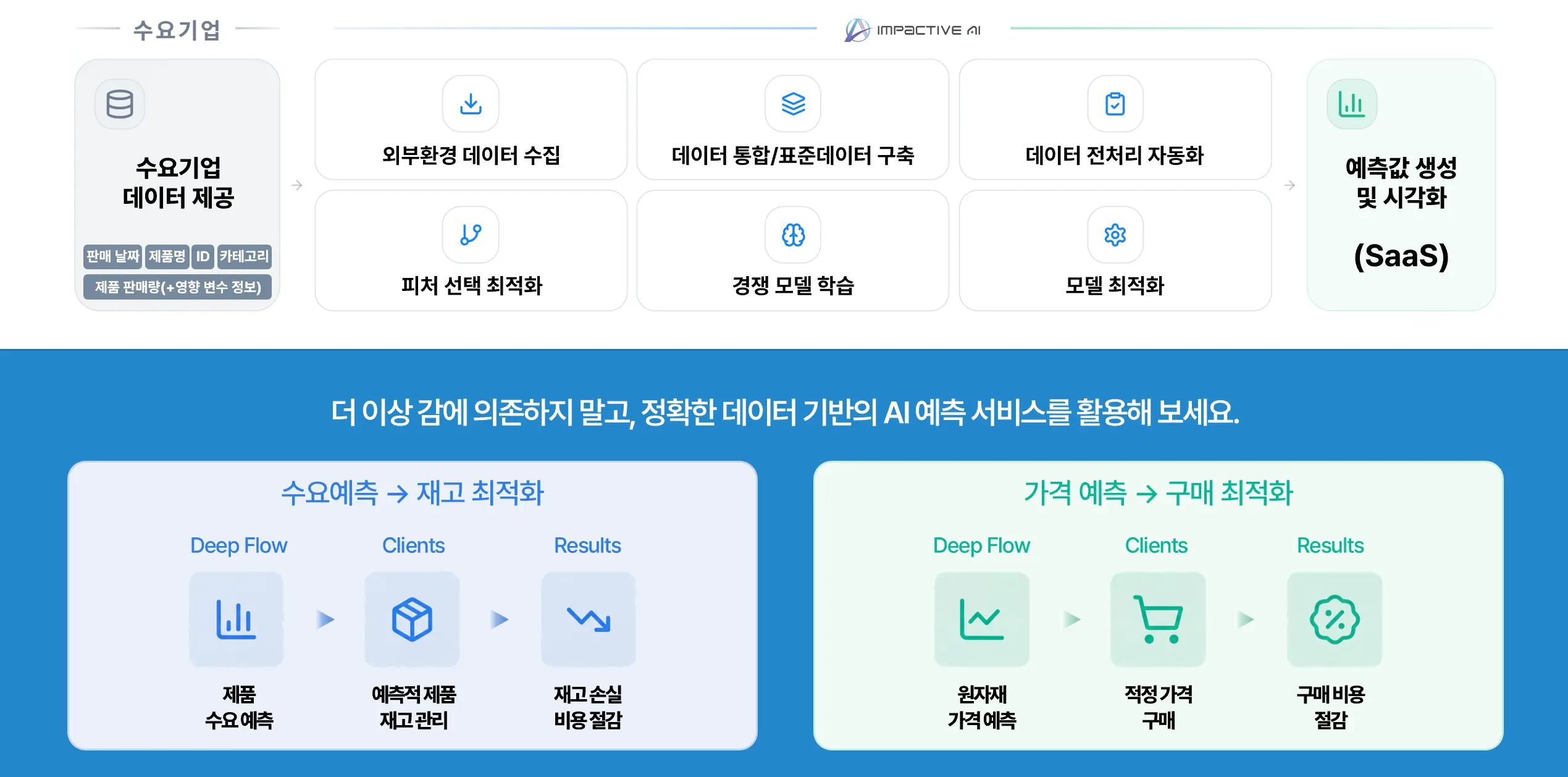
There is an important distinction that companies exploring demand or price forecasting should understand. The Data Voucher program covers only data provisioning and related services; it does not fund AI model development or AI solution subscriptions directly. The correct approach is to use the Data Voucher for data collection, integration, preprocessing, analysis, and visualization — while running forecasting through a separately operated SaaS platform.
ImpactiveAI's Deepflow is a fully developed SaaS platform that delivers demand forecasting and raw material price forecasting services powered by over 224 AI models and backed by 72 patented technologies. It generates highly accurate forecasts for product sales volume, shipment quantity, and raw material prices over a 6- to 12-month horizon. Through the Data Voucher, companies can receive support for collecting, integrating, and preprocessing their data, then connecting it to Deepflow for analysis and visualization.
Inventory Optimization Through Demand Forecasting
For manufacturing and distribution companies, demand forecasting can serve as the foundation for inventory optimization. The Data Voucher can support the following areas of work: collecting and integrating a company's sales, inventory, and product data; gathering external data (weather, oil prices, exchange rates, economic indicators) and linking it with internal data; automating data preprocessing and establishing standardized formats; and generating forecasts through the Deepflow SaaS platform with BI dashboard visualization.
As a result, companies can maintain optimal inventory levels by understanding future demand at the SKU level, automatically calculate days-of-stock to reduce stockout risk, and prevent cost losses from excess inventory. Deepflow's BI dashboard provides a consolidated view of understocked and overstocked SKUs, while its LLM-powered analytical reports deliver tailored action strategies for sales, marketing, and SCM teams.
Procurement Optimization Through Raw Material Price Forecasting
For companies that purchase raw materials, price forecasting can help optimize procurement timing. The Data Voucher can support the following areas of work: collecting raw material price data, integrating global economic indicators and market data, preprocessing through feature selection optimization, and generating price forecasts and visualizations through the Deepflow SaaS platform.
As a result, companies can reduce costs by procuring at the right moment before prices rise, and make proactive decisions in response to price volatility. Deepflow's MI dashboard monitors exchange rates, interest rates, and raw material prices, while offering 3-month short-term AI forecasting for exchange rates and oil prices to help companies navigate market fluctuations.
Key Considerations for Writing Your Business Plan
Since the Data Voucher covers only data provisioning and related services, a few points must be made clear in your business plan. Specify that the project involves "utilizing an already-developed SaaS platform," not developing an AI model from scratch. The scope of support must also be clearly delineated: data collection, integration, preprocessing, analysis, and visualization are covered, but AI model development itself is not. Presenting expected outcomes in measurable terms — such as inventory reduction rates, cost savings, and stockout rate improvements — works in your favor during the business viability evaluation.
Given that the project period is six months, it's important to set realistic goals that can be completed from data collection through visualization within that timeframe. During preliminary discussions with your supply-side partner, finalize a concrete timeline and deliverables, and reflect them in your business plan.
If You Qualify for Preferential Treatment, Now Is the Time to Prepare
If your company meets even one of the following criteria — non-capital region location, small merchant, micro small merchant, or youth-led company — the 2026 Data Voucher program offers an opportunity to start on favorable footing. Thanks to the quota system, smaller companies outside the capital region actually stand a better chance of being selected, and the co-funding reductions significantly ease the cash burden.
ImpactiveAI has participated as a Data Voucher supply-side company for multiple years, working alongside demand-side companies from project planning through to connecting data workflows with AI-powered solutions. If you have questions about eligibility requirements or how to shape your business plan, don't hesitate to reach out.
👉🏻 What changed from last year? 3 Key Updates in the 2026 Data Voucher Program >> Click
👉🏻 2026 Data Voucher Eligibility Guide for Small Merchants, Startups, and SMEs >> Click
.svg)

.svg)




%201.svg)
%202.svg)


.svg)