.svg)

.svg)
Download Brouchure
%202.svg)
Oops! Something went wrong while submitting the form.
%201.svg)

What actually occupies a monthly sourcing meeting is not the retail price of cheese. The real questions are whether to lock next month's shredded cheese volume now, how many months to set the cream cheese contract for, and whether to get an alternative formulation pre-approved in case cream supply tightens.
Heatwave coverage floods in every year, but it rarely tells you which items get hit first and which ones you can keep handling as usual. Raw milk means milk as it comes from the cow, before processing. Unlike crude oil, whose price is set on an exchange, raw milk is produced differently and the way price flows into contracts is entirely different too.
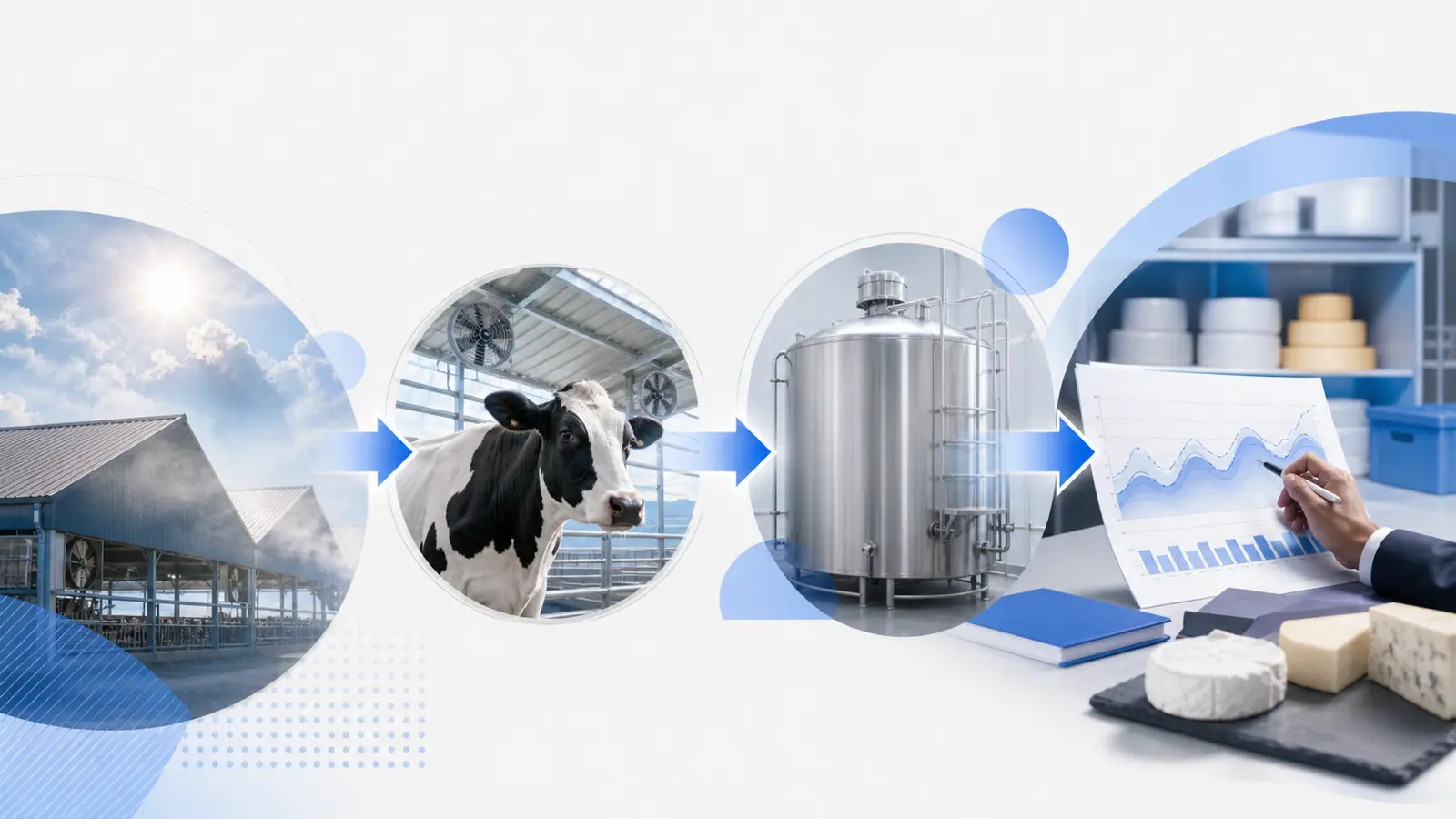
This article walks through how heat affects raw milk production, how that pressure carries into different product families such as fresh cream, cream cheese, and imported hard cheese, and finally what procurement teams should actually verify. The point is not to declare that cheese prices are going up. It is to understand how you decide which SKUs to adjust, when, and on what evidence.
📕 Summary
THI, the temperature-humidity index, combines air temperature and humidity into a single number representing the heat load on livestock. At the same 33°C, higher humidity pushes THI up, and the heat stress on dairy cattle can rise with it.
According to studies analyzing milk production records in Korea, once THI passes 70, milk yield tends to fall while MUN (milk urea nitrogen) and somatic cell count both rise. Yield simply describes how much raw milk you receive; MUN and somatic cell count indicate its quality. So the same volume of raw milk can still produce different processing outcomes.
Another Korean study on repeated heat stress uses a daily maximum THI above 72 between May and September as its reference threshold. Looking not just at peak daily temperature but at how many consecutive days high THI persisted is what gives you something substantive to work with when negotiating raw milk supply.
Both studies converge only on the point that milk yield falls and quality indicators worsen in hot or humid conditions. Neither draws conclusions about how much raw milk procurement costs actually rise. And because barn conditions, cooling systems, and herd size can produce different outcomes under identical THI, national data cannot be read straight across as an assessment of any particular supplier's capability. The complication is that this productivity decline does not transmit to every dairy product the same way.
A briefing from Korea's Ministry of Agriculture, Food and Rural Affairs estimated that raw milk production during a heatwave period fell from 5,270 tonnes to 5,030 tonnes per day, roughly 4.6%, while noting that fluid milk supply held up and only fresh cream ran temporarily short.
The point worth reading is the allocation, not the headline decline. A 4.6% overall drop does not mean every dairy product absorbed 4.6%. Fluid milk saw little change, while shortages surfaced first in a handful of items — most notably fresh cream, where milkfat makes up a large share.
Cheese is no different. Fresh varieties with high milkfat content, such as cream cheese and mascarpone, and hard varieties that need long aging and are largely imported travel different exposure paths through the same summer. Segmenting SKUs by domestic versus imported and by milkfat content lets you ask suppliers far more specific questions.
So a drop in raw milk output cannot be generalized into a supply problem across every item. The next question for procurement is not "did raw milk output fall?" but "which SKU's sourcing conditions change first?" Volume risk and cost increases also need to be tracked separately rather than bundled into one concept.
Raw milk output is only the starting point. The actual procurement cost is determined together by the raw milk pricing system, allocation across end uses, inventory and aging periods, and international prices and exchange rates.

The first buffer is how the price gets set in the first place. Korean raw milk prices are negotiated according to end use. The Ministry's raw milk pricing briefing shows that in 2024 the drinking-milk price was frozen at 1,084 KRW/L while the processing-milk price fell from 887 KRW/L to 882 KRW/L. In other words, a summer production decline does not get layered straight onto that year's input cost. There have been years when the rate applied to cheese inputs actually came down.
The second condition is process and inventory. Raw milk is received, coagulated and formed, aged for several months, and delivered on a contract cycle — and throughout that stretch, inventory already secured and rates already agreed act as a buffer. Cheese made from a summer's reduced milk supply is unlikely to show up in quotes during that same summer, and the longer the aging, the wider that gap grows.
Hard cheese with a heavy import share responds first to raw milk supply in the exporting country, international dairy prices, and exchange rates rather than to a Korean heatwave. Even so, a move in overseas milk prices or FX does not shift next month's cheese quote by the same margin. Raw milk becomes cheese only after processing and aging, with refrigerated transport and distribution costs layered on. Contract timing and inventory on hand also change when the shift shows up.
The variables above move on different clocks. Heatwaves and THI exert influence cumulatively over several days, while domestic raw milk prices and contract rates change all at once at fixed negotiation points. Aged cheese inventory reflects ordering decisions made months ago, surfacing only now.
Read each factor in isolation and the conclusion changes at every meeting. That is why monthly buying meetings should review the following five together, SKU by SKU.
The key point is that these numbers are not to be added up into a "next month's price" forecast. They are inputs for deciding, for each individual item, whether to pull ordering forward, hold the existing contract, split the volume across orders, or wait a little longer. Conclusions differing across SKUs within the same month is exactly what you should expect.
Four more conditions determine whether the right-hand column can actually be executed.
ImpactiveAI's Deepflow is used to keep this decision table on a single screen. It places internal data such as sales, inventory, and raw material prices alongside external variables such as weather, international dairy prices, and exchange rates, and records what assumptions each scenario was built on and on what basis early securing, split buying, or waiting was chosen. The final call stays with the buyer and the approver.
Translate a heatwave into a single percentage and you lose the ability to trace which assumption was wrong. Heat load lands on raw milk first, then splits into different magnitudes by item, and by the time it reaches procurement costs it has been delayed and diluted by negotiation cycles, aging periods, and import routes.
The moment you compress those three stages into one percentage, you lose the means to retrace which stage's assumption failed when the budget misses. A heatwave is not a number to copy into a budget. It is a signal telling you which question to ask first.
At your next sourcing meeting, rather than debating a rate of increase off heatwave headlines and last month's quotes, start by checking the current value of the five signals and the scenario they point to. The question in the room then shifts from "how much will it go up?" to "which items do we lock, until when, and on what terms?"
.svg)

.svg)

.svg)










%201.svg)
%202.svg)


