.svg)

.svg)
Download Brouchure
%202.svg)
Oops! Something went wrong while submitting the form.
%201.svg)

Ice cream sees its demand concentrated in a single summer window, and fashion-season merchandise loses value the moment a trend passes. Seasonal products have a structural duality — they generate explosive revenue opportunities while also leaving behind dead stock the moment the season ends. In the past, it was common for merchandisers to set order volumes based on personal experience and the prior year's sell-through. But rising supply chain volatility and the accelerating pace of consumer-trend shifts now demand a more sophisticated approach to seasonal product inventory management.
This article examines an SCM (Supply Chain Management) strategy that organically connects quantitative data across category, sales, inventory, and reorder dimensions to optimize order timing for seasonal products and reduce inventory risk. Drawing on examples from fashion, retail, and food, we look at how AI demand forecasting technology is actually being applied on the ground.
Ordering seasonal products is, at its core, a decision-making problem. It means finding the optimal balance between the opportunity loss caused by stockouts and the disposal and holding costs caused by overstock. Leaning too far in either direction tends to erode profitability quickly.

For trend-driven items like apparel and footwear, the initial order quantity is critical. Getting this number right is what allows a brand to protect margin without resorting to deep end-of-season markdowns.
Rather than simply ordering "however many units we think will sell," the more effective approach is to first set a target for how much of the assortment you want to move at full price before the season ends. This is known as the full-price sell-through target.
Full-price sell-through rate = the share of units sold at original price without discounts.
For example, if the plan is to sell 1,000 units in total and you want 700 of them to sell at full price, your full-price sell-through target is 70%.
The initial order quantity is then back-calculated as follows. First, decide the number of units you want to sell at full price (700). Then divide that by the full-price sell-through target (70%). The result — 700 ÷ 0.70 = 1,000 units — becomes your initial order quantity.
The essence of this method is protecting profit by minimizing markdowns from the outset rather than reacting to them after the fact.
Applying the same order ratio across products without differentiating by product characteristics and production lead time tends to amplify inventory risk. ABC analysis is a widely used way to address this.
In practice, the following ranges are commonly referenced. A-grade basics, which do not follow trends and where stockout prevention is paramount, are often placed at an initial order weighting of 70–80%. B-grade trend items are typically launched at 30–50% of projected volume, with reorder weighting expanded once market response is confirmed. C-grade experimental designs are usually limited to small test production runs, with no reorders as a matter of principle.
These ratios vary by industry, brand strategy, and production environment, so they should be adjusted against the company's own historical sell-through data and reorder success rates.
Lead time is another key variable. For products with long lead times of two to three months, such as overseas-manufactured goods, a larger initial order is typically needed to ensure the inventory arrives in time to sell through the season. Conversely, where domestic production allows replenishment within one to two weeks, a lower initial order paired with fast, market-responsive reorders tends to be the more advantageous strategy.
In fresh food, short shelf lives mean that ordering errors translate almost directly into disposal losses. Among the variables that influence demand in this category, weather is one of the most significant. Small shifts in temperature, rainfall, and humidity have been shown to drive substantial swings in the sales of seasonal items like lunchboxes, beverages, and ice cream.
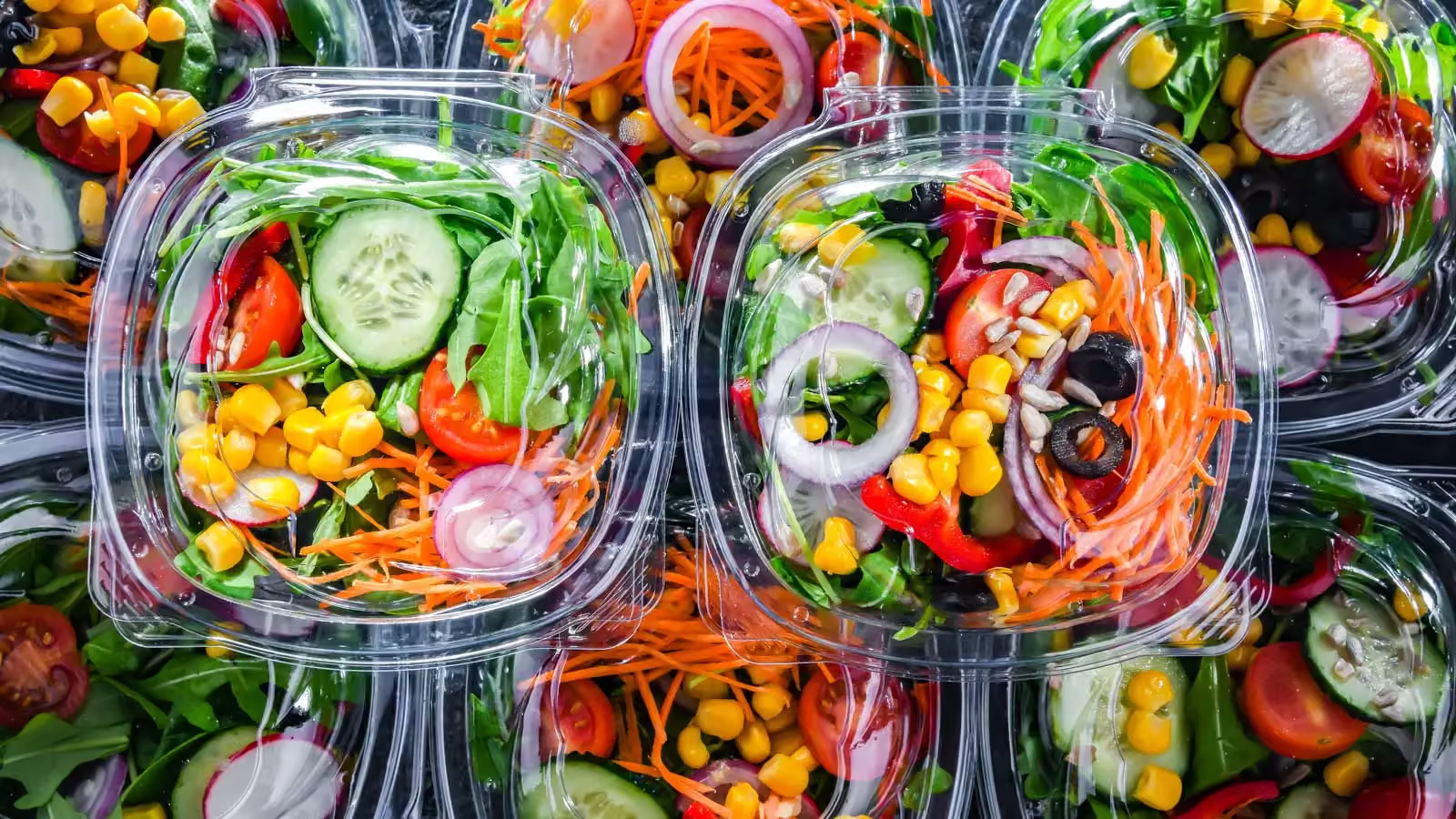
GS25 has been applying AI to its fresh food (FF) auto-ordering system, which automatically places orders for short-shelf-life items like lunchboxes and hamburgers as well as ambient goods by accounting for average daily sales volume and seasonality. The system is designed to help store operators maintain optimal inventory levels. Combining sales data with weather and seasonal variables to propose order quantities is regarded as effective for capturing the fine-grained demand fluctuations that occur at the individual store level. (Source: Electronic Times)
Global retailer Walmart is a leading example of using weather data as a core variable in demand forecasting. Walmart integrates historical sales, weather forecasts, local event information, and real-time inventory levels into AI models to forecast demand at the store and SKU level. When a storm warning is issued for a specific region, for instance, the system predicts spikes in bottled water, batteries, and emergency supplies in advance, triggering preemptive replenishment orders. When Hurricane Ian struck Florida in 2022, Walmart was reportedly able to respond to post-storm demand surges through AI-driven logistics reallocation, even as its distribution centers were out of operation for seven days. Systems like this, which incorporate weather variables into demand forecasting in real time, are becoming a core piece of infrastructure — reducing disposal losses on seasonal products while strengthening responsiveness to rapidly shifting demand.
Modern supply chain management is being rapidly reshaped by the adoption of AI- and deep-learning-based demand forecasting solutions. The greater the volatility in a given category — as is the case with seasonal products — the greater the accuracy gains and automation benefits that AI delivers.
AI forecast accuracy is heavily dependent on the volume and quality of training data. Leading models are evolving toward greater resolution by combining internal enterprise data — sales volume, inventory status, promotion history — with external data such as macroeconomic indicators, weather, online sentiment, and competitor activity. In particular, it is becoming essential to build architectures that can separate "promotion-driven artificial demand amplification," which is difficult to isolate through human judgment alone, from baseline demand.
Because market conditions are constantly shifting, model drift — the gradual decay in predictive power of models trained on historical data — is largely unavoidable. To counteract this, it is necessary to periodically measure the error between forecasted and actual demand, and retrain the model with the latest data once that error exceeds a defined threshold. In categories like seasonal products, where patterns repeat on an annual cycle, this kind of continuous learning architecture plays a particularly important role.
Even the most accurate forecast loses its edge when the physical time required to produce and ship a product is too long. For seasonal merchandise, shortening lead times is just as critical a challenge as capturing demand.
The first requirement is an integrated SCM management structure that connects data across sales, production, and logistics functions into a single source of truth. When different departments make decisions based on different data, small shifts in demand tend to amplify as they travel up the supply chain — the well-known bullwhip effect.
One option is to leverage systems such as cloud-based ERP to put the entire enterprise on a unified data foundation, but the core principle is not the specific tool but the SCM design philosophy of eliminating information silos between departments. Only when demand forecasts, inventory status, and production schedules are shared in real time can the bullwhip effect be mitigated at a structural level.
Manual administrative work is another factor that extends lead times. Applying RPA (Robotic Process Automation) to repetitive tasks such as inventory reconciliation, order-data aggregation, and reorder processing has been shown to compress work that previously took more than a day into just minutes. When AI analytics are layered on top of automated infrastructure, the result is a system in which production and ordering instructions can respond to market changes with speed.
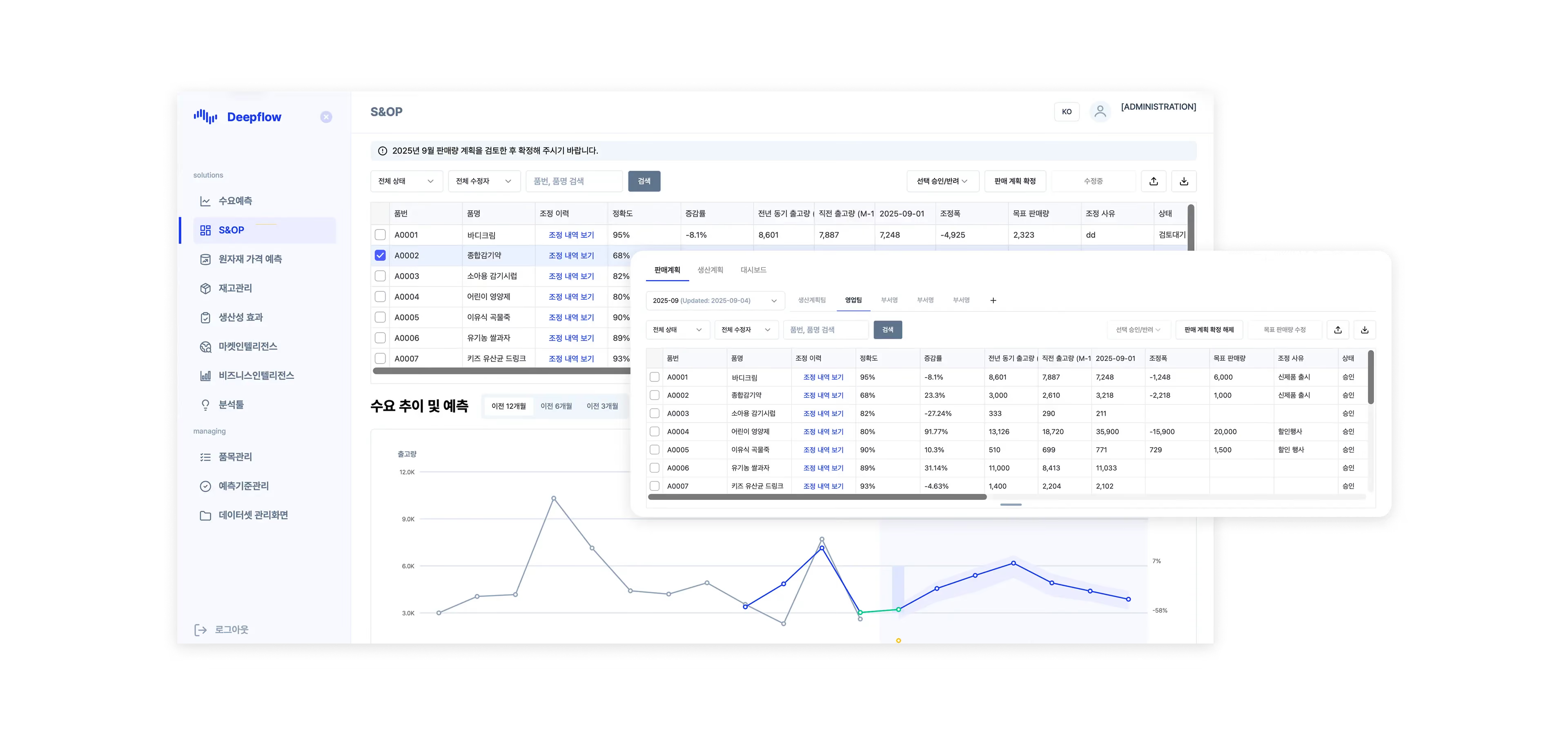
The hardest part of seasonal product inventory management for practitioners is usually not the forecast number itself, but how to interpret that number and translate it into specific actions across departments. Deepflow, ImpactiveAI's AI demand forecasting solution, is designed with exactly this gap in mind.
Deepflow is built around the principle that demand patterns differ from product to product, automatically identifying and applying the forecasting model best suited to each SKU. Even for seasonal items whose demand curves diverge sharply between summer and winter, the model selected matches that specific pattern — reducing the need for practitioners to manually tune models or correct forecast outputs every time. With the solution handling the heavy lifting of complex data analysis, practitioners can redirect the time they used to spend on data interpretation and report writing toward strategic decision-making.
Deepflow's LLM-based analysis reports are particularly applicable to seasonal inventory management. The solution automatically generates historical sales analysis, the rationale behind demand forecasts, and department-specific action plans, so practitioners receive not just forecast numbers but also supporting materials for judging initial order volumes and reorder timing.
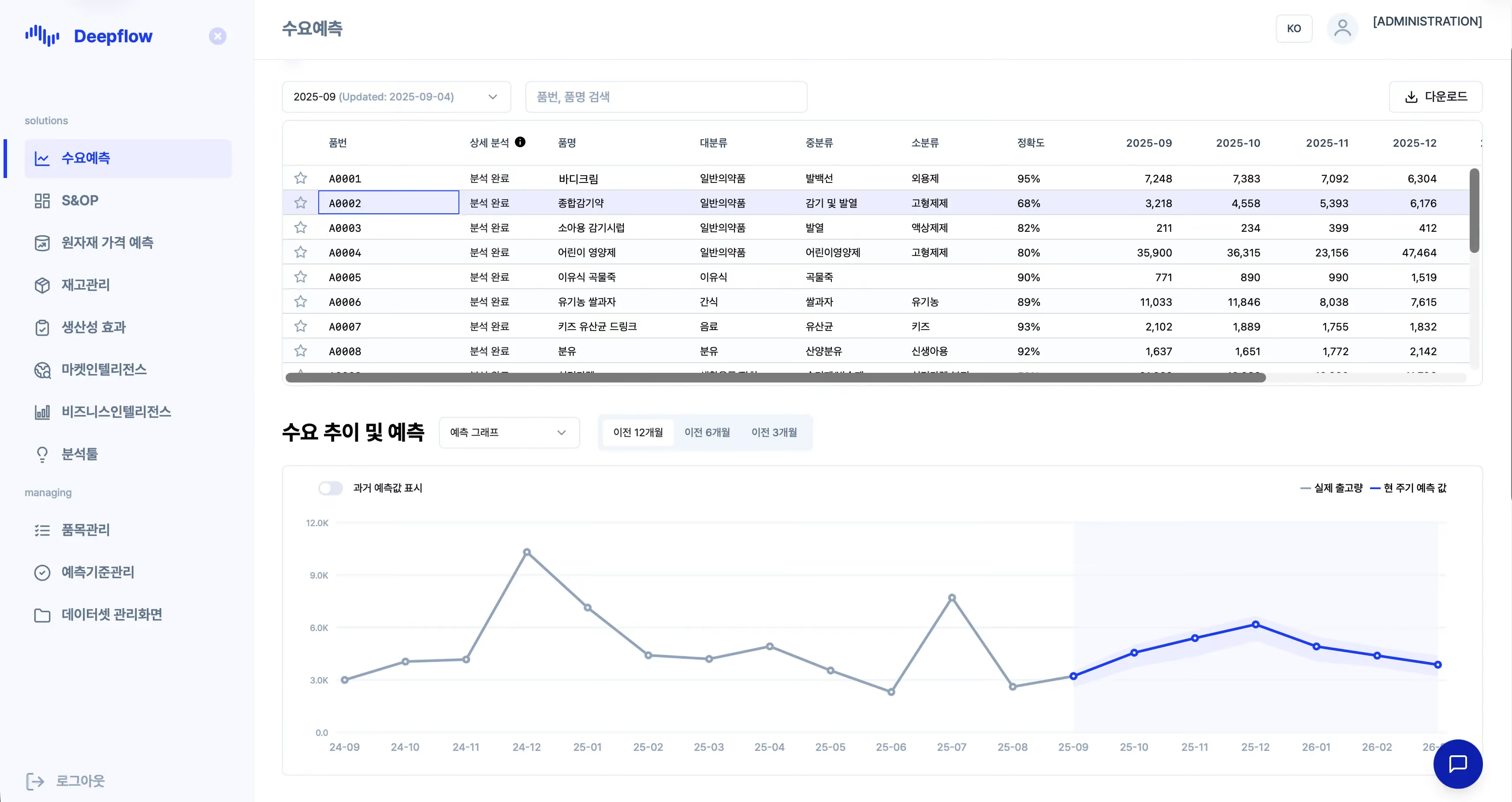
The BI dashboard identifies SKUs with excess or insufficient stock, and automatically calculates days of supply and recommended production volume, providing a quantitative answer to the question "how much additional production is needed to sell through within the season." The MI dashboard provides external environment data such as exchange rates and interest rates, and supports preemptive responses to market volatility through three-month short-term AI forecasts (beta) for FX and oil prices.
Real-world deployments are also instructive. Ildong Foodis, a diversified food company, adopted Deepflow to address the characteristics of the food industry — short shelf lives and rapid shifts in consumer trends. Following the deployment, the company confirmed a reduction in inventory risk of over 26%. In a food industry operating under the dual constraints of seasonality and shelf life, that is a meaningful result.
A free PoC is also available for companies evaluating Deepflow. The free PoC covers validation at the level of forecast accuracy, item-level graphs, and trend explanations. For organizations that need deeper analysis, a paid PoC is available, with modeling tailored to the characteristics of the customer's own data.
Seasonal product inventory management is not something that is ever "completed" by a one-off AI deployment. Accuracy only begins to compound when the stages of observing the market and integrating data, executing through system automation, and measuring and feeding back results are connected into a single continuous loop.
The key is a posture that looks at the quantitative numbers produced by algorithms alongside the qualitative feedback gathered in the field. When both streams of information are consistently fed back into the planning stage, the overstock and stockout risks that plague seasonal categories gradually recede, and the demand peaks that recur each season become easier to convert into profit. As much as forecast accuracy matters, it is the structural design that links those forecasts to organizational execution that increasingly determines competitiveness in seasonal product inventory management.
.svg)

.svg)

.svg)










%201.svg)
%202.svg)


