.svg)

.svg)
Download Brouchure
%202.svg)
Oops! Something went wrong while submitting the form.
%201.svg)
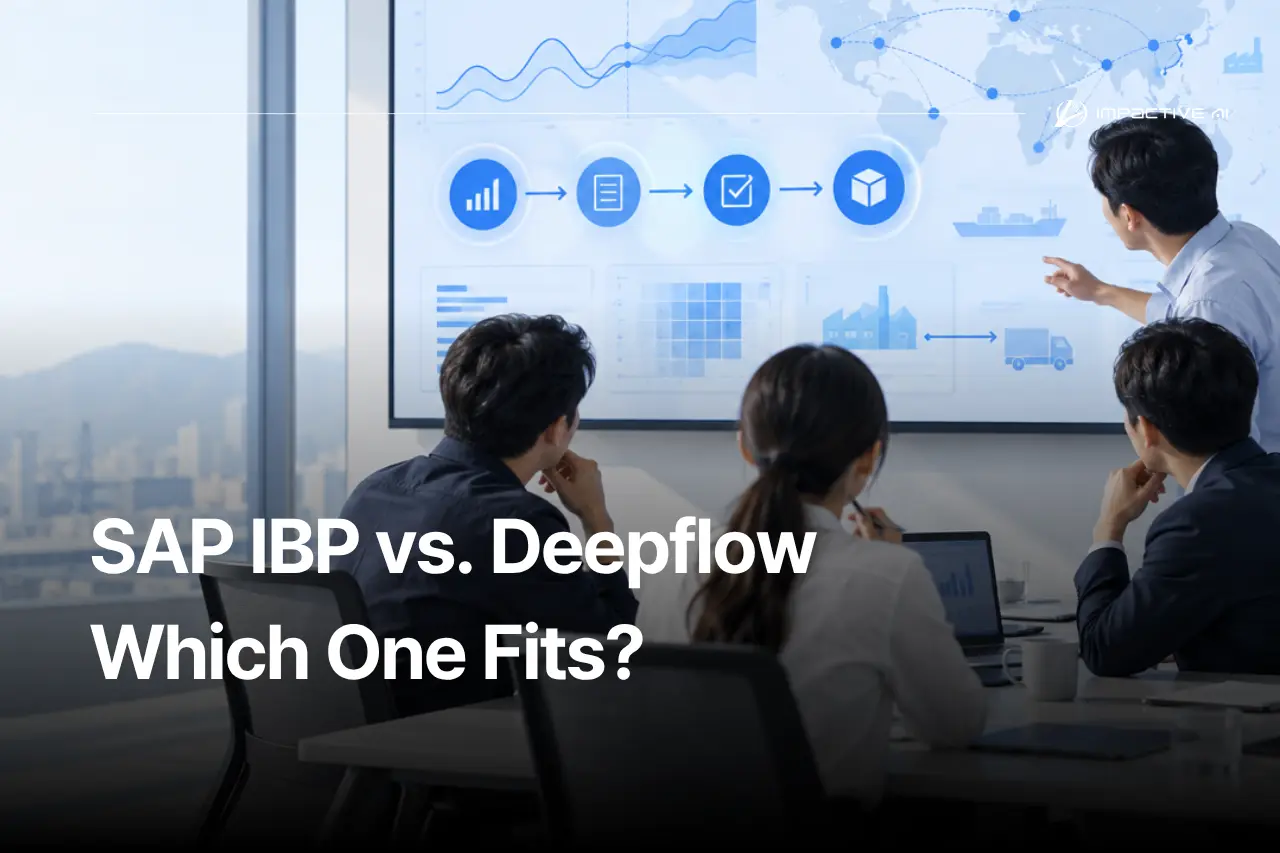
When you're evaluating AI demand forecasting software, the natural starting point is what each platform does and how it would plug into your S&OP process. But lining up feature lists side by side rarely tells you which one actually fits your business.
SAP IBP is an integrated planning suite that covers the full breadth of supply chain planning, from statistical forecasting and ML-driven demand sensing to multi-echelon inventory optimization, scenario planning, and S&OP. Deepflow is built around the practical calls demand planners and buyers make every month. It goes deep on interpreting forecast output and turning it into action. Because the two products target different layers of the problem, a feature-by-feature comparison misses the real difference.
A more useful lens is your company's size, your operating environment, and the specific problem you're trying to solve right now. With that in mind, here are four questions worth raising in your next evaluation meeting.
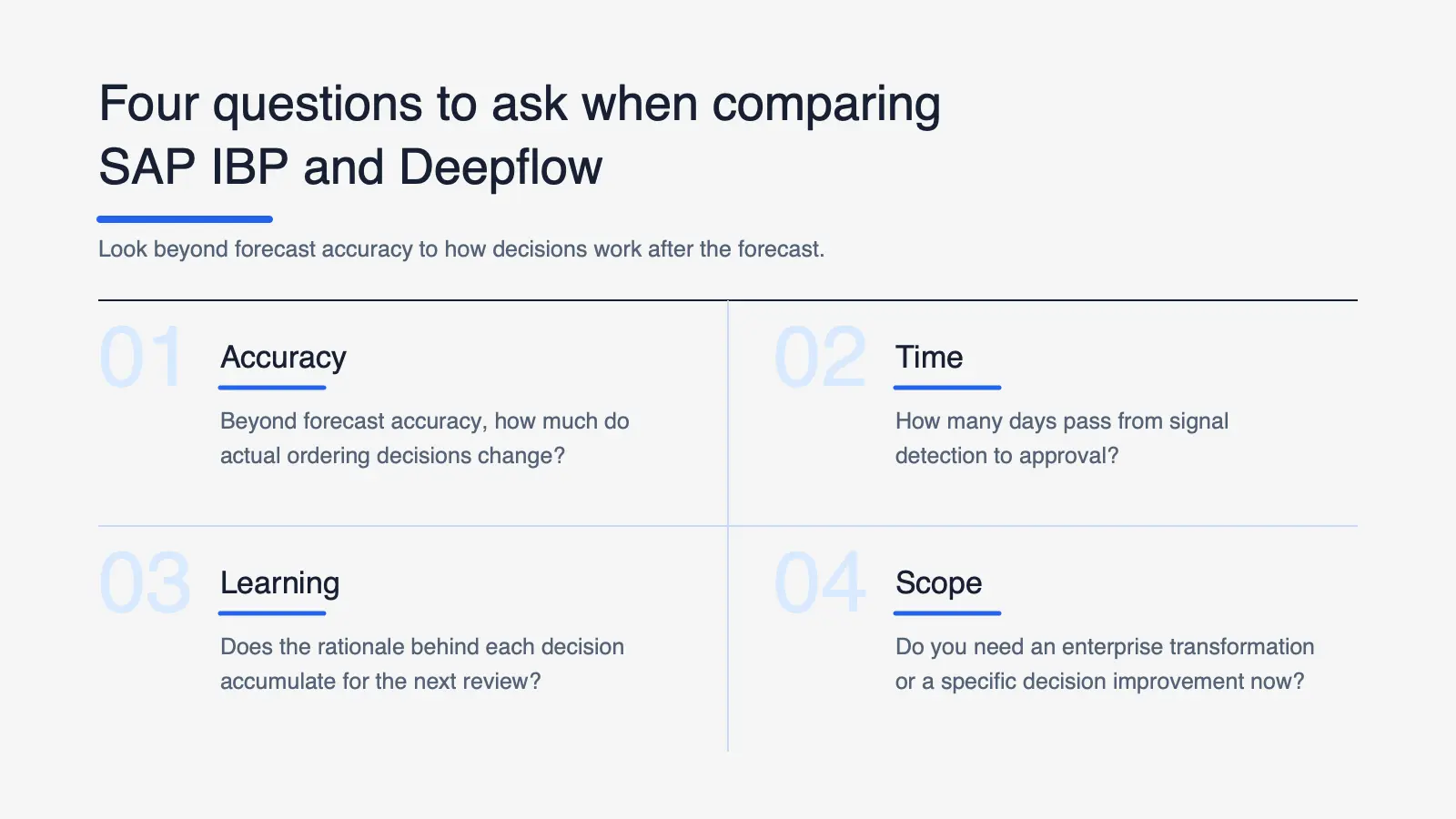
Open any AI demand forecasting proposal and the first number you'll see is forecast accuracy. On its own, though, that figure says very little about how two fundamentally different solutions like SAP IBP and Deepflow compare.
MAPE measures, on average, how far forecasts deviate from actuals in percentage terms. But product mix and demand volatility vary so much from company to company that apples-to-apples comparisons are hard to make. Even within a single company, results can shift depending on how you aggregate SKUs.
Long-time SAP IBP users may reasonably ask why they should revisit forecast accuracy when they're already running ML-based forecasting. It's a fair point. SAP IBP offers demand planning capabilities built on both statistical models and machine learning. So "does it have AI?" isn't a meaningful differentiator. The right approach is to benchmark forecast performance on the same data under the same evaluation conditions, and to check which capabilities your team actually needs day to day.

The real difference between the two products shows up after the forecast is generated.
Picture your monthly demand review. The meeting opens with the system forecast on screen, but the moment sales shares next month's promotion plan, the numbers start moving. The planner opens Excel and reworks the order quantity for the affected SKUs. Then procurement mentions that a supplier's lead time has stretched, and the quantity gets adjusted again.
Here's the problem. When the meeting ends, the only thing that usually survives is the final order quantity. How far it drifted from the original forecast, and why, lives in the planner's head unless someone deliberately writes it down.
That's why better forecast accuracy doesn't automatically translate into better ordering decisions. Reviewing the forecast, adjusting it, approving it, releasing the order, and tracking the outcome need to flow as one continuous process. When you compare products, look past the accuracy figure and ask where in that process your team still has to do extra manual work.
A PoC is the right place to quantify this. Track the share of at-risk SKUs that actually got reviewed, whether each recommended order was approved as-is, modified, or rejected, and the reason behind every modification. You can also measure how many approved recommendations turned into real purchase orders, and what happened afterward to stockouts, excess inventory, and unit purchase costs.
If capturing that data means stepping outside the system every time to build a separate spreadsheet and chase down inputs, you've found the point where the tool creates extra work in real operations.
📖 SAP IBP's demand sensing incorporates the latest demand signals to generate daily forecasts over a 4–8 week horizon. Deepflow, by contrast, produces monthly forecasts and turns them into reports and action plans each department can use, dramatically cutting the time spent on interpretation and reporting. The two products differ right from the time horizon they're designed for.
When raw material prices swing sharply or demand suddenly spikes in a particular sales channel, it can take days for a planner to assess the situation and get sign-off. That's where you'll feel the difference between the two systems.
SAP IBP's demand sensing feature uses recent demand signals such as open sales orders, downstream POS data, and promotions to forecast a short-term window of roughly 4–8 weeks. Forecasts are generated down to the daily level by product, location, and customer, and most runs are executed daily as well. Because the computation is heavy, SAP recommends running a full recalculation weekly and lighter incremental updates daily.
According to SAP's official learning materials, the demand sensing algorithm runs at a planning level that combines product, location, customer, and time attributes. The forecast periodicity must be set to daily, and only one forecast step is allowed. Preprocessing is limited to promotion effect removal, and the feature doesn't calculate forecast error or ex-post forecasts.
These aren't defects. They're constraints built into the design. That said, demand sensing requires master data and sales history to be cleanly structured by product, location, and customer at daily granularity, so real-world implementation effort can vary widely depending on the state of your data.
Deepflow's strength lies less in the forecast number itself and more in compressing the interpretation and reporting work that follows. Deepflow Forecast predicts monthly shipments and sales, and its LLM-powered analysis reports automatically lay out historical sales trends, seasonal patterns, forecast drivers, and department-specific action plans.
The work that used to eat up hours, digging into the root causes behind a forecast or building a report deck from scratch, shrinks considerably. Teams that routinely scramble to pull materials together the day before a meeting will feel this difference most.
📖 Both products can retain planning history. The difference lies in what gets saved as a single unit. Whether adjustment reasons and outcomes are carried forward at the SKU level into the next meeting is something you should verify directly on screen during the PoC.
When a planner overrides an AI recommendation, check whether the reason and the outcome get revisited in next month's meeting. That tells you how the system preserves decision-making experience.
SAP IBP supports plan versions and scenarios. For example, with SAP IBP's Excel-based planning, you can adjust plan values, run a simulation, and save the result as a separate version.
Plan versions and decision logs serve different purposes, though. A plan version is a snapshot of plan values at a given point in time, useful for comparing the previous plan against the current one. A decision log focuses on capturing, for each individual SKU, who made an adjustment, why, by how much, and what happened afterward.
As those records build up, you can start to see whether similar calls keep recurring for a given item, and how well past overrides held up against actual results.
This difference rarely comes through in a proposal. During the demo or PoC, open up last month's adjustment history yourself and check whether those reasons and outcomes are actually being used in this month's meeting. Since every company runs its process differently, Deepflow deserves the same scrutiny: see how these records are captured and reused within your actual workflow.
📖 If you need to standardize a complex, multi-entity supply chain under a single framework, start by looking at an enterprise-wide platform like SAP IBP. If, on the other hand, you're already seeing recurring losses in specific product lines or purchasing decisions, validating a solution on a narrower scope first may be the more pragmatic move.
In the end, the key question isn't "which product should we use?" It's "where does our business stand right now?" Before anything else, you need to decide whether your entire supply chain needs to be redesigned, or whether you'll get more value from fixing the specific decisions that keep costing you money.
If you're managing a global supply chain or running multiple legal entities, and you need to bring many organizations and plans under one standard, a broad platform is the natural fit. SAP IBP offers modular capabilities spanning demand planning, S&OP, inventory, supply and response, demand-driven replenishment, and supply chain control tower. You can start with the modules you need most, or connect several of them as your requirements grow.
But not every company needs to kick off with an enterprise-wide redesign. If there's a clearly defined problem area, such as recurring excess inventory in a particular product category or repeated losses from mistimed raw material purchases, a narrowly scoped evaluation focused on that pain point may be the better fit.
If losses are already clearly concentrated in one area, there's no reason to wait for an enterprise-wide rollout to finish. You can scope a pilot to that area, run it on real data, and measure the impact. If the results are meaningful, expanding the scope from there is a perfectly sound path.
ImpactiveAI provides AI-powered demand forecasting and raw material price forecasting solutions, backed by 75 patents in related technologies. As one example, Ildong Foodis reduced inventory risk by more than 26% after adopting Deepflow. The platform has two core products: Deepflow Forecast for demand forecasting and Deepflow Materials for raw material price forecasting.
Deepflow Forecast combines more than 224 deep learning and machine learning models, matched to the characteristics of each item, to forecast shipments and sales. Its LLM-powered analysis reports explain the forecast drivers and break down risks and opportunities by function, including sales, marketing, and SCM, with a recommended action plan for each.
Forecasts are delivered at monthly granularity, so if your environment requires the system itself to generate daily replenishment plans, you'll need to consider a different setup.

Deepflow Materials forecasts prices across a wide range of commodities, from non-ferrous metals and steelmaking raw materials to food ingredients. Current coverage includes copper cathode, nickel, iron ore, coking coal, steel scrap, and cheese, with soybeans, corn, and other commodities being added. For many procurement professionals in Korea, the day starts by checking the previous day's closing prices and putting together a report.
Deepflow's AI monitors the news 24/7 and summarizes the direction of price movements and the reasons behind them before the workday starts. Buyers can begin their morning from an organized briefing and quantify market impacts that are hard to gauge from headlines alone.
Work through the questions below, and you'll have a rough sense of which product to look at first.
☐ Can you name, right now, the product category with the largest forecast error last month?
☐ Can you quickly compare the forecast from three months ago against actual demand?
☐ Is there a record of how the forecast fed into the final decision in your ordering meetings?
☐ When a planner overrides a forecast, where does the reason get stored?
☐ Do raw material price outlooks actually influence the timing of your purchases?
☐ Are sales, production, and procurement all working from the same forecast?
☐ Are your master data and channel-level sales data properly structured by product, location, and customer?
☐ Over the next 12 months, does your entire planning framework need to change, or just one specific decision?
If your answer to the last question is "the entire planning framework," an enterprise-wide platform belongs at the top of your shortlist. If it's "one specific decision," start by estimating the annual loss that decision generates, then use that number to define the scope of your rollout.
If SAP IBP provides the big picture for enterprise-wide planning, Deepflow helps planners make clearer calls on the orders and purchases they need to approve this month. Because the two products operate at different layers rather than competing head to head, the deciding factor is what your business needs to improve right now.
If your planning already runs on SAP, you can keep your existing systems in place and use Deepflow alongside them. ERP continues to handle execution and system-of-record data, IBP remains the standard for enterprise planning, and Deepflow sits in between, interpreting forecast output and supporting day-to-day decisions. During evaluation, confirm that the source data needed for forecasting can be pulled from your existing systems, and that Deepflow's output can be pushed back into them.
Want to see Deepflow in action? You can request a free Porequest a separate demoC. Send us your data and you'll receive a results report within two weeks, covering item-level forecasts, accuracy, and an explanation of forecast trends. It's a straightforward way to see how well your own data can support demand forecasting before you commit. If raw material price forecasting is what you're after, you can request a separate demo.
.svg)

.svg)

.svg)








%201.svg)
%202.svg)


