.svg)

.svg)
Download Brouchure
%202.svg)
Oops! Something went wrong while submitting the form.
%201.svg)

In today’s rapidly changing market environment, companies face new challenges every day. In particular, the statistic that 75% of new products fail in the market clearly illustrates how critical it is for businesses to anticipate the future and prepare accordingly. In an era defined by uncertainty, one of the most powerful tools guiding companies toward successful navigation is AI demand forecasting. Beyond simple prediction, AI has become a key enabler of strategic decision-making by uncovering hidden business opportunities embedded within data.
From inventory management to new product launches, every business activity begins with accurate forecasting. The fact that 64% of manufacturing companies experience inventory losses serves as a stark reminder of how costly forecasting failures can be.
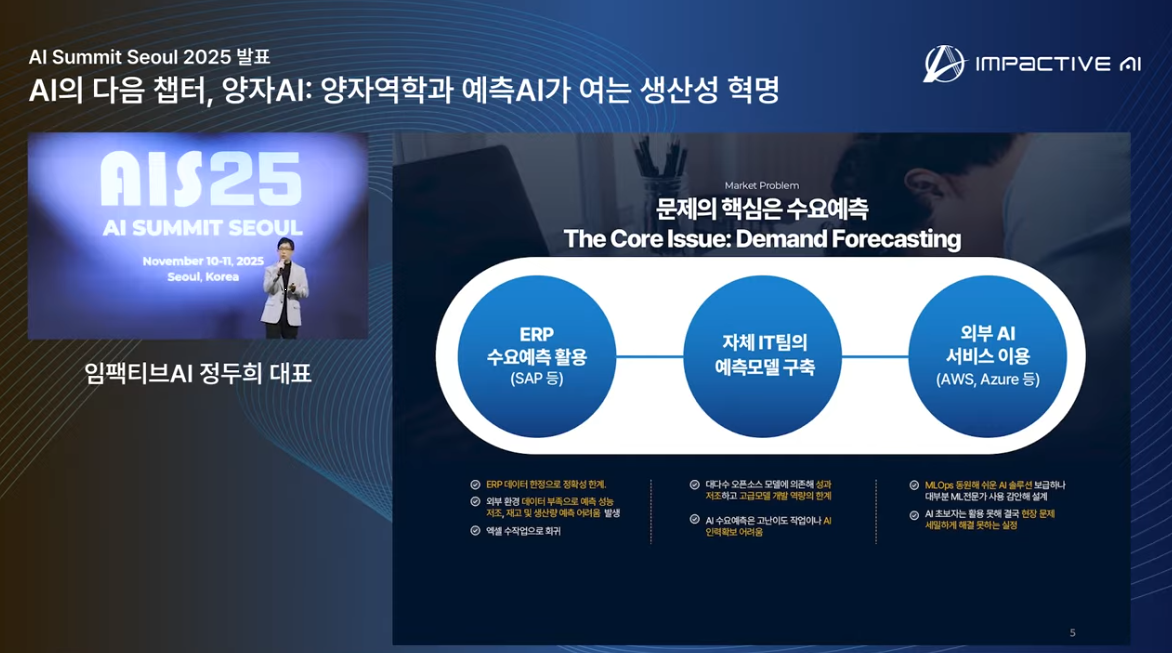
Consider the case of a German publishing company. By applying AI to analyze historical sales data alongside regional event schedules and marketing activities, the company was able to forecast book demand more precisely. This enabled it to secure inventory in advance for region-specific events and focus marketing resources on titles with strong bestseller potential. As a result, unnecessary inventory costs were reduced while sales revenue was maximized. This example demonstrates how accurate demand forecasting is not only the foundation of effective inventory management, but also a critical process that enables informed and strategic business decisions.
In some cases, businesses encounter unexpected variables often described as “black swan” events—situations that are difficult to predict using historical data alone. A technology that pushes beyond the limits of traditional forecasting models in such scenarios is Quantum AI.
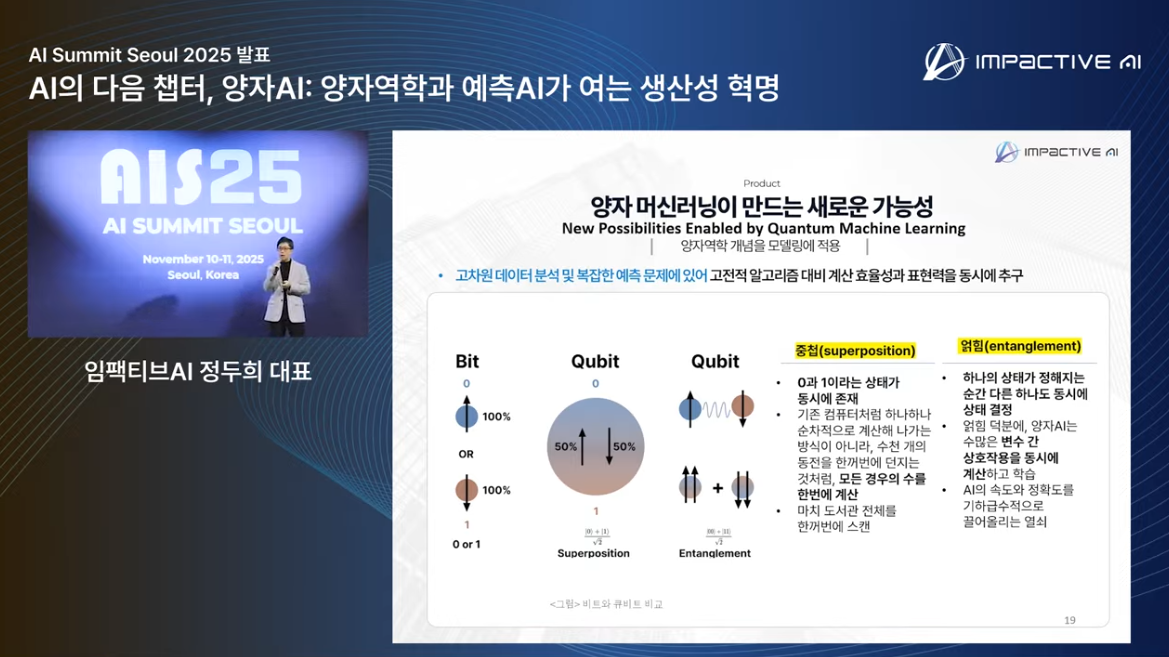
Quantum AI leverages principles of quantum physics to process complex, high-dimensional data far more efficiently. In forecasting challenges where numerous market variables and customer behavior patterns are intricately intertwined, Quantum AI utilizes quantum properties such as superposition and entanglement to perform calculations at speeds that even conventional supercomputers struggle to achieve. This significantly enhances forecasting accuracy and efficiency, opening new possibilities beyond the constraints of traditional machine learning models.
Events that appear unpredictable often emerge under specific conditions. These conditions can be transformed into quantifiable data and incorporated into forecasting models. For example, data related to disease outbreaks, sudden policy changes, or natural disasters can be collected, simulated, and integrated into future models to strengthen forecasting robustness. In this way, Quantum AI contributes to reducing the “gray zones” of uncertainty in prediction.
Accurate demand forecasting is essential for effective inventory management. Without reliable forecasts, companies risk losing sales opportunities due to stock shortages or incurring significant losses from excess inventory, including storage and disposal costs. As supply chains grow increasingly complex, these challenges become even more pronounced. AI demand forecasting is the most powerful tool for analyzing market volatility and ensuring that the right amount of inventory is secured at the right time.
Even the most advanced AI technology cannot deliver true value if it fails to solve real problems for users in operational settings. Rather than focusing solely on technical performance, it is essential to consider how AI can be applied in ways that are genuinely useful to end users. This requires closely aligning technological development with business needs and data, and integrating AI naturally into existing workflows.
While Quantum AI is still in its early stages, the central driving force behind today’s AI forecasting models is deep learning. Deep learning mirrors the structure of the human brain, using multi-layered neural networks to learn from data and identify patterns.
By analyzing vast datasets—including sales patterns, seasonal consumer preferences, economic indicators, and even social media trends—deep learning models uncover complex correlations that are difficult to detect otherwise. These models enable future demand forecasting with high precision, achieving prediction accuracy of up to 90.1% for specific products, and providing a robust foundation for business decision-making. Deep learning–based forecasting has already delivered transformative results across industries such as healthcare, logistics, and manufacturing.
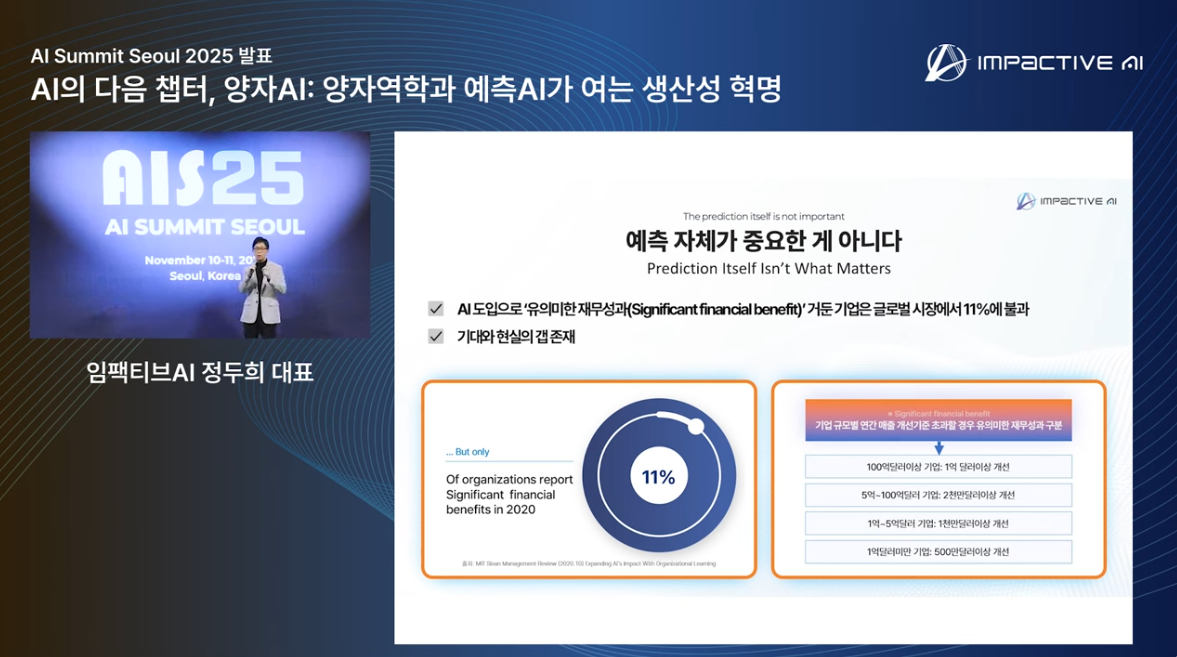
Forecasting is not a modern invention—it has been part of human history for millennia. In ancient Egypt, predicting the flooding of the Nile was a decisive factor in agricultural success or failure. Through astronomical observations and historical records, Egyptians anticipated the river’s cycles and determined optimal planting times, ensuring stable harvests and societal prosperity. This reflects humanity’s long-standing effort to prepare for the future through data and insight.
Modern AI demand forecasting is fundamentally no different from the ancient Egyptians’ approach—only the tools, data complexity, and scale of potential value have grown exponentially.
AI demand forecasting goes far beyond predicting future numbers. It is a core strategy that enables companies to identify growth opportunities and secure sustainable competitive advantage amid uncertainty. Across product development, production planning, marketing strategy, and inventory management, AI-driven forecasting enables smarter and more agile decision-making.
Advancements in Quantum AI and deep learning are elevating forecast accuracy to an entirely new level, providing a clear blueprint for capturing hidden business opportunities within data. In the future of business, AI will no longer serve merely as a tool—it will act as a strategic partner driving corporate success. For a deeper exploration, please refer to the lecture on the productivity revolution driven by Quantum AI.
.svg)

.svg)

.svg)




%201.svg)
%202.svg)


