.svg)

.svg)
%202.svg)
%201.svg)
Where Does Your Company Stand in Demand Forecasting? A Forecast Operations Assessment Checklist

Imagine your next monthly demand planning meeting.
The sales team argues that market sentiment is strong and recommends increasing order volumes. The production team takes the opposite view, pointing out that inventory is already high and urging a more conservative plan. Meanwhile, procurement wants additional evidence before making a decision because raw material prices remain volatile. Each department presents different numbers—and different reasoning. No one is necessarily wrong, yet no one is truly confident. In the end, the meeting often concludes with the same decision: "Let's just use last month's numbers for now."
This isn't unique to demand planning meetings. In procurement meetings, contract terms are revisited only after raw material prices have already increased. In new product meetings, production plans are adjusted only after the first few weeks of sales data become available. Although the topics differ, they all share the same underlying problem: decisions are made after the event, rather than before it.
When evaluating forecasting performance, most organizations start by looking at accuracy. They measure MAPE, compare improvements in WMAPE, and examine how well the model fits historical data. Accuracy is undoubtedly important—but operational performance isn't determined by accuracy alone.
Many companies improve forecast accuracy without reducing stockouts. Others implement sophisticated forecasting models yet continue to struggle with excess inventory. Procurement teams may monitor raw material prices every day and still consistently miss the best purchasing opportunities. The reason is simple: even highly accurate forecasts create little business value if they fail to influence decisions early enough.
At ImpactiveAI, we believe forecasting maturity should not be measured by accuracy alone. What matters more is when and how forecasts lead to action. Organizations that react only after problems occur achieve fundamentally different outcomes from those that act before problems arise—even when using the same forecasting models. Based on this perspective, we define forecasting maturity through four stages in the T.I.M.E. Framework.
Few organizations fit perfectly into a single stage. In reality, different departments—and even different business functions—often operate at different levels of maturity. Let's take a closer look at each stage.
Stage 1. Trail: Reacting After the Market Has Already Moved
Organizations at the Trail stage recognize changes only after they have already occurred. Transactions are recorded in the ERP system, but considerable time passes before those records become reports, are reviewed, and finally reach the decision-making table. Meanwhile, competitors adjust prices, inventories either accumulate or run short, and raw material prices move once again. Despite today's abundance of data, many organizations still operate this way.
Demand planners open last month's sales spreadsheet at the beginning of each month to determine this month's purchase orders. Procurement teams renegotiate supplier contracts only after settlement reports reveal higher raw material costs. For new products, production volumes are adjusted only after two or three weeks of sales data have accumulated. Since future demand remains uncertain, companies compensate by maintaining larger safety stocks. Ironically, organizations at this stage often possess plenty of data—they simply don't use it effectively.
Their data serves primarily as a record of what has already happened. It explains why inventory shortages occurred, but it provides little guidance on what actions should be taken before they happen. As a result, delayed decision-making frequently leads to unnecessary costs and operational inefficiencies.
Stage 2. Inform: Faster Visibility, But Still Reactive
Organizations at the Inform stage understand what's happening much faster than those at the Trail stage. Inventory managers begin each morning by reviewing SKU-level inventory dashboards. If a particular store shows a high stockout risk, an emergency replenishment order can be placed immediately. Sales teams operate similarly. By monitoring real-time sales across channels, they quickly notify SCM teams whenever a product begins selling faster than expected.
However, these organizations are still reacting rather than anticipating. By the time an alert reports a surge in sales, those sales have already occurred. When teams notice inventory depleting rapidly, stockouts are often only days away. Likewise, when procurement receives news that raw material prices have surged, the market has usually already moved. They detect change much faster—but they still respond after the fact.
Stage 3. Move: Acting Before Results Appear
Beginning at the Move stage, organizations identify signals before the market moves and take action proactively. Leading indicators—such as search trends, weather forecasts, and social media activity—are analyzed before demand or prices actually change. The same applies to events that could disrupt commodity markets, including government policy announcements and supply chain disruptions.
In demand forecasting, SCM teams use forecasts for the coming month or quarter to determine order quantities and safety stock levels in advance. Intermittent-demand products are modeled according to their own demand characteristics rather than being averaged together with other products. Even new products without historical sales can have their demand curves estimated before launch using similar products, product attributes, and early customer response data.
In raw material price forecasting, procurement teams no longer wait until prices have already increased. Instead, when news of supply disruptions or policy announcements emerges, AI evaluates the expected impact of those events on future prices. These impact scores become inputs to forecasting models, helping procurement teams determine whether to purchase early, split purchases over time, or initiate hedging strategies.
To reach this stage, both forecasting performance and explainability become critical. Business users need forecasts that are sufficiently accurate to support real operational decisions, and they must understand why the model produced a particular forecast. Even highly accurate predictions are unlikely to gain organizational trust if they cannot be explained.
Stage 4. Engineer: Designing Decisions, Not Just Forecasts
At the Engineer stage, forecasting is no longer the destination. Instead, forecasts become the foundation for evaluating risks, opportunities, and recommended actions.
Rather than simply stating, "Demand for Product A is expected to increase by 18% next week," the system goes further: "We recommend ordering an additional 380 units. Delaying the order increases the probability of a stockout by 35%. However, if demand falls below expectations, excess inventory could result in disposal losses of up to KRW 400 million."
Decision-makers no longer choose between competing forecasts. Instead, they choose among well-prepared response strategies—whether to increase orders, rebalance inventory, reduce promotional quantities, or adjust safety stock policies.
The same principle applies to raw material procurement. When the system predicts a high probability of price increases, it compares multiple purchasing strategies—such as early purchasing, phased purchasing, or delaying purchases. Each scenario includes projected procurement costs, working capital requirements, production disruption risks, and potential downside if prices move in the opposite direction. At this stage, procurement meetings fundamentally change. Instead of debating which forecast is correct, discussions focus on selecting the most appropriate response strategy and proactively managing risk before it materializes.
Self-Assessment Checklist
Use the checklist below to determine which stage best reflects your organization's forecasting maturity. In most cases, the highest stage that consistently applies represents your current level. If different stages apply across functions, the lowest stage often indicates the primary operational bottleneck.
Demand Planning & SCM Professionals
Procurement & Sourcing Professionals
How to Move to the Next Stage
If your organization is currently at Stage 1, the first priority is to move from retrospective reporting to real-time visibility. Start by consolidating channel- and SKU-level sales data, inventory data, raw material prices, and exchange rate data into a single view. Building a unified source of operational data lays the foundation for faster decision-making.
If you've already reached Stage 2, the next step is to enrich your internal data with external signals. Integrate leading indicators—such as search trends, weather conditions, and supply chain disruptions—into your forecasting models, and ensure the resulting forecasts directly support ordering and procurement decisions.
If your organization is already operating at Stage 3, it's time to move beyond forecasting itself. Layer scenario simulations and decision rules on top of your forecasts. Automate execution wherever predefined business rules allow, and shift your KPIs from forecast accuracy toward business outcomes such as profitability, inventory performance, and service levels. This is what enables organizations to reach Stage 4.
Most organizations don't reach Stage 4 overnight. The key is to understand where you are today and focus on preparing for the next stage—one step at a time.
Is It Time to Reassess Your Forecasting Maturity?
If your organization is already using AI forecasting or decision-support solutions, ask yourself one simple question: Are your forecasts actually helping you place orders earlier and make procurement decisions sooner, or are they mainly being used for reporting? If the answer isn't immediately clear, it may be time to re-evaluate your forecasting operations.
Competitive advantage doesn't come from building a more accurate forecasting model alone. Real business value is created when accurate forecasts translate into faster decisions—and faster execution.
Deepflow by ImpactiveAI goes beyond demand forecasting and raw material price forecasting to support the entire decision-making process that turns forecasts into action. Instead of remaining at the Trail stage—where organizations simply react to market changes—Deepflow helps businesses progress toward the Engineer stage, where decisions are proactively designed and executed.
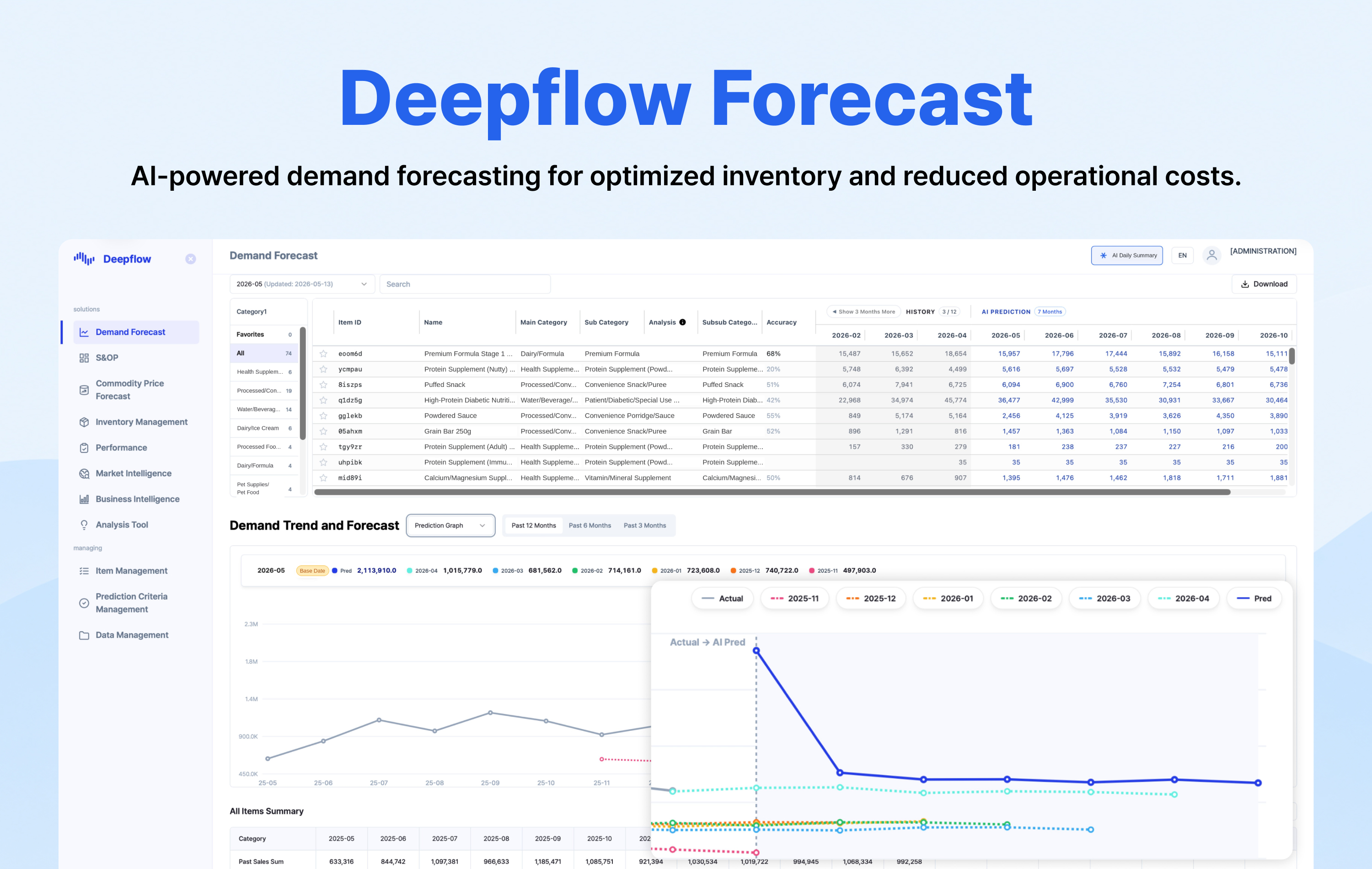
Today, organizations across industries use Deepflow to improve supply chain decision-making, reduce uncertainty in new product launches, minimize inventory risk in the food industry, and lower raw material procurement costs. If you're wondering whether Deepflow could deliver similar results for your business, experience it firsthand through our free Demand Forecasting PoC or a live demo of the Deepflow Materials solution.
.svg)


.svg)









%201.svg)
%202.svg)


.svg)