.svg)

.svg)
%202.svg)
%201.svg)
S&OP Meetings and Data-Driven Decision-Making for Revenue Growth

When you think of a typical S&OP meeting, you naturally picture gathering in a conference room each month to review data from a month ago. However, in today's fast-paced market environment, this approach alone makes it difficult to keep up with the flow of change.
As we approach 2026, S&OP is breaking free from its fixed monthly process framework and evolving into a platform capable of increasingly rapid real-time decision-making. In situations where consumer tastes shift in an instant and supply chain problems arise unexpectedly, companies must now make much faster and more accurate decisions than before.
If you are curious about the ''Efficient S&OP Process'' please refer to this article.
ㄴ
Three Key Changes in S&OP for 2026
Real-Time Planning Becomes the New Standard

The most striking recent change is that S&OP timelines are becoming more granular, shifting from monthly to weekly and even daily intervals. Organizations can now immediately reflect last week's demand fluctuations in this week's production plans and quickly adjust next week's sales targets to match actual market conditions. This real-time planning gives companies the power to respond quickly and flexibly to unexpected external shocks. Instead of waiting a month as in the past, they can take immediate action as soon as problems appear.
AI Changes the Forecasting Game
Gartner predicts that by 2030, 70% of large organizations will adopt AI-based demand forecasting. Companies already leveraging AI are reducing forecast error rates by up to 25%, resulting in 4% revenue increases. AI's real strength lies not in simply repeating past patterns, but in discovering complex correlations in data that humans easily miss. It analyzes seasonality, promotional effects, competitor trends, and even social media trends broadly to predict future demand more precisely.
In practice, companies that have implemented AI forecasting systems are reducing forecast error rates by 40% and cutting inventory costs by 15-30%. Working capital is also improving by about 15-25%. This goes beyond simple efficiency improvements to directly impact corporate cash flow and profitability.
S&OP's Expansion into IBP
S&OP is no longer just the domain of supply chain or production departments. It's evolving into Integrated Business Planning, or IBP, that encompasses strategy, finance, and sales. Financial planning and operational planning now synchronize in real time, with executive strategic decisions immediately translating into field execution. As departmental walls crumble, transparency emerges across the organization, allowing everyone to move forward looking at the same goals.
Designing S&OP Meetings That Boost Revenue
Data Integration Comes First
The biggest problem with past S&OP meetings was that each department discussed issues based on different data. Sales teams looked at sales data from CRM, production teams referenced inventory managed in ERP, and purchasing teams attended meetings with their own spreadsheets. Now we need a "single version of truth" that integrates all key information in real time on one platform, including sales performance, inventory, production capacity, raw material status, and market intelligence.
Recently, the importance of external data beyond internal information has been growing. External signals like climate change, macroeconomic indicators, social media trends, credit card transaction details, and internet search trends significantly improve demand forecasting accuracy. According to Bank of Korea research, combining such external data clearly enhances forecasting performance.
Demand Planning Captures Future Signals
Traditional demand planning mostly relied only on historical sales data. However, as we approach 2026, how well you capture signals looking toward the future has become more important. For example, when a specific product suddenly gets mentioned frequently on social media or scenes of celebrities using it go viral, this information must be immediately reflected in demand forecasts.
Some global consumer goods companies have case studies where they predicted surging demand right after celebrity endorsement issues emerged for specific products through social media analysis, and immediately adjusted production schedules to prepare inventory in advance. Models that integrate promotions, new product launches, and seasonal characteristics deliver far more accurate results than looking at historical data alone.
Finding Realistic Balance in Supply Planning
No matter how accurate demand forecasting is, it's useless if supply capabilities can't keep up. The key to supply planning is finding the optimal balance between demand forecasts and actual production and procurement capabilities. While acknowledging the reality that we cannot defy the laws of physics, we must seek creative solutions.
Pre-S&OP Meetings Should Focus on Exceptions
According to Gartner research, organizations with excellent S&OP processes perform 1.2 times better than competitors in OTIF (On-Time In-Full), costs, and inventory management.
The core of innovative Pre-S&OP meetings looking toward 2026 is exception-based decision-making. Items within normal ranges are automatically approved, and meeting time is concentrated only on issues that have arisen. Using real-time dashboards allows you to grasp key metrics at a glance, cutting meeting time by nearly half.
Status reports are shared via email in advance, and meeting time focuses only on actual decision-making and conflict resolution, which is much more efficient. Clear priorities must be set for each agenda item, and areas requiring trade-offs must be discussed transparently.
Executive S&OP Meetings That Set Strategic Direction
Executive S&OP meetings with direct management participation are venues for final approval of integrated business plans and determining the company's strategic direction. Above all, financial goals and operational plans must be properly aligned at this stage. Major and minor risks and opportunities must be freely shared, and practical plans that are executable while maximizing profits must be created.
Data-Driven Decision-Making That Enhances S&OP Meeting Performance
Data-driven decision-making is a method of making well-founded judgments by analyzing collected data rather than relying on intuition or guesswork. This has become the core of market competitiveness beyond simple efficiency improvements.
LLMs Lower the Barriers to Data Analysis
One of the biggest changes coming in 2025 is the proliferation of large language models and generative AI. Now, without having to write complex SQL queries directly, AI analyzes desired data immediately when you simply ask questions naturally.
For example, questions like "What product category had the highest sales over the past three months?" or "How would sales change if we raised prices by 10%?" can be answered immediately. Since AI finds data patterns on its own and even interprets analysis results, data analysis is gradually becoming established not as an expert-only domain but as a tool that any frontline practitioner can utilize.
The Five Stages of Data-Driven Decision-Making
Effective data-driven decision-making goes through five stages: collection, integration, analysis, visualization, and decision-making.
The collection stage requires integrating not only internal data but also external data like market, competitor, and social media information while ensuring accuracy and completeness. The integration stage removes data silos between departments and builds integrated platforms based on APIs and cloud. The analysis stage deepens progressively from descriptive statistics showing what happened, to diagnostic analysis explaining why it happened, predictive analysis forecasting what will happen, and prescriptive analysis suggesting what should be done. The visualization stage builds real-time dashboards separating executive summary views and detailed practitioner views while ensuring mobile accessibility. The decision-making stage converts data insights into actionable actions, delegates decision-making authority to those who have the data, and creates a cyclical structure for tracking and learning from results.
Implementing Next-Generation S&OP with ImpactivAI's Deepflow
To properly execute data-driven S&OP, a powerful AI forecasting platform is essential. ImpactivAI's Deepflow is a solution specializing in demand and price forecasting created by a five-year-old AI company. This solution excels at proactively resolving the uncertainty that companies face in business.
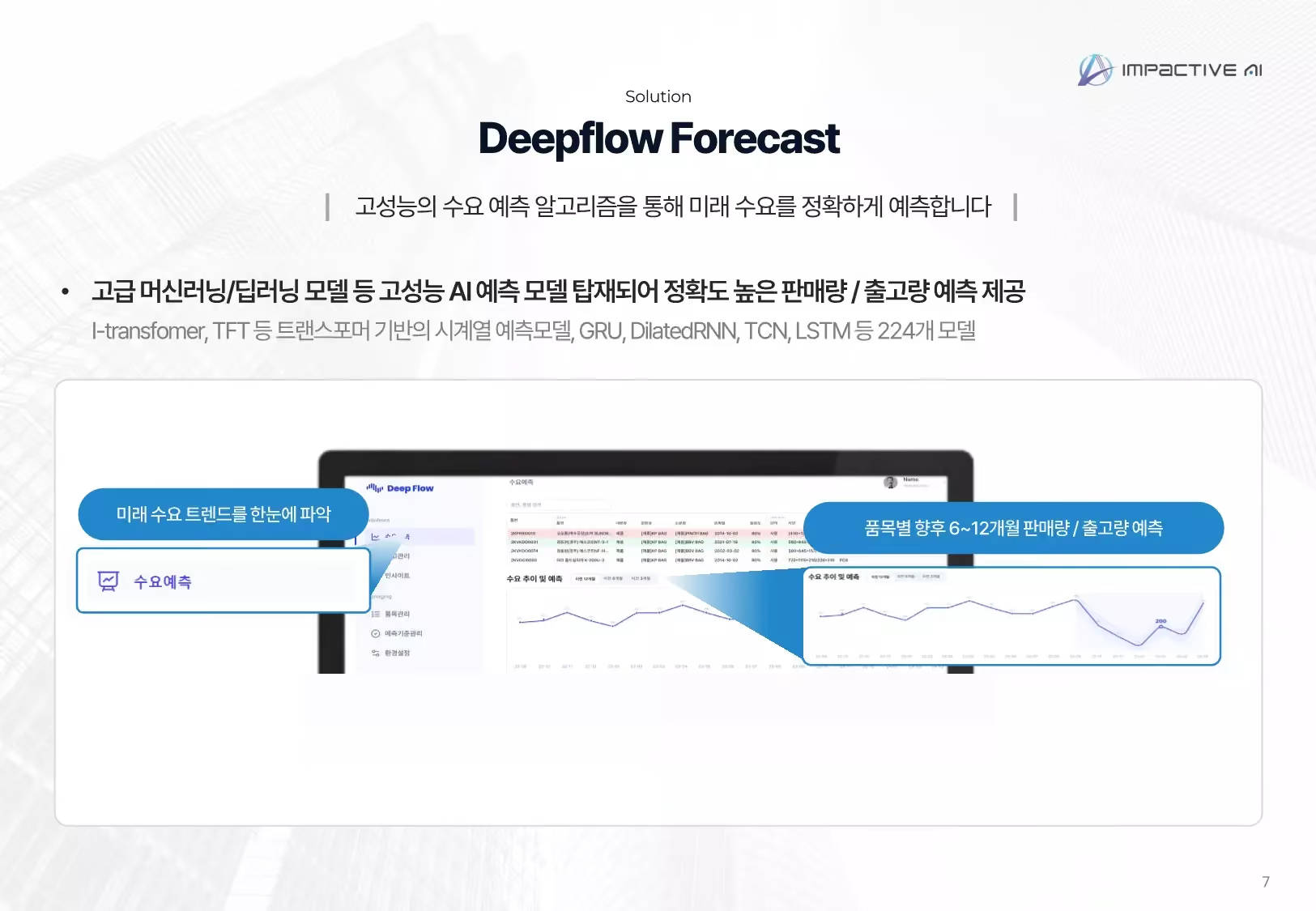
Deepflow Forecast leverages transformer-based time series forecasting models like I-transformer and TFT to provide high-performance forecasts that meticulously reflect sales and shipment patterns for each SKU. It can accurately predict sales volumes and shipment quantities for the next six to twelve months and systematically manage days of inventory supply in conjunction with base inventory. This significantly enhances data-driven S&OP decision-making capabilities.
Deepflow Material specializes in raw material price forecasting, supporting critical decision-making when selecting purchase timing. It predicts future prices for various items like minerals, agricultural and marine products, and construction materials by analyzing diverse economic indicators and variables with AI, achieving forecast accuracy up to 98.6%.
One of Deepflow's greatest strengths is its automated process with applied AutoML. Model training and deployment occur automatically whenever new data comes in, and the web dashboard shows at a glance which items are expected to face shortages or excess inventory. This is also a core function enabling the exception-based Pre-S&OP meetings mentioned earlier.
Understanding AI Demand Forecasting-Based S&OP Through Case Studies
[Deepflow Use Case Example] Food Manufacturer's Use of Deepflow Forecast
Let's take mid-sized food manufacturer Company B as an example. They had difficulties with inventory management due to producing products with severe seasonal demand fluctuations. The existing forecasting method relying on Excel and staff experience couldn't reflect external factors, repeatedly causing problems where they either missed sales opportunities due to inventory shortages or incurred disposal costs from excess inventory.
If Company B were to implement Deepflow Forecast, through a pilot with two beverage product lines, AI could learn from various data including past sales, weather, and promotions to identify detailed sales patterns and complex correlations for each SKU. For instance, AI would find key factors previously overlooked, such as explosive sales of specific beverages during heat waves.
The Deepflow dashboard clearly shows products with inventory issues, allowing monthly S&OP meetings to focus on core issues like demand increase drivers and response strategies instead of reviewing normal products. This reduces time spent explaining Excel forecasts. AI forecast results enable all departments—production, purchasing, and sales—to establish plans based on the same data, drastically reducing interdepartmental conflict and coordination time while increasing efficiency.
[Actual Customer Case] Luxury Fashion Brand M's Data-Driven S&OP Decision-Making Innovation with Deepflow

Global luxury fashion brand Company M was struggling with inventory and supply chain operation efficiency amid rapidly changing markets and regionally different consumption patterns. Traditional experience-based forecasting made it difficult to reflect complex external factors like consumer sentiment, exchange rates, and promotions, limiting SKU-level demand forecast accuracy and repeatedly causing inventory excess or stockout risks. To solve these problems and establish a sophisticated data-driven S&OP decision-making system, Company M implemented ImpactivAI's Deepflow Forecast.
Deepflow integrated learning from Company M's internal sales data as well as vast internal and external data including exchange rates, consumer behavior indicators, and real economy indicators to analyze complex demand patterns. Particularly, it selected and applied 84 models optimized for Company M's data from 224 models to capture the non-linear characteristics of luxury demand, deriving the key insight that consumer behavior factors work much more importantly than macroeconomic indicators, along with regional market differences and global consumer interest levels. This became important evidence enabling Company M to make strategic decisions based on customer psychology and behavior.
As a result, Company M achieved an average 81.3% demand forecast accuracy through the project, recording especially high accuracy of 83.6% for strategically important Top 30% SKUs. These validated forecast values were actively utilized in practical S&OP business decisions like inventory operations, ordering plans, and promotional strategies to maximize efficiency. Through AI-based sophisticated analysis, Company M established the foundation for data-driven management and plans to continuously increase global operational efficiency by expanding application of the forecasting system going forward.
[Actual Customer Case] Manufacturing Company's Use of Deepflow Material
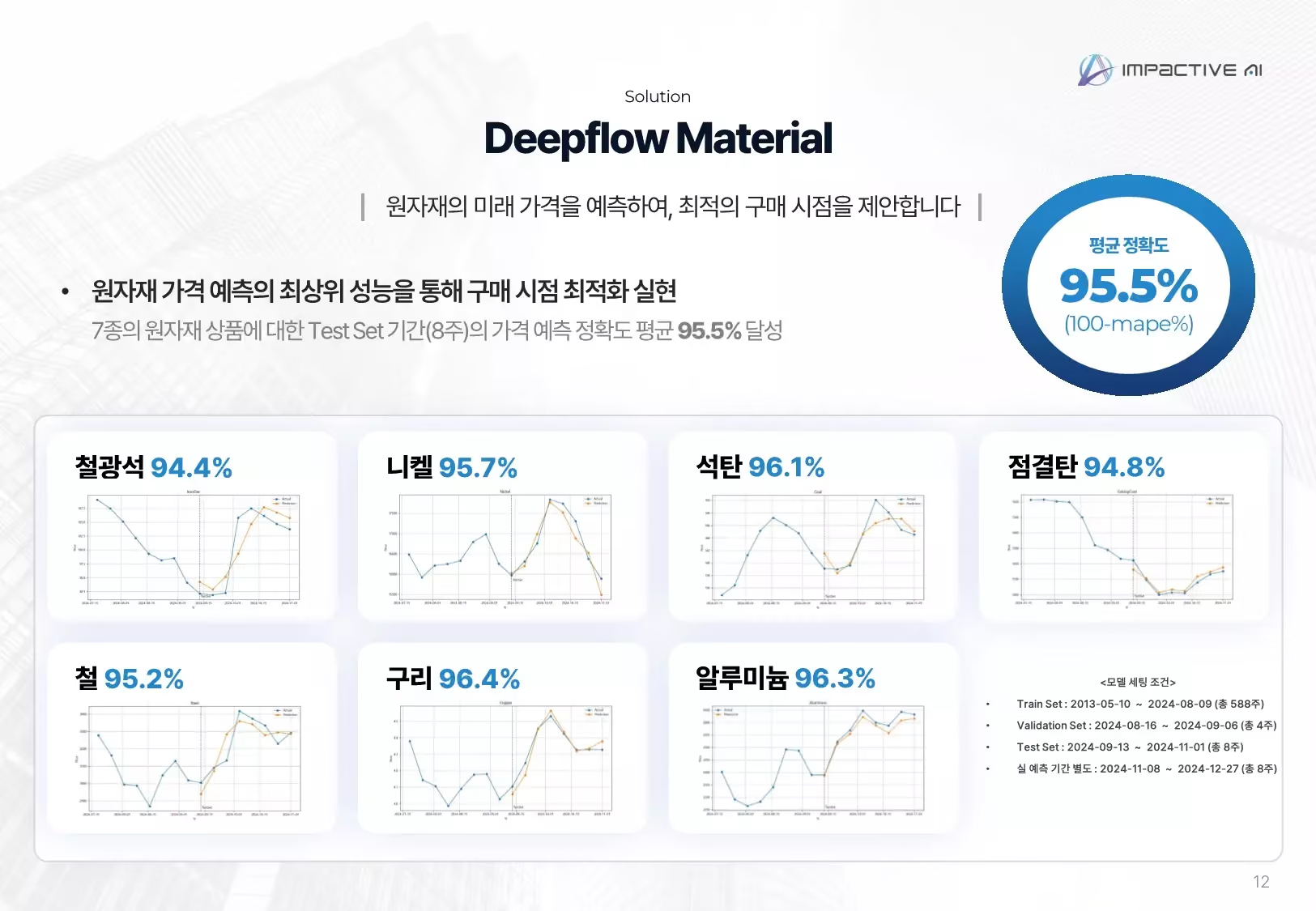
Domestic construction company B is a firm pursuing eco-friendly new businesses alongside traditional construction capabilities. However, due to recent drastic raw material price fluctuations and global supply chain instability, they were experiencing significant uncertainty in purchase timing and contract pricing decisions. Because of construction's high raw material proportion, subtle differences in purchase timing could lead to cost differences of hundreds of millions of won, and the existing experience-based judgment approach reached limits in both accuracy and speed. To solve these problems and transform raw material purchasing decisions from experience and intuition to data-based decisions, Company B implemented ImpactivAI's DeepFlow Materials and conducted an AI raw material forecasting validation project.
DeepFlow extensively utilized raw material market data as well as supply data like domestic and international production/inventory volumes, and global economic indicators like exchange rates, interest rates, and stock market indices to forecast four key raw material prices: rebar, electrolytic copper, hot-rolled coil, and thermal coal. Particularly, by selecting and applying the most suitable models from Deepflow's 224 forecasting models for Company B's major raw material characteristics and variable structures, it quantitatively analyzed non-linear and complex raw material price fluctuation factors. In this process, it clearly identified key variables having the greatest impact on price forecasting for each raw material, securing deep data-based insights.
Through this project, Company B achieved maximum 98.5% and average 96%+ accuracy in seven-week raw material price forecasting. This high accuracy established a solid foundation for Company B to make strategic purchasing decisions like purchase timing determination, order priority adjustment, and long-term contract simulation based on objective data (AI forecast values) rather than experience and intuition. Ultimately, through DeepFlow Materials, Company B effectively managed raw material price volatility to realize cost savings and reached an important turning point in establishing a data-based strategic management decision-making system.
Key Elements for Successful S&OP
How Will Future S&OP Change?
By 2026, AI will become essential rather than optional in supply chain management. With rapid decision-making, excellent risk visibility, accurate forecasting, and large-scale automation becoming possible, AI will establish itself as indispensable across global manufacturing and supply chains. Its importance continues growing amid ongoing economic and geopolitical uncertainty.
Multifaceted Approach for Successful S&OP
Building and operating a successful S&OP system requires a multifaceted approach. First, from a cultural perspective, strengthening collaboration and transparency, encouraging data-driven decision-making, and viewing failures as learning opportunities are important.
From a technical perspective, integrated planning platforms, AI forecasting tools, and real-time visualization dashboards are essential requirements. From a process perspective, clarifying S&OP cycles, operating exception-based meetings, and establishing systems for continuous improvement must be in place. Finally, from a personnel perspective, data literacy education, cross-departmental capability building, and change management programs must necessarily provide support.
Realistic Success Strategies for the AI Supply Chain Era
Above all, rather than aiming for perfection from the start, beginning with small steps, learning while gradually expanding and iterating is a realistic success strategy. In the 2026 AI supply chain era, companies that truly win will not be those that simply adopted new technology quickly, but those that naturally harmonized technology with human leadership. Now is the best time to re-examine and innovate your S&OP and decision-making processes.
.svg)


.svg)







%201.svg)
%202.svg)


.svg)