.svg)

.svg)
%202.svg)
%201.svg)
Ildong Foodis Reduces Inventory Risk by 26% with AI Demand Forecasting
[Case Summary]
- Company: Ildong Foodis
- Industry: Food
- Challenge: Inventory optimization through demand forecasting
- Solution Used: Impactive AI Deepflow Forecast
- Forecast Scope: Major product lines of Ildong Foodis
- Results: Achieved over 80% average demand forecast accuracy, reduced inventory risk by more than 26%
1. Company Overview
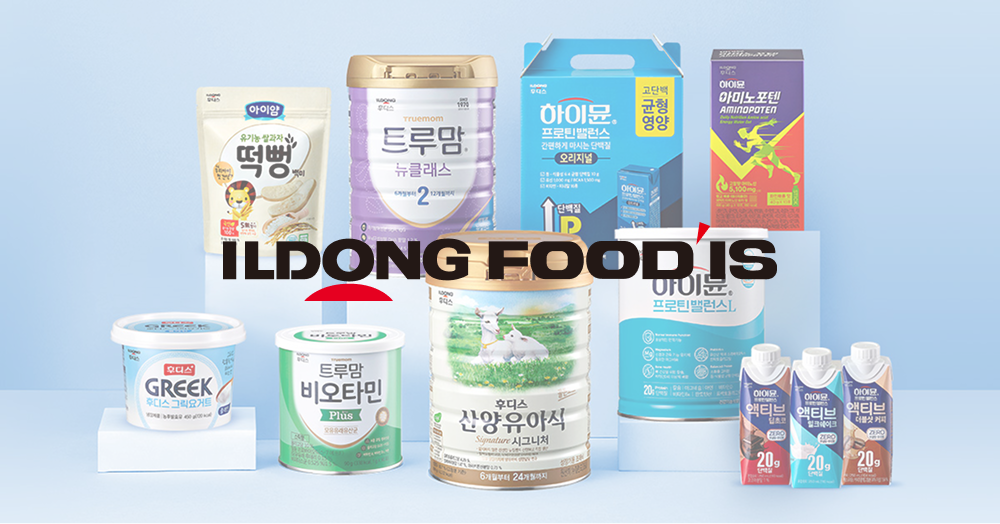
Ildong Foodis is one of Korea’s leading food companies, offering a wide range of products including infant formula, health functional foods, and fresh food products. Built on a foundation of quality and trust, the brand has been loved by consumers for many years.
As consumer trends have begun to change rapidly and distribution channels have diversified across both online and offline platforms, Ildong Foodis recognized a growing need to manage inventory more stably based on precise demand forecasting tailored to product characteristics. In particular, for products with short shelf lives, inaccurate demand forecasts often led to increased disposal costs due to excess inventory or sales losses caused by stockouts.
Against this backdrop, Ildong Foodis adopted Impactive AI’s Deepflow Forecast to establish a data-driven demand forecasting framework.
2. Project Background – Inventory Optimization for Short Shelf-Life Food Products
The food industry is characterized by multiple factors that simultaneously influence demand, including product shelf life, seasonal consumption patterns, promotional effects, and diverse sales channels. Due to this complexity, it has become increasingly difficult to accurately capture item-level demand volatility using traditional approaches.
Ildong Foodis supplies its products through a wide range of distribution channels such as online malls, large retail chains, and specialty stores, making it especially important to reflect channel-specific sales characteristics and promotional impacts in demand forecasting.
The core objective of the project was to accurately forecast demand for key product groups at the SKU level and, based on these forecasts, establish an inventory optimization strategy that minimizes both stockouts and excess inventory.
3. Data – Leveraging a Broad Range from Internal Sales to External Environmental Factors
To ensure accurate demand forecasting, both internal sales data and external environmental data were utilized. Internal data reflected actual purchasing behavior, including sales volume, sales channels, and product attributes. External data captured various environmental factors that influence consumption in the food industry. The data used included:
- Internal data: Sales volume, sales channel information, promotion data, etc.
- External data: Advertising and review data, macroeconomic indicators, industry environment change indicators, seasonal signals, etc.
Promotion-related data, in particular, played a critical role, as promotions have a direct impact on sales volume. As more promotional data accumulated, the model was able to learn more precisely how specific discount events and channel-level promotions affected demand, leading to further improvements in forecast accuracy over time.
4. Models – Applying Optimal Model Combinations Based on Product-Specific Demand Characteristics
Because demand patterns varied significantly by product, a single model was insufficient to fully explain demand volatility across the portfolio. To address this, Deepflow selected and applied the most suitable models from over 200 forecasting models based on the data structure of each product.
Model selection considered not only basic time-series patterns but also the ability to simultaneously incorporate various factors such as distribution structure–specific consumption behavior, price changes, promotions, and macroeconomic indicators. Given the nature of food products, where sudden demand spikes and event-driven fluctuations are common, model interpretability—particularly the ability to explain forecast variability—was also an important consideration.
Key Models Applied
Among the models used, the Boosting Regressor played a central role. This model is well suited to learning nonlinear relationships and interactions between variables, allowing it to effectively capture sharp increases in sales driven by promotions in specific channels, as well as the combined effects of inflation and economic indicators on demand.
In other words, it enabled a forecasting structure that reflects real market conditions rather than relying solely on historical time-based trends.
Modeling Process to Maximize Accuracy
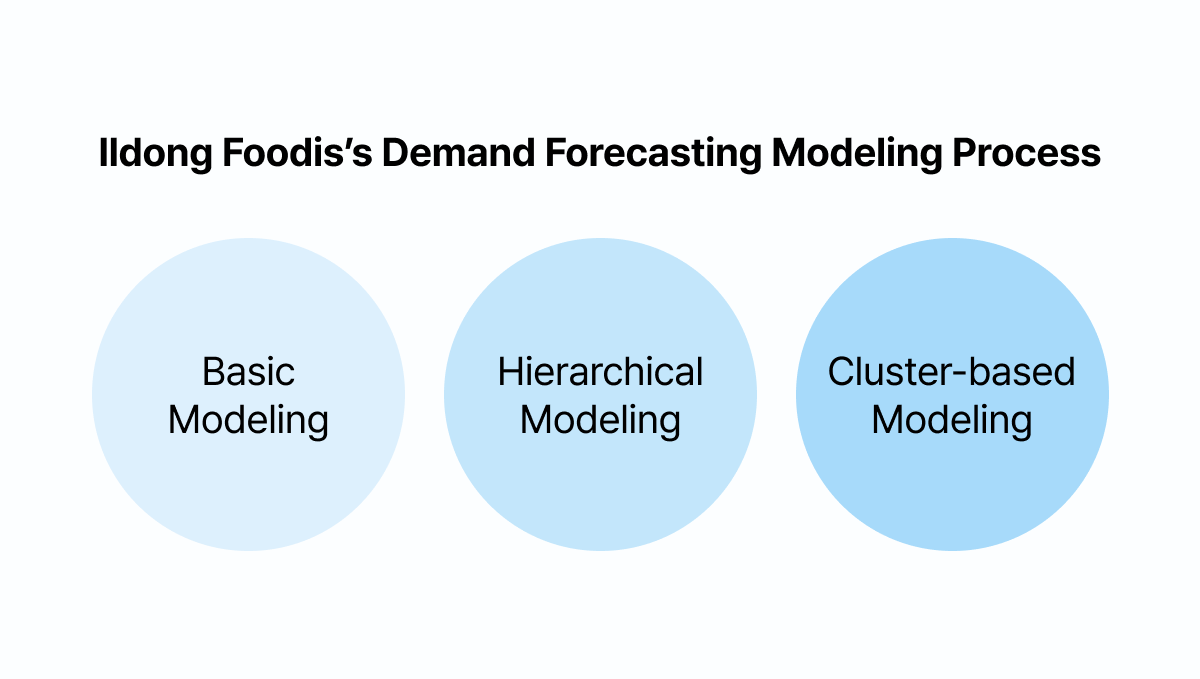
The modeling process began with baseline modeling, followed by Hierarchical Modeling that reflected product group and channel structures, and then Cluster-based Modeling, which grouped products with similar demand patterns to improve learning efficiency.
Through this approach, high forecast accuracy was achieved even for items with limited data, while also precisely capturing category-specific characteristics.
5. Results – Over 80% Average Accuracy and 26% Reduction in Inventory Risk

As a result of the project, average demand forecast accuracy for major product groups exceeded 80%. In particular, higher accuracy was observed for core products with a large share of revenue, and demand fluctuations for highly volatile items were captured in a stable manner.
When comparing opportunity costs caused by stockouts and excess inventory over a six-month period against the previous approach, inventory risk was reduced by approximately 26.2%. This represented a meaningful reduction in inventory burden for short shelf-life products and significantly improved Ildong Foodis’s overall operational efficiency.
Going forward, Ildong Foodis plans to further enhance demand forecasting accuracy using Deepflow and continue to advance its inventory strategy and supply chain operations.
6. Conclusion
Through this project, Ildong Foodis confirmed that AI-based demand forecasting can effectively improve forecast accuracy even for food products with short shelf lives and high volatility. By precisely integrating and analyzing internal sales data with external environmental factors, the company was able to manage its inventory structure more efficiently and directly realize inventory cost reduction benefits.
Impactive AI will continue to support the advancement and utilization of forecasting models to ensure that Ildong Foodis’s data-driven operational capabilities can scale in a stable and sustainable manner.
.svg)

.svg)






%201.svg)
%202.svg)


.svg)