.svg)
%202.svg)
Global Luxury Fashion Brand M Achieves 81.3% Demand Forecasting Accuracy with Deepflow
[Case Summary]
- Company: Luxury Fashion Brand M
- Industry: Fashion
- Challenge: Enhancing SKU- and Region-Level Demand Forecasting
- Solution Used: Impactive AI – Deepflow Forecast
- Forecasting Target: Demand forecasting for bags and accessories
- Result: Achieved an average forecast accuracy of 81.3%
1. Client Overview
Brand M is a global luxury fashion company that continues to grow across Asia, expanding from handbags to apparel and lifestyle products.
Operating in a fast-changing and highly competitive luxury market, M faced increasing pressure to expand its product lineup while managing inventory and supply chain operations more efficiently.
Because consumer behavior varies significantly across countries and regions, relying on inaccurate demand forecasts inevitably led to repeated risks of overstock or stockouts.
To build a more precise and data-driven forecasting system, M launched a project using Impactive AI’s Deepflow Forecast.
2. Project Background – Building a Precision SKU/Region Forecasting Framework
Luxury product demand is influenced by a wide range of factors, including consumer sentiment, exchange rates, economic environment, seasonality, promotions, and regional brand preference.
Traditional experience-based forecasting methods cannot fully reflect these factors, limiting SKU-level accuracy.
The goals of the project were:
- To identify the most suitable models for M’s bag and accessory SKUs (SKU–Region level)
- To analyze key variables that influence demand
- To build an AI-based forecasting system that can be used repeatedly in future operations
Ultimately, the aim was to provide a foundation for more data-driven decisions in sales strategies, inventory operations, and promotional planning across countries and regions.
3. Data – From Internal Sales Data to External Market Variables
To improve forecasting accuracy, Company M used both internal and external datasets. Internal data captured actual sales behavior, while external factors reflected the luxury market’s sensitivity to broader environmental changes.
Data Used
- Internal Data: Sales data (store, product code, price, discounted price, etc.), country/region information
- External Data: Exchange rates, consumer behavior indicators (e.g., Google Trends), macroeconomic indicators (such as oil prices and raw material indices), money supply, and regional variables
The combined dataset allowed the model to learn not only time-series patterns but also the complex effects of consumer sentiment and global economic indicators on demand.
4. Modeling – Selecting 84 Optimal Models Out of 224
Deepflow consists of 224 forecasting models. For M, 84 models that best matched its demand characteristics and data structure were selected.
Because luxury demand shows nonlinear patterns and complex variable interactions, combining multiple models—not a single one—generated significant performance improvements.
Key Models Applied
Among the core models applied, Boosting Regressor models and Prophet played a central role. This is because M’s demand is influenced not only by simple time-series patterns but also by various factors such as regional consumer traits, consumer sentiment, exchange rates, and promotions.
- Boosting Regressor Models:
- Learn nonlinear relationships and interactions among variables
- Suitable for incorporating regional consumer traits, exchange rates, promotions, and more
- Prophet:
- Decomposes trend, seasonality, and event effects
- Effectively captures demand surges during discounts and seasonal events
Modeling Process to Maximize Accuracy

The modeling process began with Basic Modeling, then proceeded to Hierarchical Modeling that incorporates category and regional structures, and finally to Cluster-based Modeling that groups SKUs with similar patterns to enhance predictive performance. This step-by-step approach was designed to reflect the hierarchical nature of the data and to maximize accuracy in an environment where SKU-level data can be limited.
Key Drivers Identified by the Model
Analysis of model performance showed that factors reflecting regional market differences and global consumer interest accounted for a large portion of overall variability. Economic indicators representing macroeconomic conditions also contributed at a moderate level, confirming the consistent influence of external economic environments such as oil prices and exchange rates on demand.
Additionally, consumer-behavior variables demonstrated much stronger influence than macroeconomic indicators, indicating that luxury consumption responds more sensitively to interest-based and psychological factors rather than purely economic metrics. As a result, M’s demand forecasting model was found to operate by capturing both structural market factors and macroeconomic trends while modeling consumer-behavior-driven patterns even more precisely.
5. Results – Average Accuracy of 81.3%, Up to 83.6% for Key Product Groups
The project achieved an average demand forecasting accuracy of 81.3% across all SKUs. In particular, for the top 30% of strategic SKUs with large sales volumes, accuracy increased to 83.6%, confirming strong operational applicability. (Forecast accuracy: 100 – MAPE%)
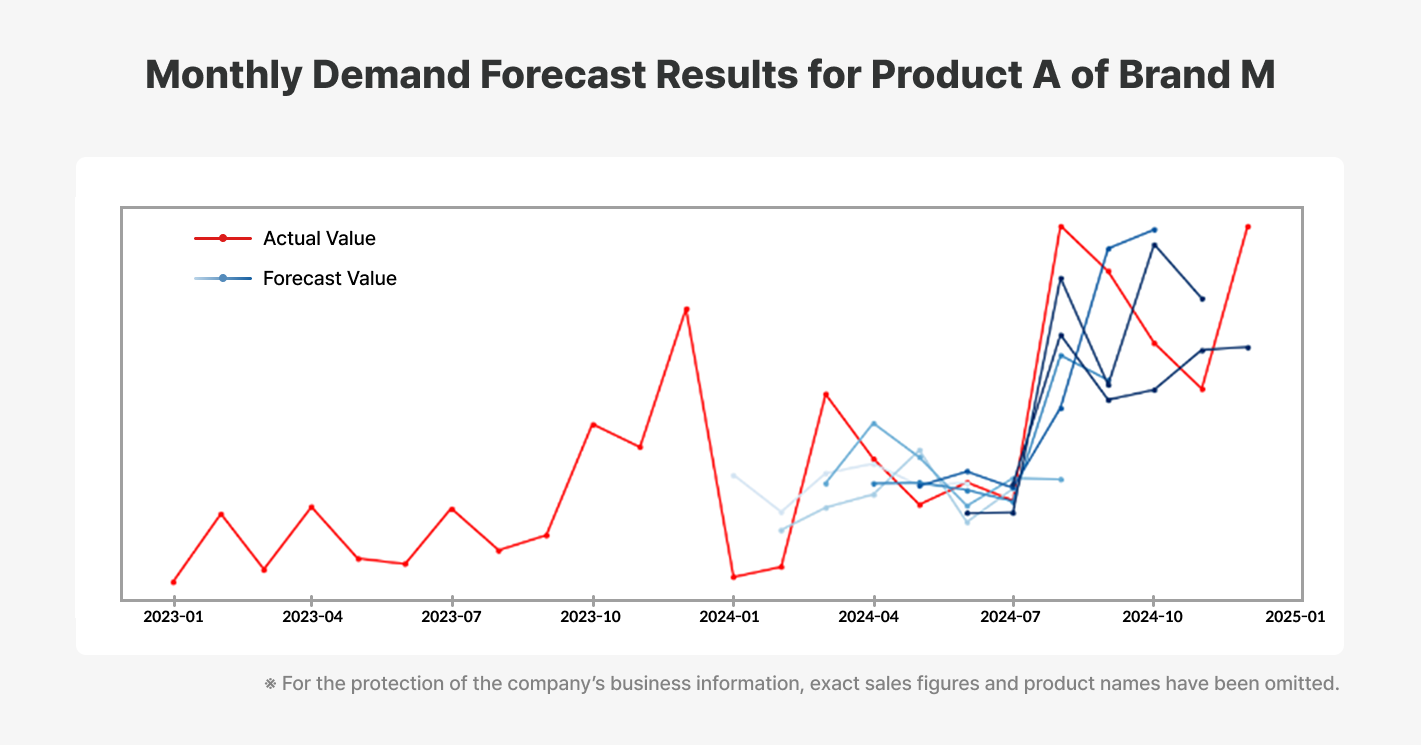
Looking at the actual monthly demand forecasts for M’s products, Deepflow’s predictions closely matched real values, capturing upward and downward movements with stability.
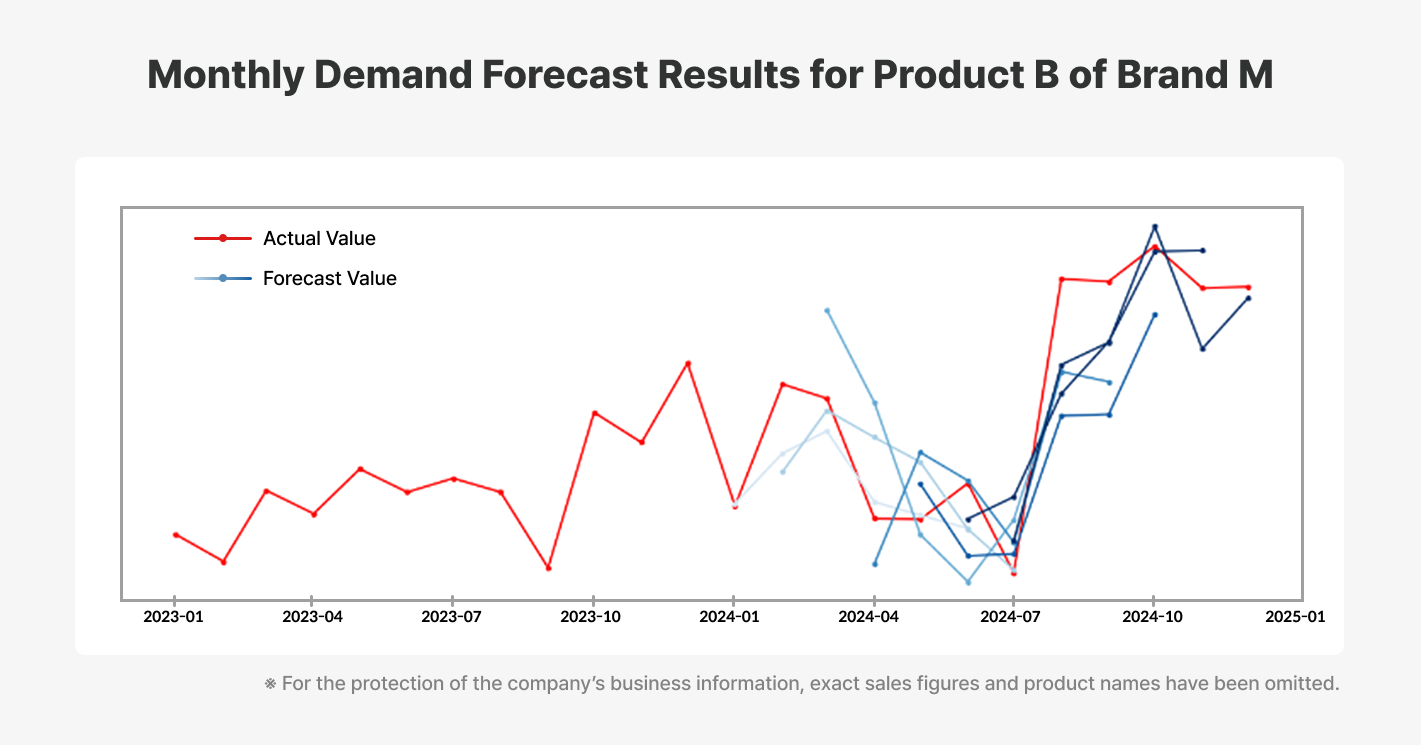
M’s products are characterized by high volatility, and Deepflow showed that it could reliably predict this volatility by using appropriate models and data. Both overall demand trends and fluctuations were accurately captured, making the forecasts highly practical for production and inventory management.
M also identified several additional insights through Deepflow. By analyzing the contribution of external variables learned by the forecasting model, the company was able to clearly understand which factors most strongly influence demand. Quantitative analysis revealed how exchange-rate fluctuations impact specific product groups and how promotion discount rates behave differently across regions, providing a foundation for more effective pricing and inventory strategies.
6. Conclusion
Through this project, M confirmed that complex SKU·Region-level demand patterns—previously difficult to capture using traditional methods—can be analyzed with precision using AI. Deepflow provided clear insight into how various internal and external variables influence demand, establishing a foundation for applying these insights in practical business decisions such as inventory operations, order planning, and promotional strategy.
Beginning with this project, M is now considering expanding its AI-based demand forecasting system to additional categories and regions, and this initiative is expected to serve as an important turning point for enhancing global operational efficiency.
.svg)

.svg)