.svg)

.svg)
Download Brouchure
%202.svg)
Oops! Something went wrong while submitting the form.
%201.svg)

In February 2026, immediately after the U.S. airstrike on Iran’s nuclear facilities, the global supply chain was shaken in an instant. Oil prices surged, while key raw material prices and logistics became unstable.
Events like this—low in probability but massively disruptive when they occur—are called Black Swan events. The key challenge is that Black Swans do not exist in historical data, making them extremely difficult to predict with traditional AI models. For a long time, this has been considered an almost impossible problem.
However, as predictive models advance and AI technologies such as LLMs and agents evolve, this “impossible” is gradually being broken. It’s not just about improving prediction accuracy—it’s about fundamentally changing how predictions are made.
Traditional demand forecasting models are trained on structured data such as historical sales records and ERP data. But Black Swans do not exist in this data.
Even when events like wars eventually affect exchange rates or oil prices, the signal always comes too late. As a result, conventional machine learning models simply extend normal patterns, creating a massive gap between predictions and reality when a shock occurs.
For supply chain managers, this leads directly to inventory imbalances, procurement failures, and cost spikes.
While Black Swans don’t appear in structured data, early signals often emerge in news articles and social media before the event occurs. Impactive AI focuses on this insight to incorporate Black Swans into prediction models.
At the core of this approach is the LLM (Large Language Model). While LLMs have limitations in numerical computation, they excel at understanding and structuring textual information.
First, when a Black Swan event occurs, news and social media data are analyzed to extract key signals. These are automatically classified into categories such as war, policy changes, and supply chain disruptions.
By quantifying the frequency and intensity of these events, a metric is created. Accumulated over time, this becomes a new form of time-series data called the “Black Swan Impact Score.”
When this data is incorporated into demand or price forecasting models, the model no longer relies solely on historical patterns—it becomes capable of reflecting market shocks.
The results are tangible. The graph below compares nickel futures prices (top) with the Black Swan Impact Score (bottom).
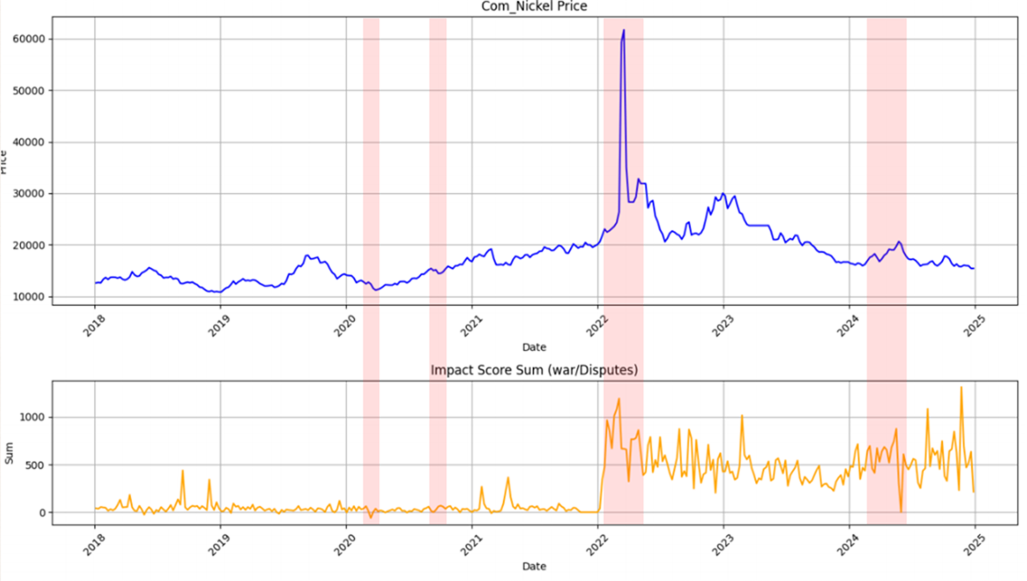
During the 2022 Russia–Ukraine war, nickel prices surged sharply. Traditional machine learning models failed to capture this and continued projecting normal patterns. In contrast, AI models trained with the event index accurately detected the price spike, improving prediction accuracy to approximately 95.5%.
Even if we can reflect the impact after a Black Swan occurs, predicting it beforehand remains challenging. Wars and pandemics are inherently difficult to foresee.
However, we can go one step further—not just reflecting shocks, but quantifying and predicting the probability of their occurrence using AI.
Not all events are entirely random. Subtle quantitative signals often appear before major events.
A well-known example is the “Pizza Index.” Observations showed that pizza orders near the Pentagon surge when military operations are being prepared. While simple, it illustrates how organizational behavior reveals itself in data before events unfold.
For example, signals that may increase the likelihood of war include:
The same principle applied during the pandemic. Canadian AI company BlueDot analyzed news data, spikes in airline bookings, and increased purchases of specific pharmacy items to warn about COVID-19 spread before the WHO. It didn’t predict the disease itself, but detected the environmental signals that increased the likelihood of spread.
We may not be able to predict “a war will break out on a specific date,” but we can detect signals that “the probability of a major disruption is increasing,” and proactively reflect this in procurement and inventory strategies.
Black Swans are not completely unpredictable—the conditions that increase their likelihood are observable in data.
Markets are not driven by numbers alone, but by human expectations, fears, judgments, and interactions. Because markets are ultimately a collection of human behaviors—not just data—there are clear limitations to predicting how people will react, especially in situations where historical data is insufficient.
AI agent-based simulation approaches this problem in a fundamentally different way. Agents are not just models; they are autonomous entities with specific goals and decision-making rules. Rather than simply processing data, they interpret situations and make decisions much like human experts. Instead of collecting more data, this approach effectively “creates” participants in the market.
Recently, simulation methods have emerged that reconstruct markets by generating multiple AI agents based on unstructured data such as news, policy updates, economic indicators, and social media. These agents are designed with different decision-making tendencies, allowing them to respond differently to the same information.
For example, simulations can incorporate diverse types of market participants, such as:
Through their interactions, the real-world market mechanism—“information → interpretation → action → interaction → collective change”—naturally emerges. When scenarios such as tariff changes or supply chain disruptions are introduced, initial reactions from a few agents gradually spread, eventually leading to phenomena like demand shocks, price spikes, and panic buying.
This approach does not rely on extrapolating the future from past data. Instead, it creates virtual scenarios and observes the outcomes. As a result, companies can more realistically evaluate procurement strategies, inventory policies, and risk response scenarios in advance.
In the age of AI, forecasting is evolving along three dimensions:
As technology advances, Black Swans are shifting from a domain of fear to a domain of preparation.
For organizations looking to proactively manage supply chain risks in demand and price forecasting, AI can be the starting point.
Impactive AI is developing proprietary methodologies to address Black Swan events—such as tariffs, geopolitical issues, and pandemics—that are difficult for traditional statistical models to capture.
If unpredictable market volatility is making procurement, inventory, and pricing strategies difficult, start a new approach to forecasting with Impactive AI.
.svg)

.svg)

.svg)









%201.svg)
%202.svg)


