.svg)

.svg)
%202.svg)
%201.svg)
Why Production Teams Don't Trust AI Demand Forecasting

What happens when you implement an AI demand forecasting solution but your production management team still insists on doing things the old way? No matter how accurate the prediction model might be, it won't deliver real results if the people on the ground don't trust its output. In reality, many companies adopt AI-based demand forecasting only to find that production teams treat the results as reference material at best, or ignore them completely at worst.
This article examines what conditions must be met for AI demand forecasting to move beyond being just another system and actually get used in daily operations. We'll also look at what practical efforts are needed to earn the trust of production management teams.
Why AI Demand Forecasting Gets Ignored in the Field
Companies that implement demand forecasting solutions share a common frustration. Even when the system generates weekly predictions, production management teams don't fully trust them and ultimately rely more on their own experience and intuition. The primary reason for this phenomenon is the "black box" problem. Without explanations of how AI arrived at its predictions, practitioners find it difficult to trust those numbers when making production plans or placing orders.
Another issue is that receiving prediction numbers alone doesn't tell you what to do with them. For instance, even if you get a forecast that next month's shipments will increase by 20%, without guidance on how much to increase production, when to purchase raw materials, or what inventory levels to maintain, those numbers remain merely reference material.
Complex interfaces create additional barriers. Sophisticated dashboards designed for data scientists can actually intimidate production personnel working in the field. Practitioners who spend their days frantically checking inventory and creating order plans lack the time to learn and adopt new systems. This makes simple tools that allow anyone to quickly access essential information absolutely critical.
Core Elements for Earning Production Team Trust
Three essential components enable AI-based demand forecasting to actually get used in the field.
First comes transparency. You need to easily explain what data and logic generated the prediction results. Only then can production management teams properly understand the reasoning behind them and confidently incorporate results into production planning and inventory management.
Next is actionability. Simply showing numbers isn't enough—you need to present concrete action plans that go with them. For example, you need immediately executable guidance like appropriate production volumes, ordering timelines, and optimal inventory levels. This allows prediction results to flow naturally into actual work.
Finally, accessibility cannot be overlooked. No matter how accurate predictions might be, they won't get used if they're inconvenient or complicated to access. Core information like items at risk of stockout, excess inventory, and stock depletion dates must be presented through intuitive screens and graphs that anyone can understand at a glance. This enables practitioners to easily comprehend and immediately apply the insights.
Explainable AI That Clearly Presents Prediction Rationale

Explainable AI has recently gained significant attention in demand forecasting. While systems previously provided only prediction numbers, increasingly they now show the major factors that influenced those predictions. For example, when demand for a specific product is expected to increase, you can see specifically which elements—seasonal patterns, past promotional effects, or macroeconomic indicators—had what degree of impact.
This explanation capability plays a major role in earning production team trust. Practitioners can directly verify AI's reasoning based on their own experience and market understanding. If prediction results seem sufficiently convincing, they can use them more actively. If certain aspects don't match field reality, they can appropriately adjust or supplement them. This kind of interaction enables natural collaboration between AI and practitioners.
Features that specifically show external variables that influenced the model—like macroeconomic indicators or industry data—along with each variable's contribution prove quite useful in practice. From the production management team's perspective, they can see at a glance which market factors most significantly affect demand and use this foundation to craft more sophisticated production plans and inventory strategies.
Enhancing Execution Through LLM-Based Analysis Reports
Generative AI technology has recently elevated demand forecasting practicality to new heights through analysis reports. LLM-based analysis reports explain complex prediction data in accessible terms and propose execution strategies tailored to each department.
Looking more closely, these reports analyze past shipment trends and naturally explain seasonal patterns. They don't stop at showing graphs but specifically identify when and why demand changed. They then clearly present future demand projections and their rationale, organizing major influencing factors by importance.
The most practically helpful aspect is customized action plans by department. SCM teams receive appropriate inventory levels and ordering plans. Production teams get production volume adjustment guidance. Purchasing teams learn optimal timing for securing raw materials. Marketing teams discover effective promotion timing and methods. This facilitates smoother cross-departmental collaboration. Practitioners can quickly grasp the situation from these reports alone and immediately take necessary action.
With analysis reports in place, the time staff spend manually checking prediction values and creating separate analysis reports drops significantly. Rather than getting mired in complex data interpretation, they can focus more on strategic decision-making—the greatest advantage of all.
Maximizing Field Adoption Through Intuitive BI Dashboards

Beyond analysis reports, intuitive BI dashboards play a major role. On the production floor, quickly monitoring daily inventory changes and responding immediately matters most. This requires visualization that delivers information at a glance and insights that enable immediate action.
Effective BI dashboards immediately highlight SKUs in shortage or excess states. You can easily distinguish through colors or icons which products face imminent stockout risk and which have accumulated excessively. Without complex data analysis, you can immediately identify current priorities—a major advantage. Production management teams can thus prevent situations where sales losses from stockouts or storage costs from excess inventory spiral out of control.
Additionally, features that predict future sales flows and automatically calculate stock depletion timing or appropriate production volumes prove useful. Practitioners can reference numbers presented on dashboards to decide production plans or orders without complex calculations. Visualized materials can be used directly in executive reports without separate editing, significantly boosting work efficiency.
MI dashboards that compile external environmental information also aid decision-making. For example, when you can check exchange rates, interest rates, raw material prices, and major economic indicators at a glance, with short-term forecasts added, you can respond quickly to market changes. Particularly in industries with significant raw material price volatility, such dashboards provide reliable criteria for determining optimal purchasing timing.
ImpactivAI Deepflow's Field-Friendly Approach
ImpactivAI's Deepflow, from a five-year-old AI company, has gained attention as a demand forecasting solution ready for immediate field application. Through technical capabilities reflected in 64 patents and 224 AI models, the company focuses not just on improving prediction accuracy but on creating solutions usable in actual work.
Deepflow's greatest advantage lies in using AutoML technology to automatically handle all processes. Everything from data preprocessing through model training to prediction result generation is automated step by step. When new data arrives, models automatically retrain and immediately provide the latest prediction results. Without any technical work, staff always receive predictions based on the most current data.
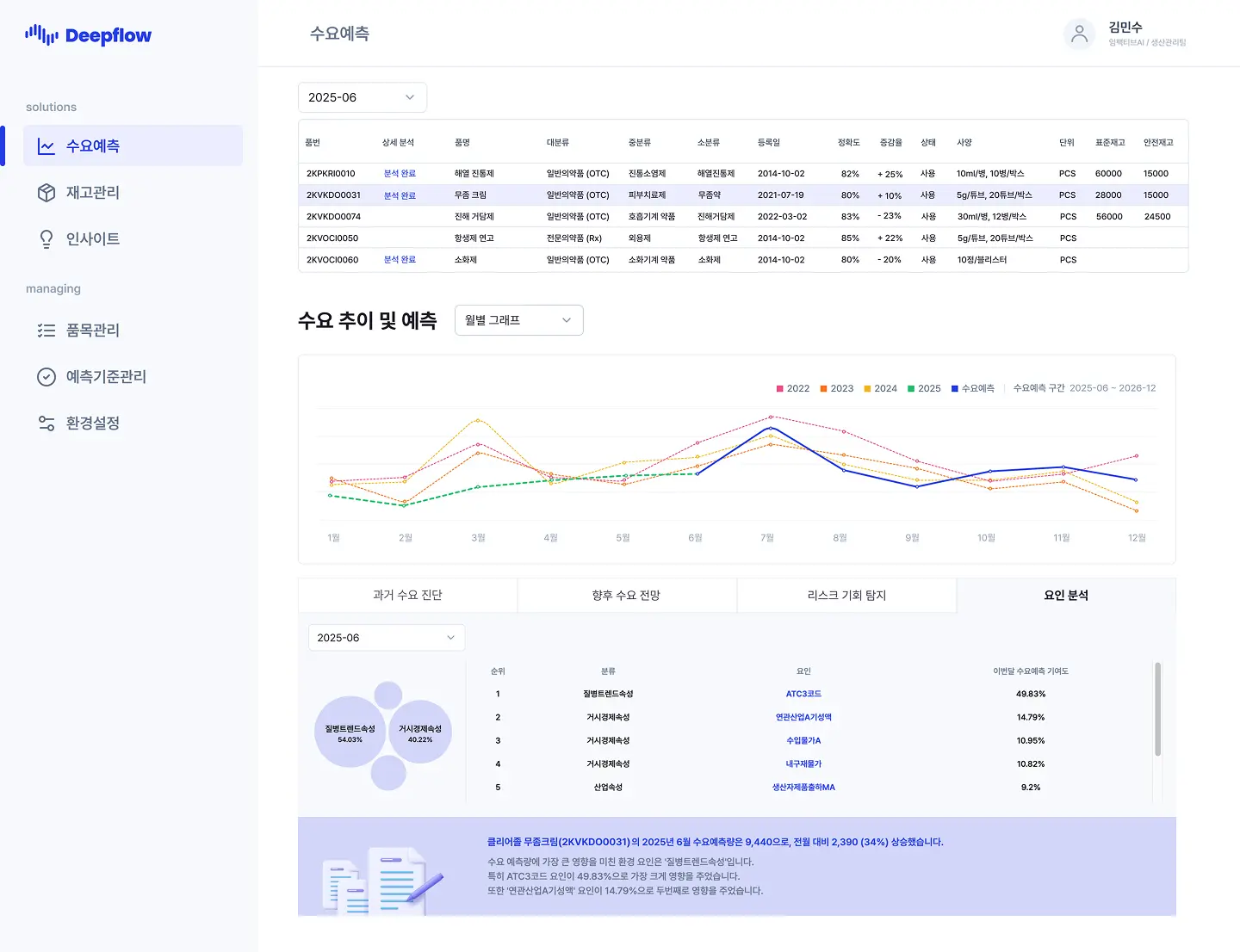
The recently added LLM-based analysis report feature proves impressive. This capability explains the reasoning behind prediction results and automatically proposes execution strategies tailored to each department. For instance, it analyzes past shipment trends and seasonal patterns to explain future demand, then provides optimized action plans for SCM, production, purchasing, and marketing departments. This allows practitioners to reduce time spent on complex data interpretation or report writing and focus solely on strategic judgment.
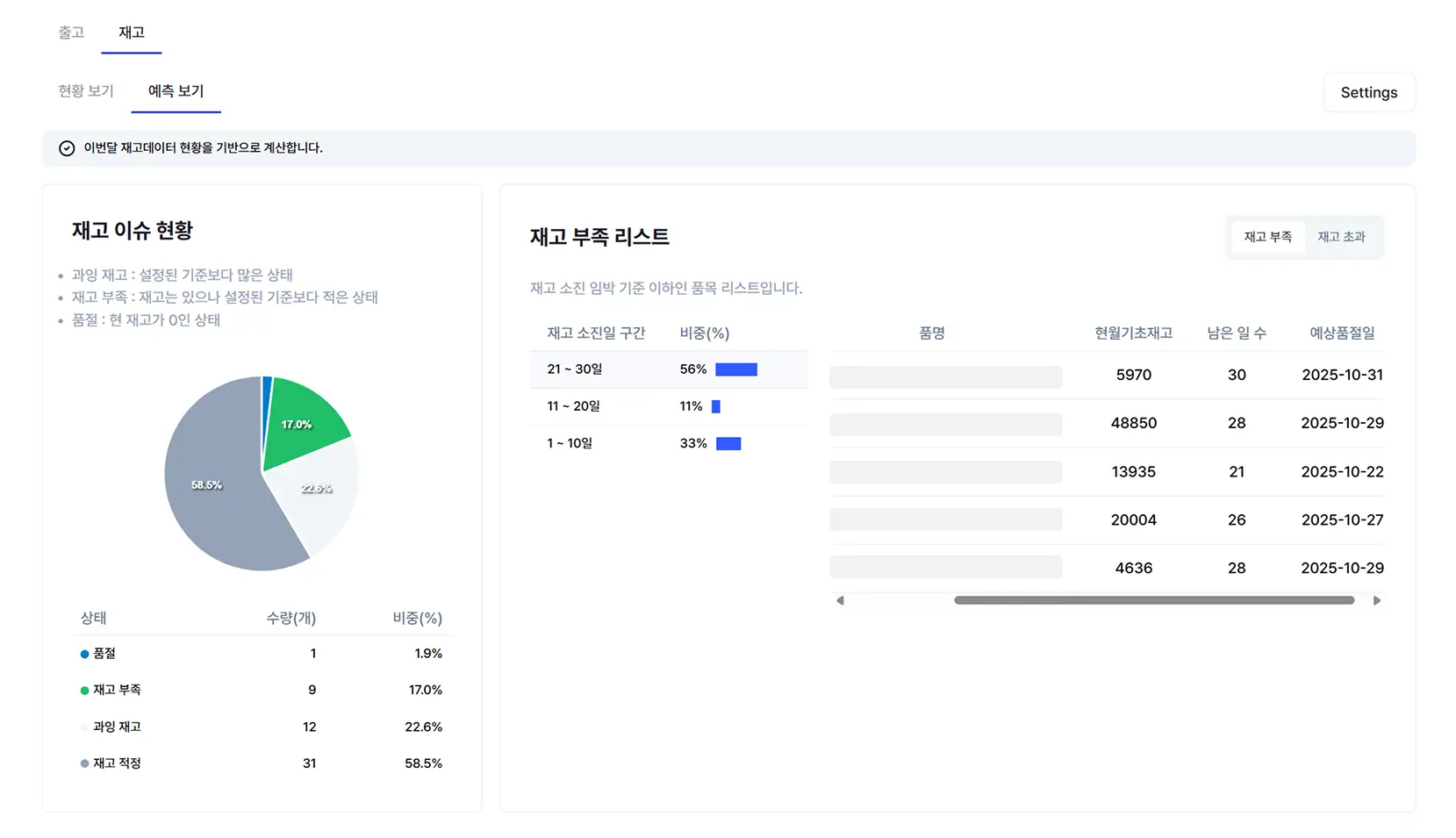
The BI dashboard's defining feature is enabling at-a-glance identification of inventory shortage or excess SKU status. By reflecting future sales fluctuations to automatically calculate stock depletion dates and appropriate production volumes, it reduces both unnecessary inventory costs and stockout risks. It also considers various elements like lead time, order cycles, and safety stock levels to help maintain appropriate inventory for each item continuously while proposing optimal order quantities and timing.
The MI dashboard provides three-month short-term forecasts for exchange rates and oil prices, enabling proactive responses to market volatility. Particularly when utilizing the Deepflow Materials feature, you can anticipate future raw material prices and get substantial help determining appropriate purchasing timing. Testing on seven raw materials actually recorded an average price prediction accuracy of 95.5%.
Actual implementation cases prove noteworthy. Companies that adopted Deepflow achieved an average 33.4% reduction in inventory imbalances. Some clients reduced monthly inventory costs by $24.8 million while boosting work productivity to 99%. These results stem not simply from AI's superior predictive power but from providing information that practitioners can immediately apply in the field.
Trust Comes from Transparency and Practicality
For AI-powered demand forecasting to succeed, high prediction accuracy alone isn't sufficient. Even the most outstanding algorithm has no real value if it doesn't earn trust in the field. To actually gain production management team trust, you must clearly disclose prediction reasoning and provide actionable insights. A user-friendly interface that anyone can easily navigate is also essential.
In this regard, LLM-based analysis reports and intuitive BI dashboards can provide powerful solutions. They organize prediction data that might otherwise feel complex for at-a-glance review and provide practical guidance that each department can immediately use. When this approach takes root, AI and practitioners collaborate naturally, and demand forecasting can position itself as a core decision-making tool rather than mere reference material.
Therefore, when companies implement AI demand forecasting systems, they shouldn't look only at technical accuracy but must also examine how easily practitioners can use them. Choosing a system that production management teams can trust and actively utilize ultimately becomes the starting point for successful digital transformation that maintains appropriate inventory levels and reduces costs.
.svg)

.svg)








%201.svg)
%202.svg)


.svg)