.svg)

.svg)
%202.svg)
%201.svg)
What's Changing in Korea's 2026 Data Voucher Program: Key Updates for Applicants
Preparations for the 2026 Data Voucher program are already underway. ImpactiveAI is once again participating as a registered supplier, and we're sharing the key changes early so that demand-side companies can get a head start on planning their AI demand forecasting initiatives.
While 2025 marked a major structural shift with the introduction of the integrated voucher framework, 2026 is building on that foundation with a sharper focus on quality control and program effectiveness. Companies that prepared based on the 2025 announcement might assume this year's requirements are similar, but several important details have changed.
The most meaningful updates involve supplier qualification management, data quality standards, and the overall support environment. Although the demand-side company recruitment notice has not yet been released, understanding the changes confirmed through the supplier recruitment announcement will give applicants a significant advantage when the time comes.
⚠️ This article is based on the 2025 demand-side company recruitment notice. The 2026 demand-side recruitment notice has not yet been published, and specifics such as allocation ratios, funding limits, and evaluation criteria may differ in the final announcement. Always verify details through the official notices from the Ministry of Science and ICT (MSIT) and K-DATA before submitting your application.
Change #1: Stricter Supplier Qualifications with Annual Re-Evaluation
The most notable change in the 2026 Data Voucher program is the way supplier qualifications are managed. Even companies that were registered suppliers in 2025 will not have their status automatically carried over. All 2025 supplier qualifications expired on December 31, and any company wishing to participate in the 2026 program must submit a new application and undergo a fresh evaluation.
This is not a simple renewal process—it's a full reassessment from scratch. Existing registered companies must re-demonstrate that they meet all qualification requirements, and the evaluation criteria have been tightened compared to previous years. With annual re-evaluation now established as the standard framework, the government's intent is clear: only high-performing suppliers will be allowed to continue participating.
Starting in 2026, companies will likely be required to complete their Data Business Operator registration under Article 16 of the Framework Act on Promotion and Utilization of the Data Industry before they can apply as suppliers. This adds a legal requirement that was not explicitly mandated before. Any domestic entity selling data products or providing data utilization services—whether a corporation, institution, research organization, or university—must complete this registration first, as applications may not be accepted without it.
For demand-side companies, this translates into greater reliability. With only annually re-evaluated and legally registered suppliers eligible to participate, companies can spend less time vetting potential partners and more time focusing on project execution—especially valuable for first-time applicants who may find it difficult to assess supplier credibility on their own.
Change #2: Clearer Quality and Pricing Standards for Data Products and Services
The second major update is that quality and pricing standards for data products and services have become significantly more detailed and rigorous. While 2025 focused on raising the evaluation cutoff from 60 to 70 points, 2026 goes further by breaking down the evaluation criteria into finer categories and adding more hands-on verification requirements.
For data products, suppliers must demonstrate actual ownership of the data and hold direct distribution and sales rights. Simply brokering or reselling data from third parties will no longer qualify. Products must also be delivered in formats that demand-side companies can use immediately, and suppliers are required to maintain transparent pricing structures. These requirements, which were somewhat ambiguous in previous years, are now clearly defined as registration conditions for 2026.
These changes make decision-making considerably easier for demand-side companies. The introduction of transparent pricing eliminates the difficulty of comparing suppliers and reduces the risk of unexpected costs, making budget planning and vendor comparison straightforward. Clearly defined service scope, delivery methods, and timelines also significantly reduce the potential for contractual disputes or misunderstandings.
For data products specifically, the verification of direct ownership and sales rights reduces legal risks related to copyright and licensing. Demand-side companies can now have greater confidence that the data they receive can be used in their own services without running into intellectual property issues down the line.
Change #3: Integrated Voucher Framework Matures Alongside Expanded Government Data Policy
The third shift is that the integrated voucher framework introduced in 2025 has stabilized for 2026, while the government's broader data economy initiatives continue to grow stronger. The integrated voucher supports the entire data utilization lifecycle—from planning and collection to processing, analysis, and application—in a single program. This eliminates the previous hassle of submitting separate applications for data procurement and processing.
What's particularly worth noting is the government's expanding investment in the data economy. Excluding the quinquennial Population, Housing, and Agriculture/Forestry/Fisheries Census, the National Data Center's 2026 budget has increased 16.9% year-over-year. The National Data Center plans to advance AI-integrated statistical production and services while strengthening cross-government data governance and hub functions, concentrating resources on data administration. The Data Voucher program operates squarely within this broader policy momentum.
For demand-side companies, the maturation of the integrated voucher framework substantially reduces administrative burden. A single application covers the entire process, and even SMEs and startups with limited data experience can receive comprehensive support from planning through implementation. The government's sustained investment also signals that the Data Voucher program is evolving into a stable, long-term support policy rather than a one-off initiative—giving demand-side companies more confidence to build long-term digital transformation roadmaps.
2026 Data Voucher Program: 7 Frequently Asked Questions
What is the integrated voucher framework, and will it continue in 2026?
The integrated voucher bundles data procurement and processing into a single program covering the entire lifecycle—planning, collection, processing, analysis, and application. It was first introduced in 2025, and the same framework will be maintained in 2026.
Can a single company apply as both a data product and a data service supplier?
Yes. However, starting in 2026, dual applicants will likely face separate capability assessments for each category. Companies must clearly demonstrate their ability to deliver in both areas.
What do demand-side companies need to prepare for their application?
SMEs, small business owners, and startups are all eligible to apply. Support covers a wide range of objectives, including data-driven product and service development, business innovation, and AI adoption. With 2026 expected to bring tighter scrutiny of business plan specificity and feasibility, it's important to prepare clear objectives and detailed utilization plans in advance.
Can the Data Voucher be used to implement an AI demand forecasting system?
Absolutely. AI demand forecasting is already being applied across manufacturing, distribution, food and beverage, and other industries for inventory optimization and production/sales strategy development. The Data Voucher can cover implementation costs, and support spans the entire process—from requirements definition and AI model development to full solution deployment.
What does the AI demand forecasting implementation process look like?
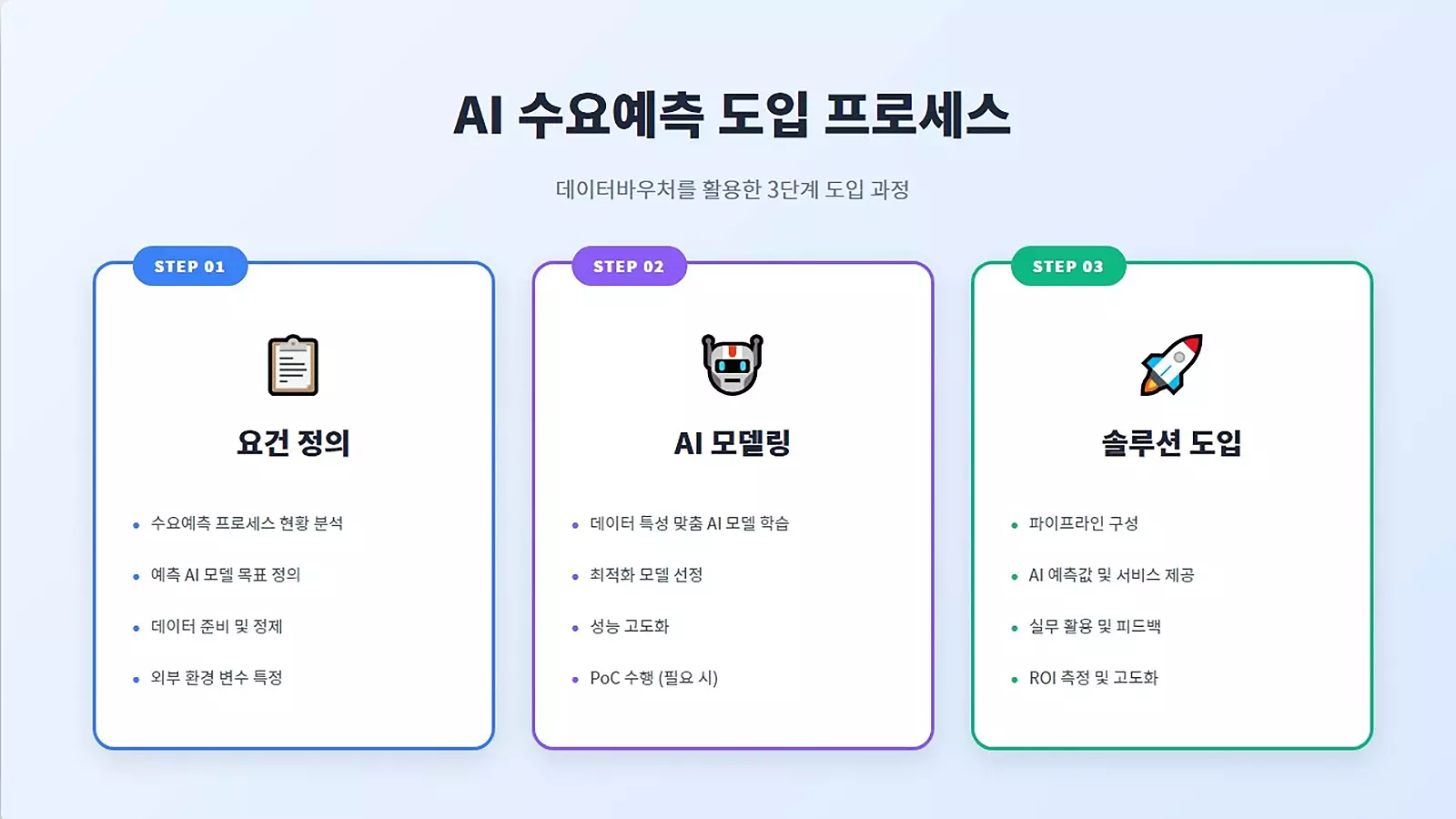
The process follows three stages. In the requirements definition phase, the company's current operations are analyzed, AI model objectives are established, and the necessary data is prepared and cleaned. In the AI modeling phase, models are trained to match data characteristics, the optimal model is selected, and performance is refined—including a proof-of-concept (PoC) when needed. In the solution deployment phase, data and inference pipelines are built, and AI-generated forecasts along with BI/MI/LLM-based analytical reports are integrated into actual business workflows.
When and where can I apply for the 2026 Data Voucher?
Applications can be submitted through the K-DATA (Korea Data Agency) Data Voucher Business Management System. Exact timelines, funding limits, and evaluation criteria will be confirmed in the 2026 demand-side company recruitment notice.
Where can I learn more about using the Data Voucher for AI demand forecasting?
If you're considering AI demand forecasting, reach out to ImpactiveAI—a specialized demand forecasting partner with deep experience in Data Voucher-supported projects.
A Practical Guide for Companies Considering AI Demand Forecasting
For companies planning to implement AI-powered demand forecasting through the Data Voucher program, choosing a solution that delivers tangible business outcomes—not just budget support—is what matters most. Demand forecasting plays a critical role across manufacturing, distribution, and food industries, driving inventory optimization, production planning, and sales strategy. As AI technology advances, both prediction accuracy and practical applicability continue to improve.
AI demand forecasting implementation through the Data Voucher follows three stages.
During requirements definition, the company's current state is analyzed, AI model objectives are set, and the necessary data is prepared and refined. External variables are also identified at this stage.
During AI demand forecasting modeling, models are trained according to data characteristics, the optimal model is selected, and performance is maximized. A proof-of-concept phase is included when necessary.
During solution deployment, data and inference pipelines are constructed, and AI-generated forecasts along with BI/MI/LLM-based analytical reports are applied to day-to-day operations.
Post-deployment, effectiveness and ROI are continuously monitored and iteratively improved.
▶ Interested in AI demand forecasting through the 2026 Data Voucher? Contact ImpactiveAI, your specialized demand forecasting partner.
What 2026 Data Voucher Applicants Need to Know
The 2026 Data Voucher program maintains the integrated voucher framework while raising the bar on quality and effectiveness. Supplier qualifications have shifted to an annual re-evaluation system, and Data Business Operator registration is expected to become mandatory. With more specific quality and pricing standards for data products and services, the overall service environment is set to improve across the board.
For demand-side companies, the application process itself won't change dramatically, but the combination of verified suppliers and increased government funding means more and better options to choose from.
That said, with stricter evaluation of business plan specificity and feasibility on the horizon, setting clear goals and preparing thorough utilization plans is essential. If you're preparing to apply, check the K-DATA Data Voucher Business Management System for the 2026 demand-side company recruitment notice. Confirmed details on funding limits, evaluation criteria, and schedules are only available through the official announcement.
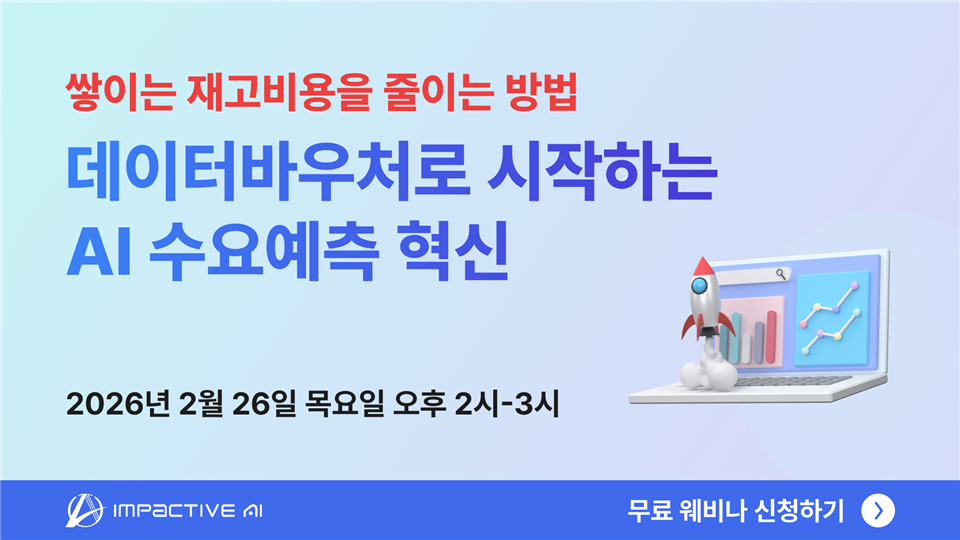
If you'd like to prepare early and build a systematic 2026 strategy, we highly recommend attending ImpactiveAI's upcoming webinar: Impact AI has prepared an innovative web seminar for AI demand forecasting using data vouchers. It will introduce information on free online lectures from 2 p.m. to 3 p.m. on February 26, 2026, as well as how to reduce inventory costs.
⚠️ The changes discussed in this article are based on a synthesis of last year's demand-side recruitment notice and preliminary guidance materials. Standards may be adjusted in the final announcement, so always verify through the official notice before applying.
.svg)


.svg)









%201.svg)
%202.svg)


.svg)