.svg)

.svg)
Download Brouchure
%202.svg)
Oops! Something went wrong while submitting the form.
%201.svg)

When excess inventory and stockouts create imbalance, they directly impact a company's operational cost structure. These issues are closely tied to demand forecasting accuracy. This article examines how reducing forecast errors affects operational costs and introduces methods for quantifying these benefits.
Inventory management costs extend far beyond warehouse rental fees. The expenses associated with maintaining inventory can be broken down into several key categories including capital costs, storage costs, depreciation costs, and opportunity costs.
Capital costs represent the loss incurred when funds tied up in inventory cannot be invested elsewhere. For instance, if a company holds $100 million worth of inventory annually and the market interest rate is 5%, that's $5 million in opportunity costs lost each year.
Storage costs encompass more than just warehouse rent. They include energy expenses for temperature and humidity control, security facility operations, fire insurance premiums, inventory management personnel, and system operating costs.
Depreciation costs reflect how inventory value decreases over time, with significant variations across product categories. IT products typically lose 20-30% of their value within six months of launch, while fashion items often sell for less than half price after the season ends. In pharmaceutical industries where expiration dates are critical, companies must also bear disposal costs for expired products.
Industry standards typically estimate annual inventory holding costs at 20-30% of inventory value. This means a company with $100 million in inventory spends $20-30 million annually just to maintain it. When demand forecasts miss the mark and excess inventory accumulates, these costs become unnecessarily inflated.
Conversely, inventory shortages create substantial costs as well. Beyond direct sales losses from stockouts, companies face additional expenses from emergency orders, expedited shipping, long-term revenue decline from customer attrition, and brand reputation damage. Analysis shows that the total cost of a single stockout often reaches 3-5 times the visible loss amount.

Demand forecast errors don't just affect inventory levels. They create cost burdens across the entire organization, particularly impacting production management, logistics, workforce allocation, and financial structure.
Inaccurate demand forecasts destabilize production planning. Frequent unexpected production adjustments require constant equipment setup changes, increasing machine downtime and reducing overall equipment utilization. In the semiconductor industry, when production plans change 4-5 times monthly, annual equipment utilization rates drop by approximately 15%.
When production increases require overtime, labor costs jump to 1.5 times normal rates. Night shift operations increase the likelihood of quality issues, which ultimately translate into additional costs. Emergency raw material orders carry premiums of 20-30% over regular delivery schedules. In industries where raw materials represent a large cost component—like steel or chemicals—just 2-3 emergency orders per month can add hundreds of millions in annual costs.
Reliance on emergency shipments due to forecast errors can drive logistics costs up 2-3 times normal levels. Companies cannot process shipments according to regular logistics plans and must resort to spot transportation, inevitably incurring additional expenses. Greater volume volatility also increases ancillary costs like handling and packaging fees. Frequent inventory movements add inter-warehouse transfer costs to the equation.
Inaccurate demand forecasting generates unexpected tasks like inventory adjustments, emergency production, and customer complaint handling. A pharmaceutical company case study showed that after implementing an AI-based demand forecasting system, time spent on inventory management decreased by 60%, allowing the company to redirect personnel to more valuable activities like strategic planning and process improvement.
Excessive inventory increases working capital, generating interest expenses and weakening financial health indicators like inventory turnover ratio and cash conversion cycle. Conversely, when improved forecast accuracy enables efficient inventory management, companies can free up cash for strategic decisions like R&D investment, new business ventures, and debt reduction.
The impact of demand forecast errors on operating costs varies across industries. Let's examine examples that illustrate how demand forecasting affects operational costs based on each industry's unique characteristics.

The fashion industry faces rapid inventory value depreciation due to significant seasonal trend changes. Remaining inventory can become a substantial cost burden for companies. Products past their season typically require price cuts of 50% or more yet still fail to sell completely, with large quantities commonly left in warehouses.
Demand forecasting proves challenging because looking at historical sales data alone doesn't provide answers. Multiple factors simultaneously influence outcomes including trend changes, weather patterns, social media reactions, and competitor launch schedules. Traditional methods like three-month moving averages or year-over-year comparisons struggle to respond effectively to sudden trend shifts or unexpected weather variations.
This is where AI-powered demand forecasting systems excel. AI can simultaneously learn diverse variables and analyze interconnected patterns. For example, when a clothing style suddenly gains social media popularity, the system references similar past cases to predict how demand will grow over the next 2-3 months. Additionally, by incorporating meteorological data, if an unusually warm winter is forecast, the system preemptively reflects reduced winter clothing demand and suggests production adjustments.
This precise forecasting yields multiple positive effects. Popular items are produced in sufficient quantities at the right time to prevent stockouts and capture sales opportunities. Conversely, items with anticipated low demand avoid overproduction, minimizing inventory that remains even after end-of-season discounts.
New products without historical data present particular challenges, but AI provides solutions here too. The system estimates new product demand based on data from existing products with similar colors, styles, price points, and target customers. For instance, when launching a new oversized knit item, the system analyzes the past three years of similar products' first-month sales volumes, repurchase rates, and seasonal sales curves to recommend optimal production quantities. This significantly reduces the risk of large-scale inventory losses when new products underperform.

Pharmaceuticals operate under stringent conditions requiring expiration date and temperature management, creating unique challenges where stockouts directly affect patient safety. This specificity forces pharmaceutical companies to maintain high safety stock levels. However, this simultaneously creates the dilemma of bearing disposal costs for expired medications.
Consider a pharmaceutical company with annual sales of $170 million. Before implementing AI-based demand forecasting, the company maintained high inventory levels to prevent potential stockouts. This resulted in average monthly excess inventory of 2.3 million units. Conversely, unexpected demand surges created shortages of 2.2 million units monthly for certain medications, causing patient inconvenience.
This recurring problem stems from the complex interplay of variables affecting pharmaceutical demand. Seasonal epidemic diseases like influenza and allergies, weather changes, health insurance policy modifications, competitor product launches, and prescription patterns at hospitals all simultaneously exert influence. Traditional forecasting methods relying solely on historical data struggled to incorporate these diverse variables in a timely manner.
However, implementing an AI demand forecasting system can dramatically change this situation. The system processes real-time meteorological data, predicting increased flu medication demand 2-3 weeks in advance when sudden temperature drops are expected. It also analyzes prescription data flows from the Health Insurance Review & Assessment Service to detect changes in physician prescribing trends for specific medications. This enables much more precise demand forecasting for each pharmaceutical product.
The effects prove particularly pronounced for medications requiring cold chain management. With AI accurately predicting demand, companies no longer need to maintain unnecessarily large refrigerated inventories, naturally reducing ancillary costs like refrigeration energy expenses. Improved expiration date management ensures proper first-in-first-out principles, reducing waste rates.
In construction cost structures, raw materials represent a substantial proportion. Major material prices react sensitively to numerous variables including global supply chain conditions, exchange rates, interest rates, and policy changes in producing countries, with frequent sudden fluctuations. Even slight differences in ordering timing can create significant contract price variations, sometimes resulting in hundreds of millions in cost changes. Companies traditionally relied on experience and expert opinions to determine purchasing timing, but as market changes accelerate, these methods struggle to capture optimal timing. This frequently results in increased cost burdens and losses from failed predictions.

To address this uncertainty, domestic construction company B partnered with ImpactivAI's Deepflow Materials system for a raw material price forecasting project. The forecast covered four primary construction materials including rebar, copper, hot-rolled coil, and bituminous coal.
The system construction process involved collecting and utilizing diverse data. The model was trained on comprehensive data including wholesale and distribution prices for each material, import prices by route, global futures commodity prices, domestic and international production volumes and inventory levels, and major economic indicators like exchange rates, interest rates, stock market indices, and government bonds.
Deepflow meticulously incorporated key variables for each material—for example, scrap iron prices and inventory levels for rebar, global economic indicators for copper, manufacturing costs and worldwide demand for hot-rolled coil, and energy supply imbalances for bituminous coal. By combining XGBOOST (external variable processing and impact analysis), LSTM (long-term trend and seasonality learning), and Transformer (macroeconomic indicator and policy change analysis) models, the system achieved enhanced predictive power. The result exceeded 96% average forecast accuracy, with rebar showing particularly strong capture of price volatility. This enabled Company B to confirm the potential for actively adapting purchasing and ordering strategies based on AI predictions.
By actively adopting data and artificial intelligence, construction companies can reduce raw material purchasing costs and transform decisions that previously relied on experience and intuition into data-driven strategies.
Traditional Excel-based demand forecasting or simple statistical methods like three-month averages struggle to keep pace with today's complex business environment. Hundreds of variables influence demand including seasonality, promotional effects, competitor movements, macroeconomic indicators, and consumption trends. Manually analyzing and forecasting all these factors proves practically impossible.
ImpactivAI's Deepflow was developed to overcome these limitations. Built on five years of demand forecasting expertise, the platform has filed and registered 67 patents and utilizes 224 machine learning models to deliver optimized forecasts tailored to each company.
Deepflow's core strength lies in applying AutoML technology to automate the entire forecasting process. Everything from data integration through preprocessing, feature engineering, model training, and prediction occurs automatically. The system explores 500 million combinations to extract optimal features, with over 200 models competing to identify the most accurate prediction model. When data changes, models automatically retrain to maintain consistently high forecast accuracy.
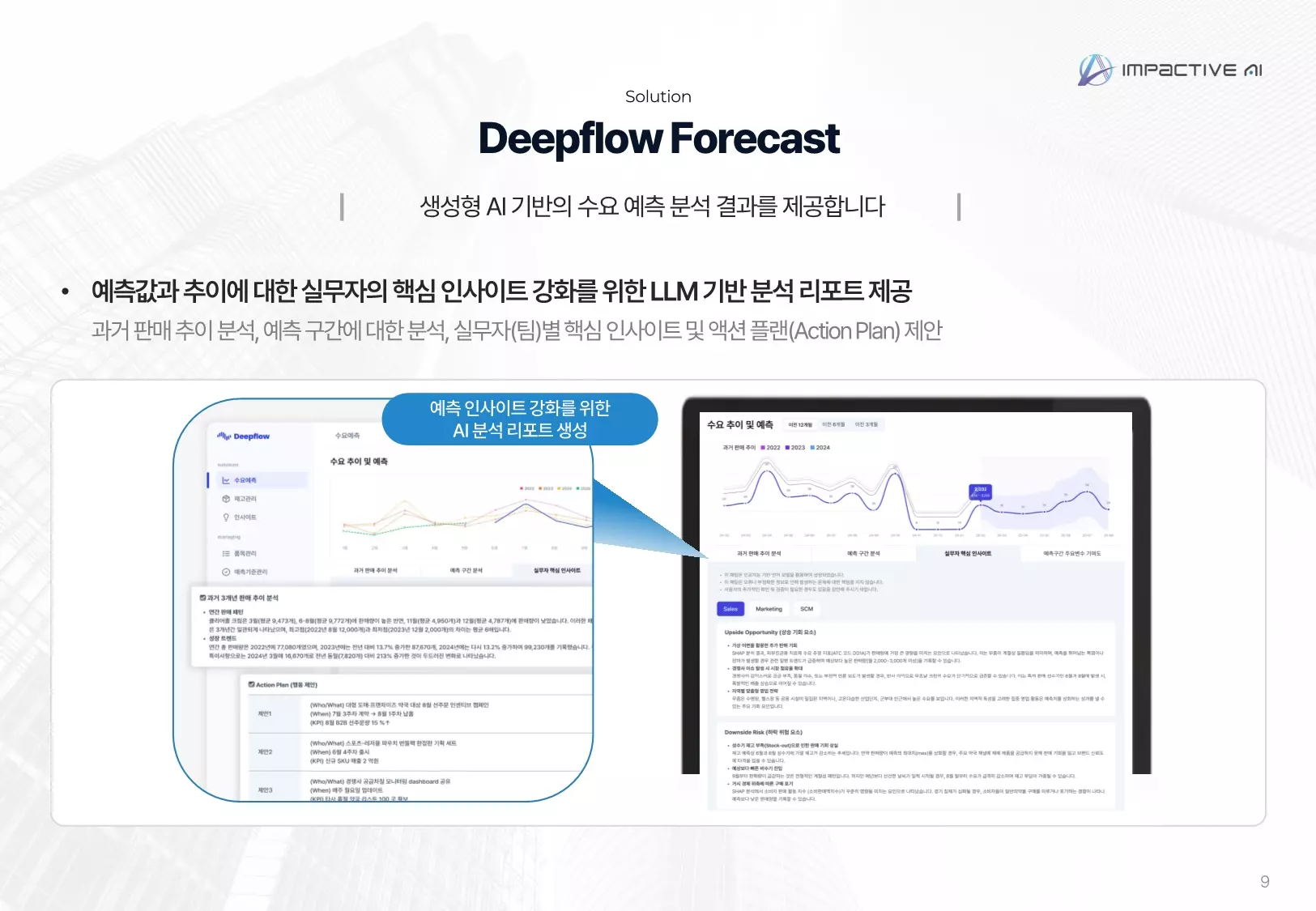
Recently, Deepflow added an LLM-based insight report feature. Now the platform doesn't just provide forecast results but explains the reasoning behind predictions and automatically generates actionable plans for sales, marketing, and SCM departments. This allows practitioners to focus on strategy development rather than spending time on complex data interpretation and report writing.
For raw material price forecasting, Deepflow Materials achieved an average 95.5% prediction accuracy across seven materials. A steel company actually used this solution to efficiently adjust raw material purchasing timing, saving over $8 million annually. The system also analyzes various external variables including exchange rates, interest rates, and global economic indicators to enable proactive responses to market volatility.
Many companies recognize the need for better demand forecasting yet fail to take action. Common barriers include adherence to familiar existing methods, concerns about implementation costs, and skepticism about new approaches' effectiveness. However, operational cost losses from forecast errors accumulate daily.
As demonstrated in the cases examined above, improving forecast accuracy produces immediate visible financial effects. Inventory assets decrease, operating costs drop, and sales opportunities expand. Moreover, the investment required for these changes typically achieves payback within one year. Most importantly, decision-making capabilities based on accurate forecasts ultimately become the core of competitive advantage.
Looking at current market trends, the pace of change accelerates rapidly while customer demands grow increasingly diverse. In this environment, traditional approaches based solely on historical data no longer suffice. AI-powered advanced forecasting systems have become essential rather than optional. Reducing demand forecast errors goes beyond simple cost savings—it represents the first step in transforming your company into a data-driven, agile organization.
.svg)

.svg)

.svg)











%201.svg)
%202.svg)


