.svg)

.svg)
Download Brouchure
%202.svg)
Oops! Something went wrong while submitting the form.
%201.svg)

As more companies recognize the strategic importance of demand forecasting, AI-powered solutions are moving to the top of the technology agenda. But when it comes to actually choosing a solution, the decision is far from straightforward. Should you use a general-purpose cloud platform's machine learning services, or adopt a solution purpose-built for demand forecasting? This is a question that keeps decision-makers up at night.
This guide examines the fundamental differences between these two approaches and explores the scenarios where each one delivers the most value. As representative examples, we'll look at Microsoft Azure Machine Learning on the general-purpose side and ImpactiveAI's Deepflow as a purpose-built demand forecasting solution. Once you understand how these approaches differ at a structural level, you'll be in a much better position to choose the right fit for your organization.
General-purpose machine learning platforms are designed to solve a wide range of AI problems. These platforms typically offer intuitive interfaces where users can drag and drop components to build complex data processing pipelines with ease. They provide a broad selection of algorithms—from boosted decision trees and Bayesian methods to deep neural networks—making them capable of tackling time-series forecasting along with many other types of prediction tasks.
The greatest appeal of a general-purpose ML platform lies in its versatility and scalability. Beyond demand forecasting, it can be applied to image recognition, natural language processing, recommendation systems, and numerous other AI projects without missing a beat. For companies already operating within a particular cloud ecosystem, integration with existing infrastructure happens naturally.
These platforms also offer a high degree of freedom in model development. Unique business logic and specialized requirements can be fully accommodated, since data scientists have the environment they need to fine-tune algorithms or experiment with entirely new model architectures. Enterprise-grade security and regulatory compliance features provide additional assurance for organizations operating in sensitive industries.
Using a general-purpose ML platform also simplifies adjacent tasks like data analysis and visualization, thanks to seamless integration with other services from the same cloud provider. Additional capabilities, such as predictive autoscaling for virtual machines, further expand the range of what's possible.
There are situations where the breadth of a general-purpose platform can actually become a constraint. Demand forecasting and inventory management require significant domain expertise. Taking Microsoft Azure as an example, while the drag-and-drop interface exists, it only simplifies the construction of model training pipelines. Deciding which algorithm to use, how to preprocess the data, and how to tune hyperparameters all remain squarely in the hands of the user.
Building a model suited to demand forecasting requires deep understanding of time-series data characteristics, and the ability to model how factors like seasonality, trends, and external variables influence outcomes. This typically means assembling a cross-functional team of data scientists, machine learning engineers, and backend developers—and even then, initial model development and validation can take several months.
The more fundamental challenge, however, is the gap between building a forecasting model and actually deploying it in day-to-day operations. A general-purpose platform can generate forecast values without difficulty, but connecting those values to inventory management systems or translating them into departmental action plans requires substantial additional development. In other words, even after the model is built, a significant amount of systems integration work remains before it can deliver real business impact.
Purpose-built demand forecasting solutions are designed from the ground up with a singular focus: demand forecasting and inventory optimization. This approach brings together everything needed to solve this specific business problem in a single, integrated package.

The defining strength of a purpose-built solution is its completeness and practical readiness. Because it was created from day one to solve the demand forecasting problem, every necessary capability is integrated into a unified system.
On the data side, these solutions dramatically reduce the burden on business teams. They come pre-loaded with a rich library of external data relevant to demand forecasting—exchange rates, interest rates, commodity prices, and a wide range of economic indicators. This eliminates the tedious process of collecting and cleaning external data in-house. These solutions also include structured frameworks for extracting the most relevant signals from a company's internal data, saving considerable time on data preparation.
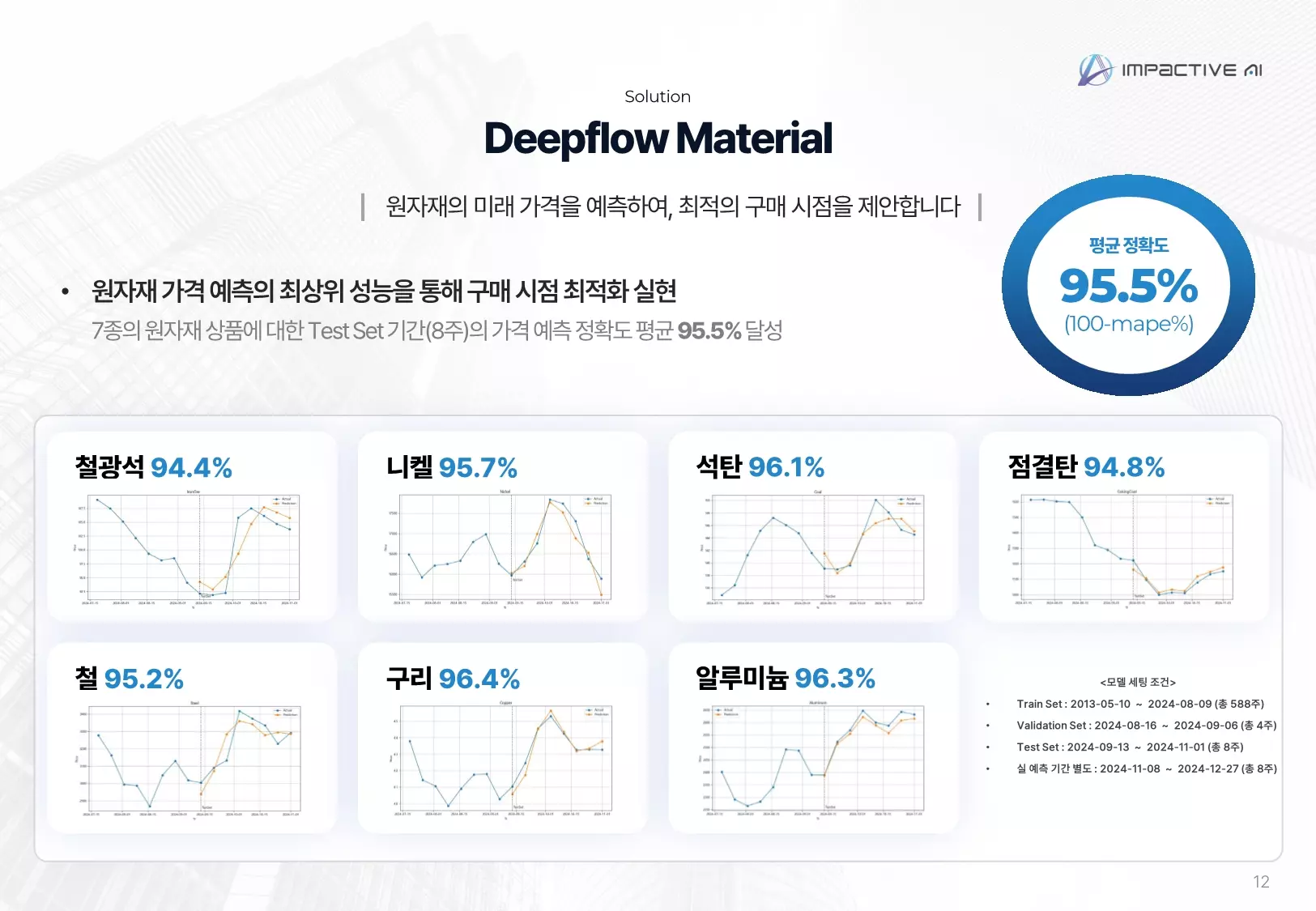
From a modeling perspective, the advantages are equally compelling. What matters isn't simply the number of models available, but how well each model is calibrated for real-world demand forecasting scenarios. Products with strong seasonal patterns are matched with models that are highly sensitive to those fluctuations. Items heavily influenced by events are analyzed with models that effectively incorporate external factors. Built-in diagnostic capabilities assess each SKU's sales pattern and automatically select the best-fit model. Combined with time-series data augmentation techniques that expand training data diversity, users can obtain reliable forecasting results without needing deep expertise in model selection or tuning.
The practical value extends directly into inventory management. Because optimized models generate forecasts tailored to each SKU's unique sales and shipment patterns, these predictions automatically integrate with baseline inventory data to calculate days of inventory remaining. There's no need to develop a separate, complex inventory management system—inventory optimization benefits are available immediately. Shortages and overstocked SKUs can be identified at a glance, enabling faster decision-making across the organization.
Purpose-built demand forecasting solutions have clear limitations as well. Because they're designed for a specific objective, their applicability naturally concentrates in that domain. While they excel at demand forecasting and inventory management, they're not easily extended to other machine learning tasks. If your organization also needs image classification, natural language processing, or other AI capabilities, separate tools will be required.
Since these solutions rely on pre-built models, there can be constraints when implementing highly unique business logic or experimenting with novel algorithms. That said, the standard demand forecasting requirements that most companies face can be handled quickly and reliably by the models already built into the platform.
There are also practical considerations around the implementation timeline. Purpose-built solutions typically progress through a requirements definition phase, followed by a proof-of-concept (PoC) stage, before moving to full deployment. The PoC phase allows organizations to validate forecast accuracy with real data before committing to a full rollout. While this process is faster than building from scratch on a general-purpose platform, it may take slightly longer than subscribing to an off-the-shelf cloud SaaS product.
When building a demand forecasting model on a general-purpose platform, you start by carefully analyzing data characteristics, selecting an appropriate model, fine-tuning hyperparameters, and directly validating performance. If your product catalog spans hundreds or thousands of SKUs, managing individual models that reflect each item's unique characteristics becomes a substantial operational burden. And when model performance falls short of expectations, the cycle of re-tuning and retraining repeats itself.
A purpose-built demand forecasting solution automates this entire workflow. It analyzes each SKU's sales pattern, automatically selects the optimal model, and leverages time-series data augmentation to broaden the training dataset. Performance monitoring and retraining are handled by the system itself, which means data science teams don't need to intervene constantly—delivering consistently stable forecasting results over time.
Building an inventory optimization system on a general-purpose platform goes well beyond just preparing a forecasting model. In practice, you need to develop separate inventory management logic that accounts for current stock levels, lead times, safety stock, and order units. Completing a procurement decision-support system requires just as much effort as designing the forecasting model itself.
A purpose-built demand forecasting solution consolidates all the functionality needed for inventory management. Forecast outputs automatically link with baseline inventory data to calculate days of remaining stock, and future sales variability is factored in to determine optimal production quantities. Shortages and excess inventory are visible at a glance, enabling rapid, informed decision-making.
A general-purpose platform can visualize forecast results, but interpreting those results and translating them into actionable execution plans remains the user's responsibility. For example, even if a forecast indicates a 15% increase in sales next quarter, how to respond to that number and what each department should do about it requires separate discussion and analysis.
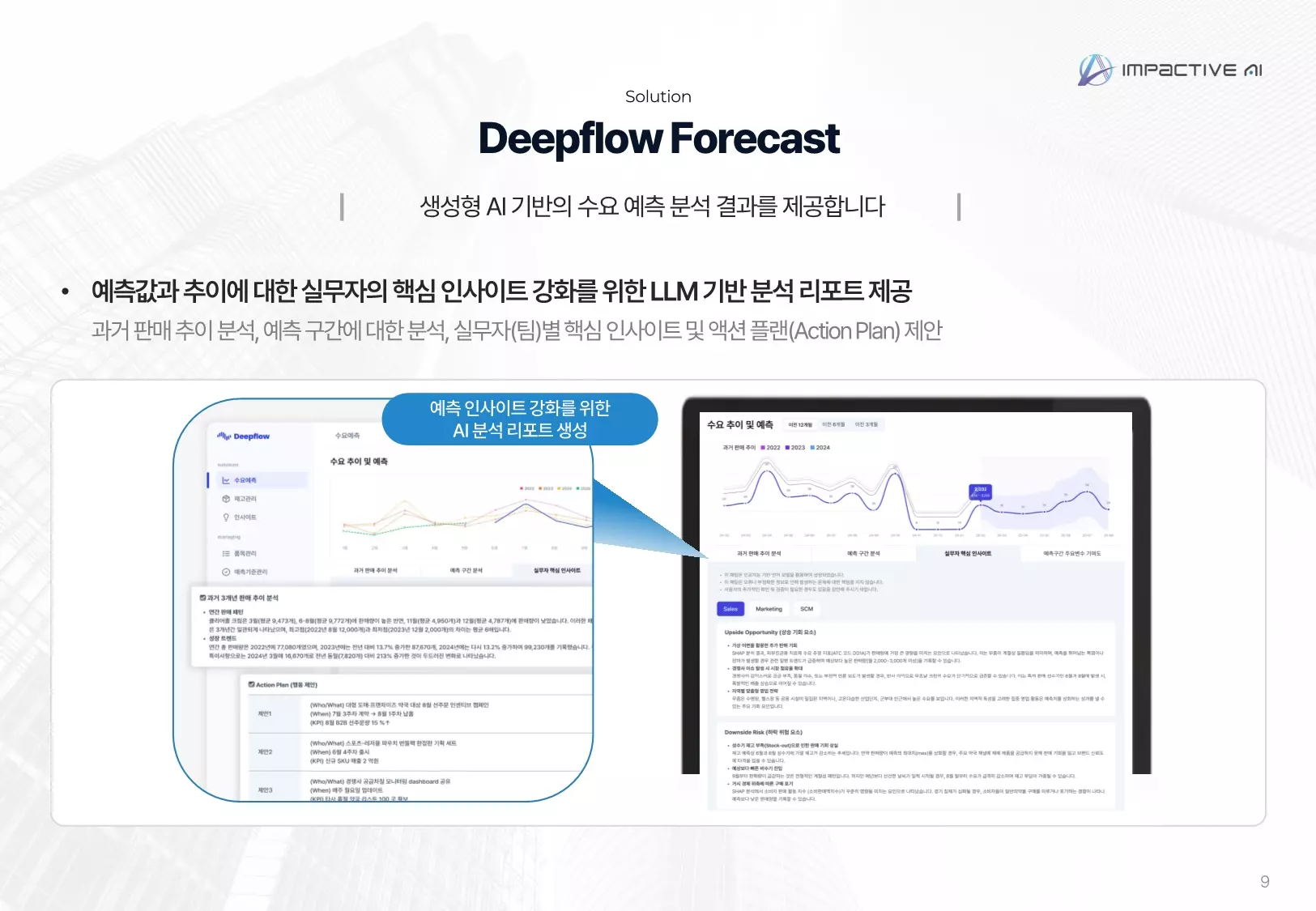
Purpose-built demand forecasting solutions automate this process through LLM-powered analytical reports. These reports provide specific reasoning behind forecasts, surface new insights through comparison with historical data, and deliver ready-to-execute action plans for sales, marketing, SCM, and other departments. This allows leadership to quickly grasp the situation and make critical decisions without wading through complex data interpretation.
A general-purpose platform is worth considering under the following conditions.
Your organization has a strong in-house data science team capable of independently handling everything from model development to ongoing operations. You've already made significant investments in your current cloud environment, and maintaining tight integration with existing infrastructure is a priority. You're planning to run multiple machine learning projects simultaneously—not just demand forecasting—and need a platform with broad applicability.
This approach is particularly advantageous when you face highly unique forecasting challenges that standard models can't address, or when you need granular, algorithm-level control over your models. If your team has already accumulated substantial experience with the platform, leveraging that investment may be far more efficient than introducing an entirely new tool.

A purpose-built solution is the stronger choice when the following conditions apply. Demand forecasting and inventory optimization are mission-critical for your business, and you need visible results fast. You don't have a dedicated data science team, or you're looking for a proven AI demand forecasting system that's ready to use from day one. You need an all-in-one solution that goes beyond raw forecast numbers to deliver actionable plans and integrated inventory management capabilities.
This approach delivers especially significant value in industries like manufacturing, distribution, and food and beverage, where inventory management directly impacts profitability. It helps maintain just the right amount of stock to minimize costs, reduces losses from stockouts and overstock, and frees operational teams to focus on strategic execution.
A purpose-built solution also has the edge when time-to-deployment matters. Rather than building a demand forecasting system from the ground up, organizations can validate effectiveness through a PoC phase and move quickly into production. In fast-moving market environments where forecasting capability needs to come online rapidly, this approach is particularly effective.
ImpactiveAI's Deepflow is a real-world example of the purpose-built approach to demand forecasting. Designed from the outset for demand forecasting and inventory management, it draws on a diverse library of machine learning and deep learning models along with patented technologies to solve forecasting challenges across manufacturing, distribution, food and beverage, and other industries.
Deepflow delivers advantages on both the data and model fronts. External data essential to demand forecasting—exchange rates, interest rates, commodity prices, and global economic indicators—is already collected and ready to use. An automated framework also identifies and extracts the most relevant signals from a company's internal data. From its library of over 224 pre-validated models, the system automatically selects the best fit for each SKU's sales pattern while effectively capturing seasonality, external factors, and other complex demand drivers.
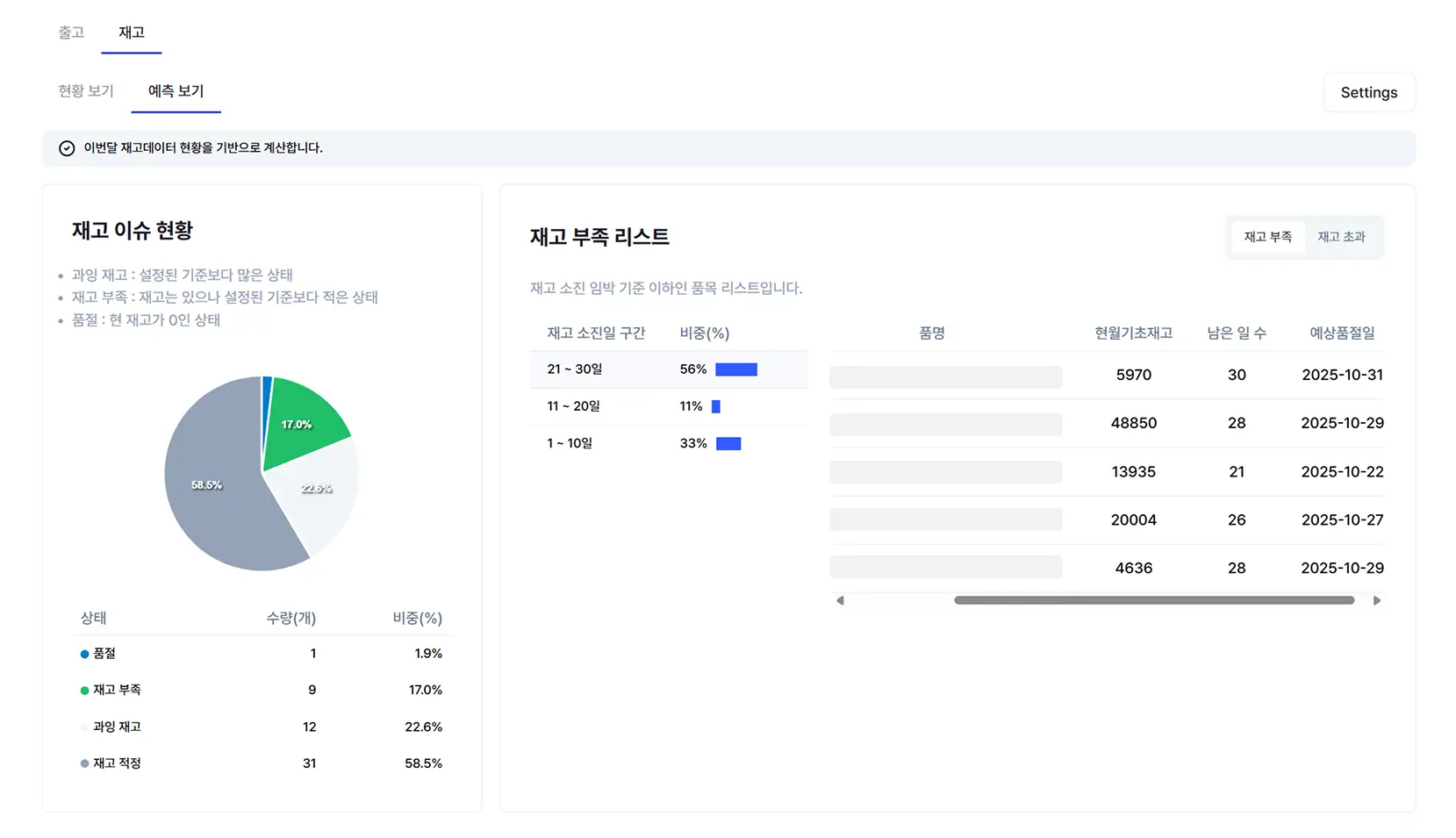
Through its BI dashboard, users can instantly identify inventory shortages and overstock situations, while the system automatically calculates projected stock depletion dates and optimal production volumes based on anticipated sales changes. The MI dashboard consolidates external data—exchange rates, interest rates, commodity prices, and global economic indicators—in a single view, and includes 3-month short-term AI forecasts for exchange rates and oil prices.
The LLM-powered analysis feature takes things further by interpreting historical sales trends and seasonal patterns to explain future demand outlooks in plain language, and automatically generating tailored action plans for sales, marketing, SCM, and other departments. This allows practitioners to spend less time on complex data interpretation and report writing, and more time on strategy and decision-making.
The implementation process follows a structured path. It begins with requirements definition, moves into a proof-of-concept phase where forecast accuracy is validated using real data, and then progresses to full deployment based on the results—enabling a more confident and informed adoption decision.
General-purpose ML platforms and purpose-built demand forecasting solutions each bring distinct strengths to the table. General-purpose platforms offer flexibility and scalability across a wide range of AI use cases. Purpose-built solutions, on the other hand, deliver a level of completeness and ease of use that makes them immediately applicable to real business operations.
When weighing your options, start by clarifying the problem your company needs to solve, the capabilities your team already has, and how quickly you need to see results. Determine whether you need the open-ended freedom of a general-purpose platform or the operational readiness of a purpose-built solution.
If demand forecasting is a strategic priority or inventory optimization is an urgent business need, a purpose-built solution that puts actionable results directly in the hands of your team may be the stronger choice. These solutions let you validate their effectiveness with real data before committing, enabling a more deliberate adoption decision.
Ultimately, choosing a technology platform isn't just a feature comparison exercise. It's a strategic decision that brings your organization closer to its business objectives. Choose the path that best aligns with where you are today and where you need to go.
.svg)

.svg)

.svg)








%201.svg)
%202.svg)


